Utah's Energy Playbook: Beehive Energy Alliance Panelists Break Down Incentives, Capital and the Data Center Debate
At a Beehive Energy Alliance gathering in Salt Lake City, Utah officials and investors described a state well-positioned to attract energy capital — but warned that workforce shortages, not funding or ideas, may be the real constraint on delivery.
Architectural Nexus Utah headquarters, 2505 E. Parleys Way, Salt Lake City
Architectural Nexus Utah headquarters, 2505 E. Parleys Way, Salt Lake City
Salt Lake City, Utah –August 18, 2026
Beehive Energy Alliance is a Utah nonprofit built to bridge private-sector engineering talent, investment capital, and federal, state and local government in order to accelerate the modernization and expansion of America's energy infrastructure, starting with Utah. Coming up on two years old, the group has grown from roughly 30 attendees at its first gathering to more than 125 at this meeting, according to vice chair Robert Axson and chairman Joe Ross. The Alliance meets regularly, mixing panel discussions, member presentations and site tours.
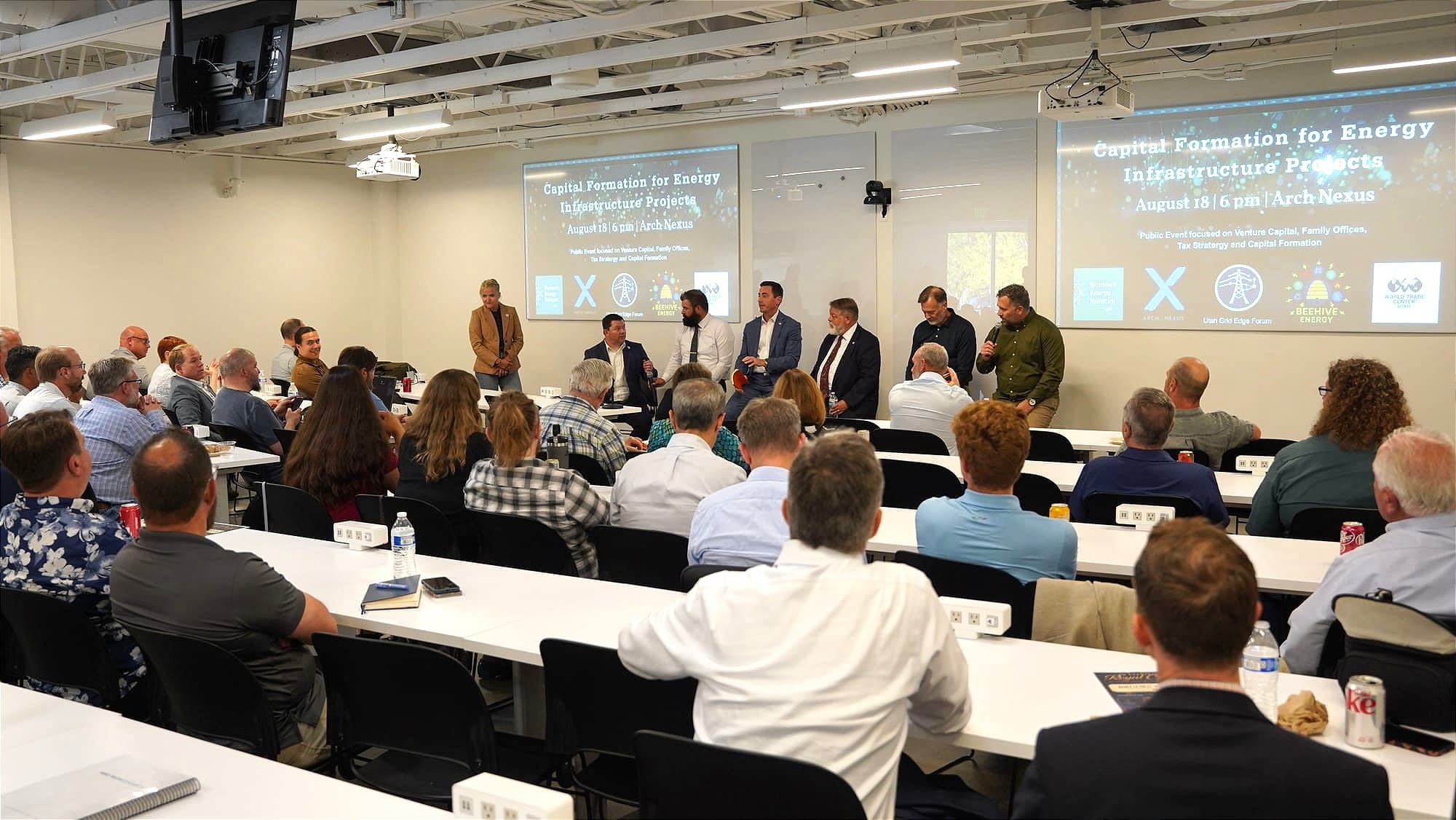
More than 125 legislators, energy executives, investors and policy leaders packed into Architectural Nexus Utah headquarters in Salt Lake City on August 18 for the evening meeting, which included stacks of gourmet pizzas and coolers of drinks.
After networking in the lobby, the organizers recognized elected officials in attendance, including state Rep. Colin Jack (R-District 73, St. George), State Senator Heidi Balderree of Utah County (R-District 22, Saratoga Springs area), and Rep. Troy Shelley, (R-District 66, covering parts of Juab and Sanpete counties).
Organizers also mentioned an October 10 fundraiser for Brooks Benson, the Republican nominee for Utah Senate District 11, whose campaign emphasizes infrastructure and energy development. The district includes portions of northwestern Utah County, Tooele County and southwestern Salt Lake County.
Panel One: Entitlements, Incentives and Capital Access
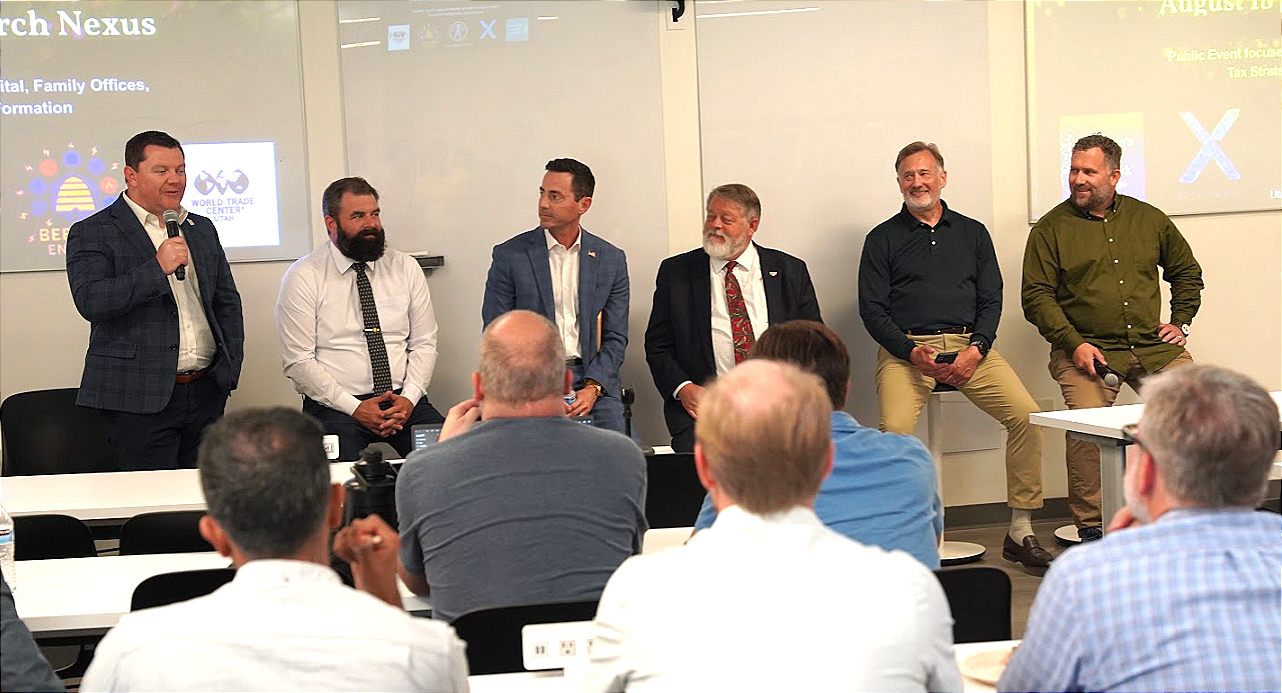
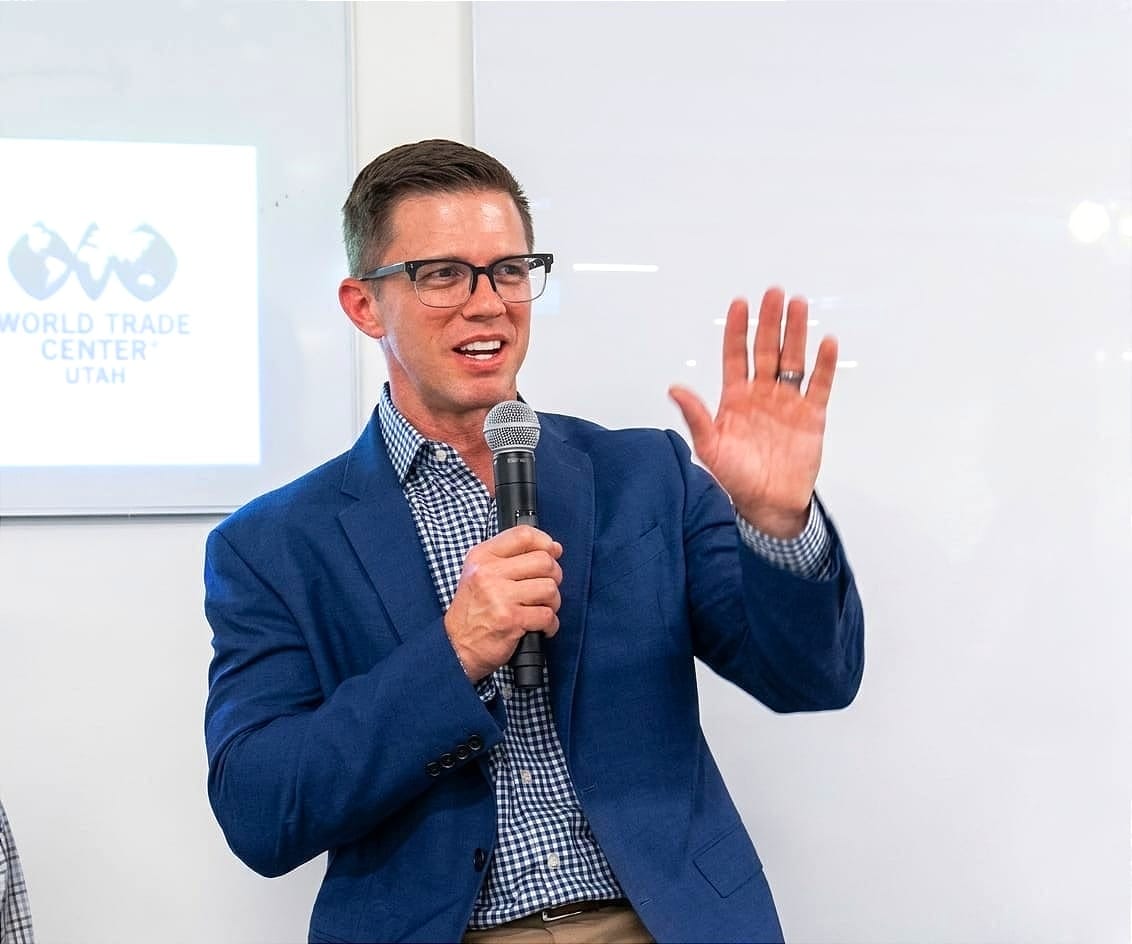
Panel one, moderated by Robert Axson, State Director at Office of US Senator Mike Lee, included included EDCUtah's Ryan Starks; Matt Wunderli of the Governor's Office of Economic Development (GOED); David Carlebach, Chief Operations Officer (COO) and Managing Director of Business Services at World Trade Center Utah; former Riverton mayor; state Rep. Colin Jack; and Trent Staggs, SBA Region 8 Regional Advocate within the U.S. Small Business Administration's Office of Advocacy (Utah, Colorado, Montana, North Dakota, South Dakota and Wyoming); Staggs was previously featured in recent TechBuzz article.
EDCUtah's Ryan Starks speaking on Panel One, Beehive Energy Alliance's August meeting at Architectural Nexus in Salt Lake City, August 18, 2026
Panelists pointed to several underused funding tools:
Make More in America — a federal manufacturing-lending program administered through the Export-Import Bank, capable of financing large-scale construction. World Trade Center Utah's representative noted few in the room had heard of it.
SBA lending changes — a policy rolled out the week of the event under which the agency will guarantee up to 90% of loan amounts for energy-sector borrowers, tied to an MOU with the U.S. Department of Energy. The speaker also cited SBIR/STTR non-dilutive grants and noted World Trade Center Utah recently received a $743,000 SBA STEP grant for Utah companies exporting energy technology, plus the SBA's Small Business Investment Company (SBIC) program, which the speaker put at roughly $53 billion in backed funding nationally.
Rural TIF and Opportunity Zones — highlighted by EDCUtah as tools for rural energy investment that defer taxes and reduce county risk.
REDI Program — a GOED program that offers up to $6,000 per newly created full-time position at a qualifying rural business, capped at $250,000 per business annually.
EDTIF / Rural TIF — Matt Wunderli outlined the state's two tax-increment financing tools: Ed TIF for Salt Lake, Utah, Weber and Davis counties, and Rural TIF for the rest of the state, available to companies in five targeted industries — aerospace and defense, energy, life sciences, fintech and manufacturing — hiring 30–50+ employees over five to 10 years. Incentives can stack with those from the Utah Inland Port Authority, MIDA and municipal partners.
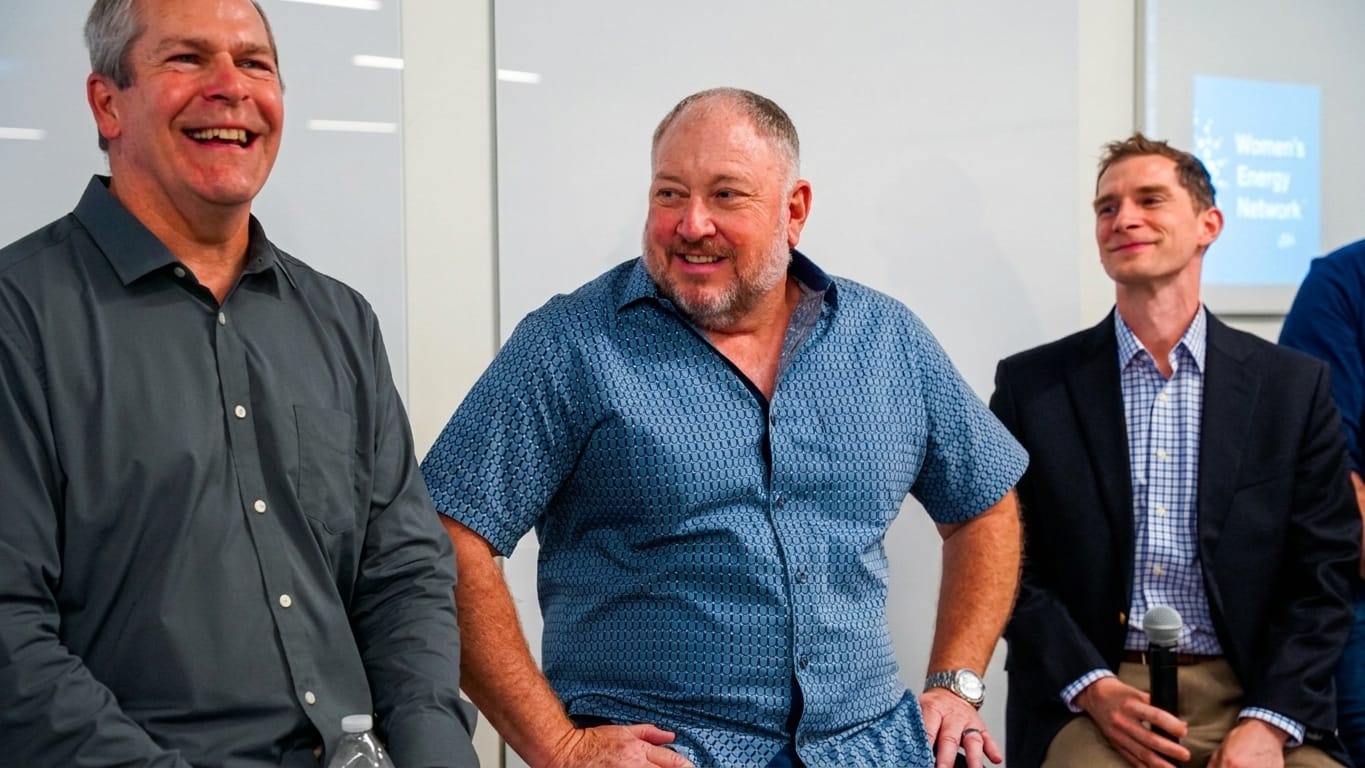
Attendees listening to Panel One of Beehive Energy Alliance's August 18 meeting at Architectural Nexus in Salt Lake City
Rep. Jack outlined pending legislation replacing Utah's expiring sales-tax exemption for solar/wind business inputs with a broader exemption covering business inputs across all energy sources, offset by a smaller tax on generated energy (excluding residential use). He said he won't sponsor the bill himself due to his employment in the power industry. TechBuzz will follow up and report on that bill once more information is available.
On capital and delays, one panelist argued for pursuing permitting, capital-raising and incentive applications in parallel rather than sequentially: "the cost of capital is predictable, but the cost of project delay is not."
Company Spotlights
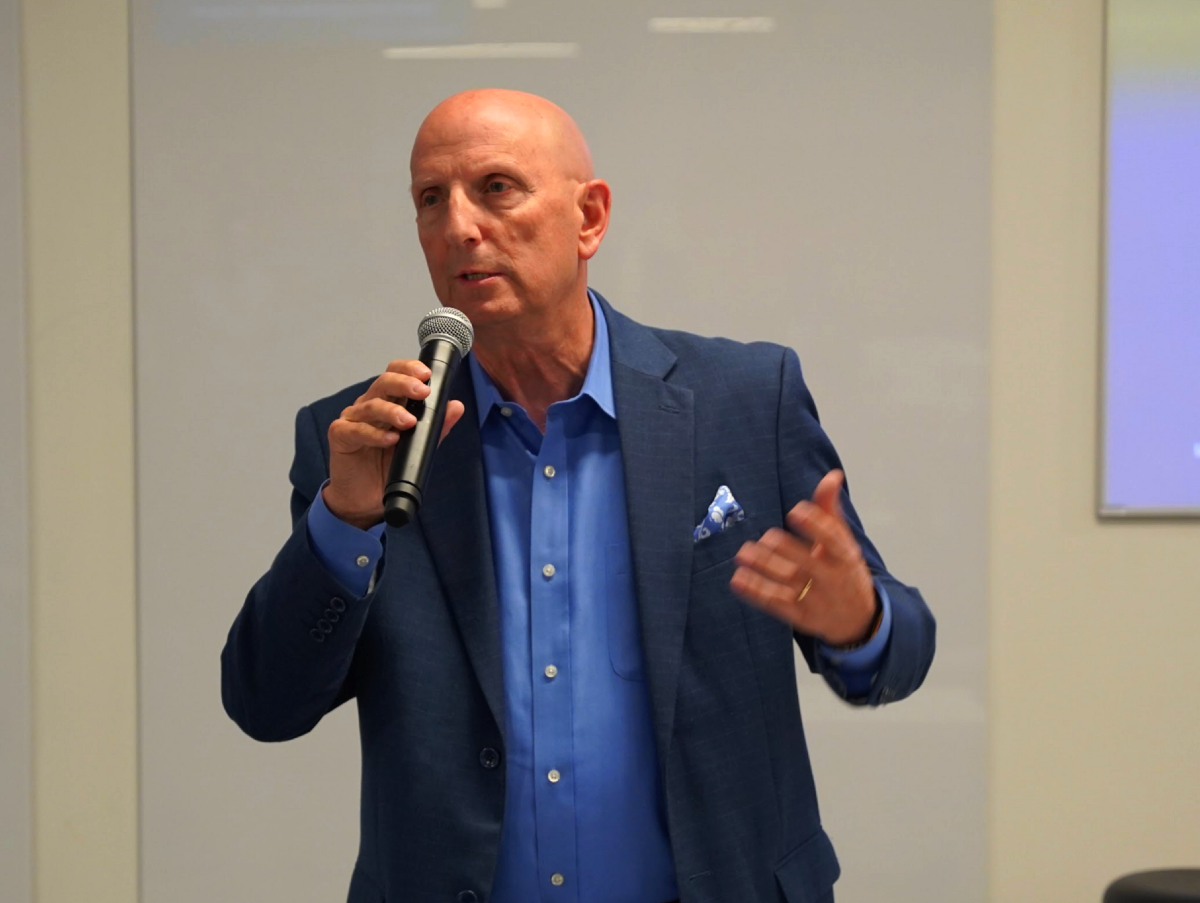
David Politis, Founder, Utah Energy Report and Utah Money Watch
Utah Money Watch Research — David Politis introduced his new venture, a Gartner/Forrester-style research subscription focused on Utah's energy ecosystem. His inaugural Utah Energy Report (MoneyFlow 2026) found $18.2 billion was spent in, through and around Utah's energy ecosystem from January 2023 through December 2025, across 11 energy subsectors and 39 transactions, not counting Fervo's IPO earlier in the year. The largest transaction was Enbridge's $14 billion acquisition of three Dominion Energy natural-gas utilities, including Questar Gas and Wexpro. The largest transaction was Enbridge's $4.3 billion acquisition of Questar Gas and its related Wexpro companies from Dominion Energy. Questar serves customers in Utah, southwestern Wyoming and southeastern Idaho, while Wexpro's operations span Utah and Wyoming. Another notable deal was Maverik's acquisition of Kum & Go, doubling Maverik's footprint to more than 800 fuel centers nationwide.
The 214-page report covers nine chapters and eight appendices, including a forward-looking chapter on critical minerals processing, energy finance/infrastructure, and firm and flexible power and storage.
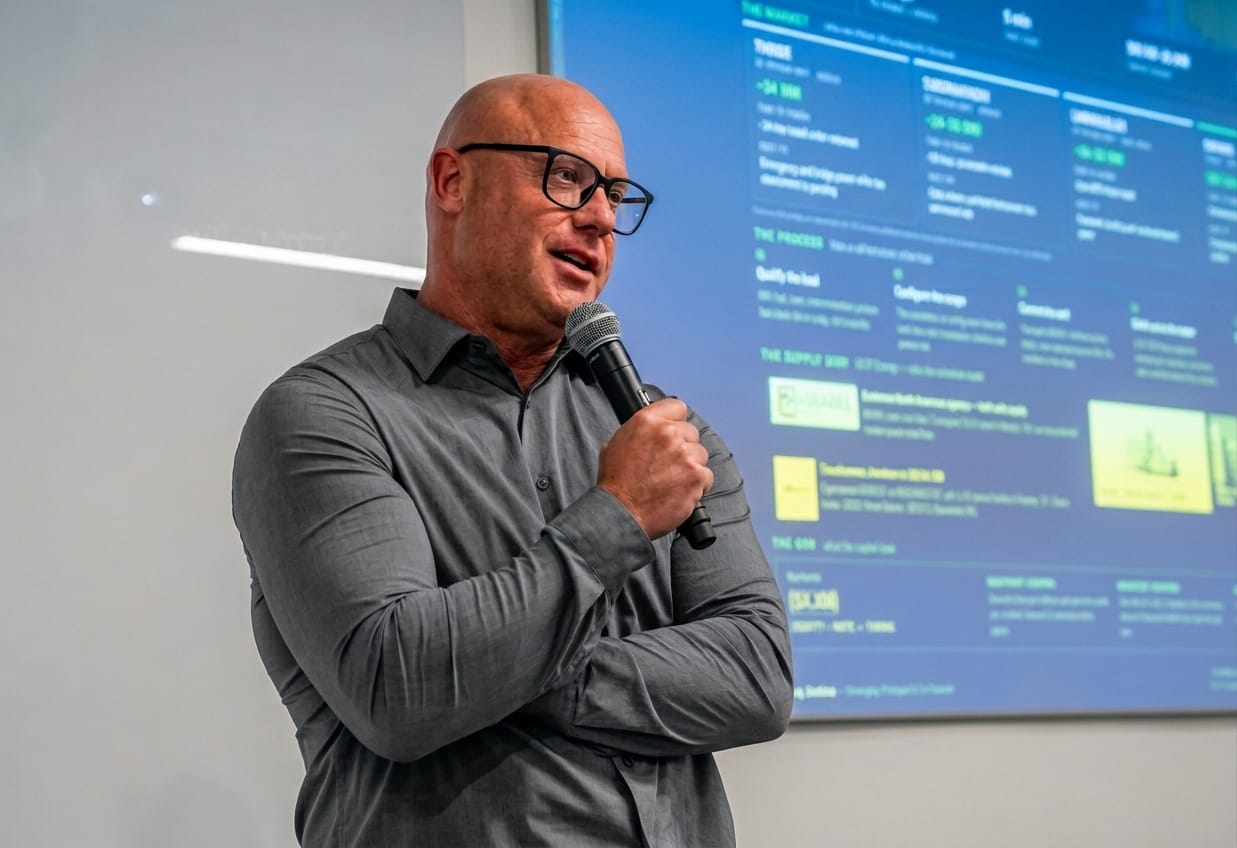
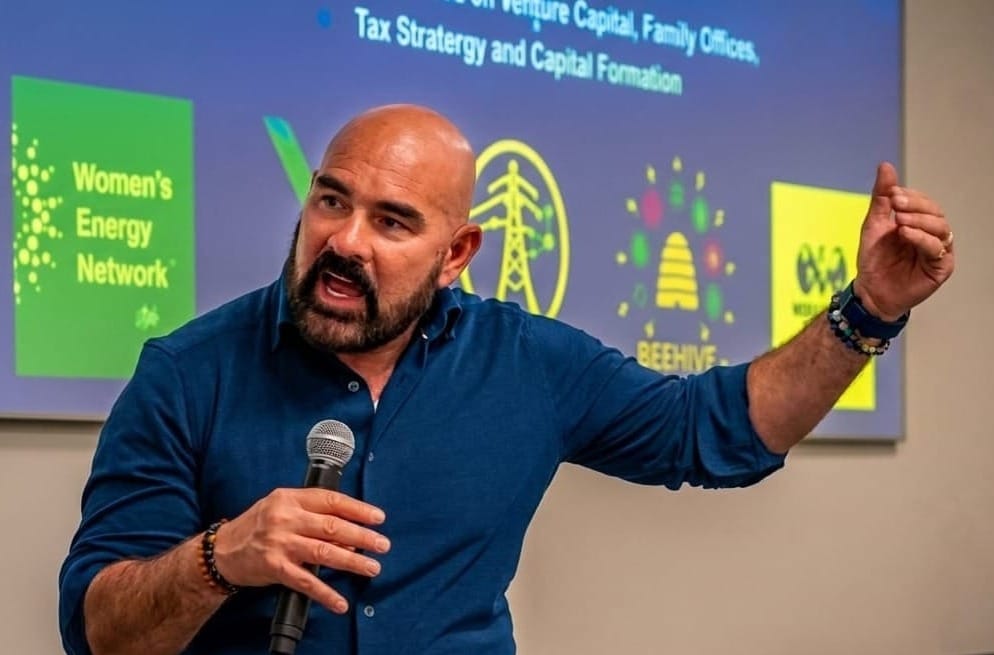
Brady Jenkins, Founder, GCP Energy, speaking at Beehive Energy Alliance's August 18 meeting, Architectural Nexus HQ, Salt Lake City
GCP Energy / PowerBloc — Brady Jenkins, founder of GCP Energy (an OEM representative/EPC-support firm founded roughly five years ago), described a widening supply-chain gap for power equipment even as project demand surges. GCP's PowerBloc line supplies turbine-to-meter power solutions, including TM2500 trailer-mounted turbines useful for interim power during air-quality permitting, plus decommissioned and rebuilt larger turbines for investors seeking offtake opportunities. Jenkins, who lives in South Jordan, said GCP is watching Salt Lake City-area nuclear projects and transmission buildout (500kV/345kV lines) as its next growth area, with warehousing in Reno and Texas.
Panel Two: Capital, Family Offices and Tax Strategy
Panel Two: Michael Andrews (Hawkstone Capital); Troy Tucker (Blue Sky Business Resources); and Matthew Neuenswander (TannerLLC), speaking about energy financing at Beehive Energy Alliance's August 18 meeting, Architectural Nexus HQ, Salt Lake City
Panelists, moderated by Monica Thornburg, COO of ROW Energy:
Joe Kaiser, Switchyard Partners (invests at the intersection of infrastructure and growth equity); previously ran Mercato Partners in Utah and helped raise project finance at Vivint Solar before its multibillion-dollar sale.
Mike Andrews, managing partner, Hawkstone Capital, a Park City-based infrastructure/energy firm that invests across early-stage tech, sustainability-focused real estate design, and behind-the-meter generation/storage.
Matthew Neuenswander, senior tax manager atTanner LLC, focused on tax credits and incentives.
Angel Shelburne, a capital advisor and Beehive Energy Alliance Board member with a background at BlackRock focused on middle-market investments and non-dilutive structured capital.
Eric Evans, Operating Partner, One Rock Capital Partners, LLC, focused on income tax structuring (C-corp vs. LLC formation, investor-driven structuring).
On what separates companies that successfully raise capital from those that struggle, panelists pointed to fully permitted projects with strong offtake agreements, AI-adjacency (only half-joking), and — per Tucker — a genuinely difficult lending environment right now, with even well-covered loans struggling to get bank interest amid broader economic uncertainty.
On what "smart capital" should provide beyond a check, panelists cited: network access and CEO introductions (VC); strategic/M&A experience and operating executives (PE); flexible, non-time-boxed capital and market channels (family offices); and specialized tax/credit guidance (accounting partners).
Joe Kaiser, Founder and Managing Partner, Switchyard Partners
Kaiser invoked a April 2025 podcast appearance by Uber co-founder Travis Kalanick, who argued that founders should evaluate investors not simply on whether they are “founder friendly,” but on whether they are likely to help or harm the company. Kalanick's advice was blunt: founders should ask which investor “does the least amount of harm.”
Kaiser said founders should treat fundraising as a two-way recruiting process, vetting prospective investors as carefully as investors vet the companies seeking their money. He recommends asking to speak directly with CEOs from an investor's portfolio—including those who may have had difficult experiences.
Workforce Shortage a Recurring Theme
Steve Thomas, founder and convener of the Utah Grid Edge Forum, told attendees that labor, not unemployment, is the core constraint on Utah's energy buildout. He described plans for a direct-hire event, Utah Bridge to Work, pairing trade and technology workers with employers who have dozens of unfilled openings, in partnership with the University of Utah's Utah Center for Renewables, Efficiency, and Workforce (U-CREW) Center. Interested employers can sign up at utahbridgetowork.org, Thomas said, noting the effort has around 30 vendors registered so far.
Ibi Guevara, a partner and vice president at Hunt Electric and a recent addition to the WEN (Women in Energy) Utah Chapter board, stood before the audience and promoted the group's annual conference, to take place October 8, 2026 from 9 a.m. to 6 p.m. at the Ken Garff Red Zone at Rice Eccles Stadium.
Audience Q&A: Data Centers, AI and Community Buy-In
The longest exchange of the evening came from an audience question whether investors are accounting for the actual economic output value of AI when evaluating data center investments, given land and resource constraints.
The discussion comes as communities across the country increasingly push back against data-center development. New York has imposed a one-year moratorium on large new facilities, while on August 18, 2026 Pennsylvania removed data centers from its fast-track permitting process and imposed new environmental and local-approval requirements. Dozens of counties and municipalities have also paused, restricted or rejected projects amid concerns about electricity costs, water use, infrastructure demands and community impacts.
That national backlash framed one of the evening's most consequential discussions: how Utah can attract energy-intensive projects while ensuring that communities understand—and benefit from—their costs and economic potential.
Utah energy leaders were discussing how to responsibly accommodate data centers at precisely the moment other states are beginning to put the brakes on them.
Angel Shelburne, Capital Advisor and Beehive Energy Alliance Executive Board Member
Panelists acknowledged there's no easy answer, noting:
Data centers aren't solely an AI story — one panelist noted medical imaging represents a substantial and rapidly growing data-center workload, particularly for storage, and increasingly for compute as AI is applied to medical data. The Society for Imaging Informatics in Medicine notes that the growing size and complexity of medical-imaging datasets are driving adoption of cloud platforms such as AWS, Google Cloud, Microsoft Azure and NVIDIA's DGX Cloud for storage, distributed computing and AI training
Community relations were framed as decisive: panelists contrasted the stalled Kevin O'Leary-backed Stratos project in Box Elder County, Utah, which has generated fierce and widespread community backlash, against Project Jupiter, a 4,000-acre data center campus underway in Millard County, and against data center development in Eagle Mountain, which panelists described as having built strong local buy-in, transparency, and tax-revenue sharing. One panelist described a Millard County operator responding directly to a resident's complaint about a visible security light by disabling it via app — offered as an example of continuous community engagement.
A recent Weber County symposium on small-scale nuclear energy, covered by TechBuzz, where developers fielded technical and safety questions before any project was formally announced, was cited as a model "playbook" for transparency and early community engagement.
Panelists agreed most data centers now require behind-the-meter power generation, citing insufficient grid capacity, and referenced PJM Interconnection warnings that some existing data center contracts may not be honored during power surges.
Audience member Jessica Elwell, COO and co-founder of OxEon Energy, engaged the panel, mentioning $36.3 million in U.S. Department of Energy funding and her role as co-PI with Pacific Northwest National Laboratory (PNNL) on a project she is working on. She asked the panelists how non-AI, non-data-center energy technology companies should differentiate themselves while competing for the same capital pool. Panelists advised: integrate AI meaningfully into the business plan and operations, citing an MIT finding that 95% of enterprise AI implementations show no ROI; seek investors with a track record in the specific sector rather than generalist "AI lottery ticket" capital; and vet investors as carefully as they vet founders.
A memorable part of the discussion highlighted another emerging feature of AI infrastructure finance: long-term offtake commitments. Companies such as CoreWeave use take-or-pay contracts with customers to provide predictable revenue against which data-center and GPU infrastructure can be financed. NVIDIA has increasingly become involved in these financing structures, through investments, capacity arrangements and guarantees.
The structure resembles project finance in the energy industry, where a long-term power-purchase or offtake agreement can provide lenders with confidence that a new generation project will have revenue to service its debt. In AI infrastructure, the contracted commodity is computing capacity rather than electricity.
Conclusion
Taken together, the evening's threads point to a single underlying question that Utah's energy boosters haven't fully answered yet. The challenge facing Utah's energy industry may not be finding ideas, or even finding capital. It is creating the contracts, incentives, permits, infrastructure and predictable cash flows that allow investors to put billions of dollars behind those ideas. The emerging financing model for AI infrastructure, where data center operators are increasingly underwriting projects through offtake and take-or-pay agreements rather than waiting on more traditional project finance, offers a glimpse of how that can work. Whether Utah can build the workforce, the permitting speed and the policy certainty to make that model repeatable across its broader energy sector, rather than just its data center boom, may be the real test of whether the state becomes the national energy destination its boosters describe.