Weber State’s MARS Center Opens its Doors to Advanced Aerospace Manufacturing
Weber State University’s MARS Center (Clearfield, UT) opened its doors this week, showcasing advanced manufacturing equipment and research designed to help aerospace and defense partners develop, test and scale materials and components for extreme environments.
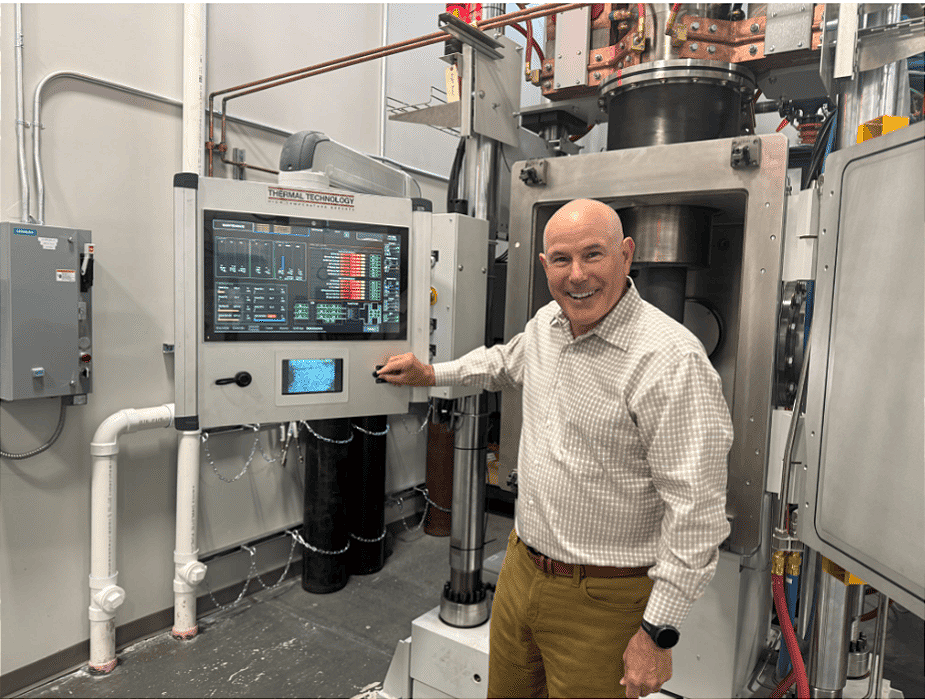
Guy Letendre, VP of Strategic Initiatives at 47G, stands beside MARS Center’s high-temperature processing equipment during the center’s Sept. 18 open house at Weber State University's MARS facility, 633 Falcon Hills Drive, in Clearfield, Utah. Letendre described the complex manufacturing processes required to produce composites capable of operating in extreme-temperature environments. Photo: Isabella Pedroza, Nucleus Institute - TechBuzz
Guy Letendre, VP of Strategic Initiatives at 47G, stands beside MARS Center’s high-temperature processing equipment during the center’s Sept. 18 open house at Weber State University's MARS facility, 633 Falcon Hills Drive, in Clearfield, Utah. Letendre described the complex manufacturing processes required to produce composites capable of operating in extreme-temperature environments. Photo: Isabella Pedroza, Nucleus Institute - TechBuzz
Clearfield, Utah – September 18, 2026
Weber State University's Miller Advanced Research & Solutions (MARS) Center on Falcon Hills Drive in Clearfield opened its doors September 17–18, giving industry, government and community visitors a look at the advanced manufacturing equipment and processes it is developing for aerospace and defense applications.
Among the demonstrations was live rocket-motor testing, along with continuous-fiber additive manufacturing, composite machining and advanced inspection technologies. Visitors also saw a 200-ton direct-current sintering system capable of reaching temperatures of 2,500 degrees Celsius and other equipment designed to manufacture and test materials for extreme environments.
For MARS Executive Director Benjamin Garcia, the equipment represents a larger purpose: giving aerospace and defense companies a place to work through the difficult and expensive transition from an advanced material or component that works in the laboratory to one that can be manufactured repeatedly and affordably.
Benjamin Garcia, Executive Director, Miller Advanced Research & Solutions (MARS) Center, Clearfield, Utah
“Materials that can withstand extremely high temperatures and high speeds, for example, are expensive and time-consuming to make,” Garcia said ahead of the open house. “Our work here helps improve that.”
MARS was established in August 2022 at Falcon Hill Aerospace Research Park in Clearfield, adjacent to Hill Air Force Base. The center began with a $3.5 million donation from the Larry H. & Gail Miller Family Foundation and was created to give Weber State students and faculty a place to work on real-world aerospace and national defense problems.
Since then, the center has developed into a manufacturing and testing hub connecting Weber State with government and industry partners.
That role was visible at the open house, where visitors could see equipment that is intended not simply to demonstrate new materials, but to address the manufacturing challenges that determine whether those materials can eventually be produced at scale.
“We’ve taken on that risk,” Garcia said. “We brought in this kind of high-value equipment, and we’re showcasing how you can make these materials using next-generation manufacturing technologies, and showing that they can also scale and be produced affordably.”
The center works with government and industry partners to test whether components can be produced using newer manufacturing processes. MARS can take a component through the manufacturing cycle, assessing its cost, manufacturability and mechanical and thermal properties before providing the partner with a finished part for testing.
If testing is successful, Garcia said, the partner has both a tested component and data supporting the manufacturing process. That can give the company a business case for investing in the equipment and moving production into its own facilities.
The approach builds on MARS' earlier work with advanced high-temperature materials. In 2023, Weber State students and faculty demonstrated a carbon-composite rocket nozzle at the center during a visit by U.S. Space Command official Thomas A. Lockhart. The team was testing materials and technologies for rocket-nozzle applications and collecting performance data that could eventually help reduce the time, labor and cost associated with developing rocket components.
The center's mission has since expanded toward the manufacturing gap between research and production. MARS has described its work as helping move technologies from Manufacturing Readiness Level 4, or prototyping, toward Level 6, or pilot-scale production, particularly for advanced thermal-protection systems. The center also works with partners on defense, aerospace and other advanced manufacturing applications.
One example of that work is happening on the materials side of the process.
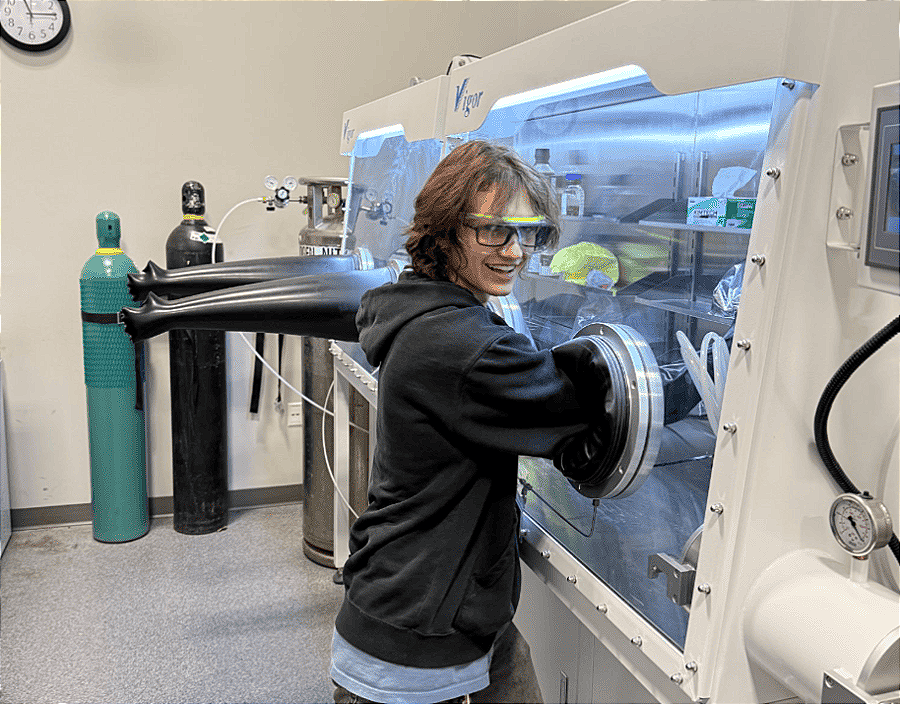
Weber State student Adam Evans works inside a glovebox during the MARS Center’s September 18 open house. Evans, a chemistry and applied mathematics major, researches ceramic-filled resins used in advanced additive manufacturing. Photo: Isabella Pedroza, Nucleus Institute - TechBuzz
Adam Evans, a 21-year-old undergraduate double majoring in chemistry and applied mathematics, joined the center after being referred by a professor. He said the experience has connected his academic work to applications beyond the classroom.
“It’s kind of already gotten me out of my academia bubble,” Evans said. “It’s kind of showing me more of like, oh, there’s, I’m doing this for a reason, so it’s giving me kind of like a bigger picture look. All my experiments mean something.”
Evans mixes resins for the center's CF3D printer, a continuous-fiber additive manufacturing system that feeds fiber through the machine to create reinforced parts. For ceramic components, Evans mixes ceramic powder into the resin. The material can then be printed before subsequent processing removes the polymer and converts the remaining material into its final ceramic form.
His research focuses on increasing the amount of ceramic powder that can be incorporated into the printable resin. A higher concentration of ceramic can produce a denser final part and reduce shrinkage during subsequent processing.
“My job is kind of figuring out how do we fit more powder into these resins that we print with, so that we can kind of get more bang for our buck,” Evans said.
The challenge becomes even greater when those printed or formed components must survive extreme temperatures.
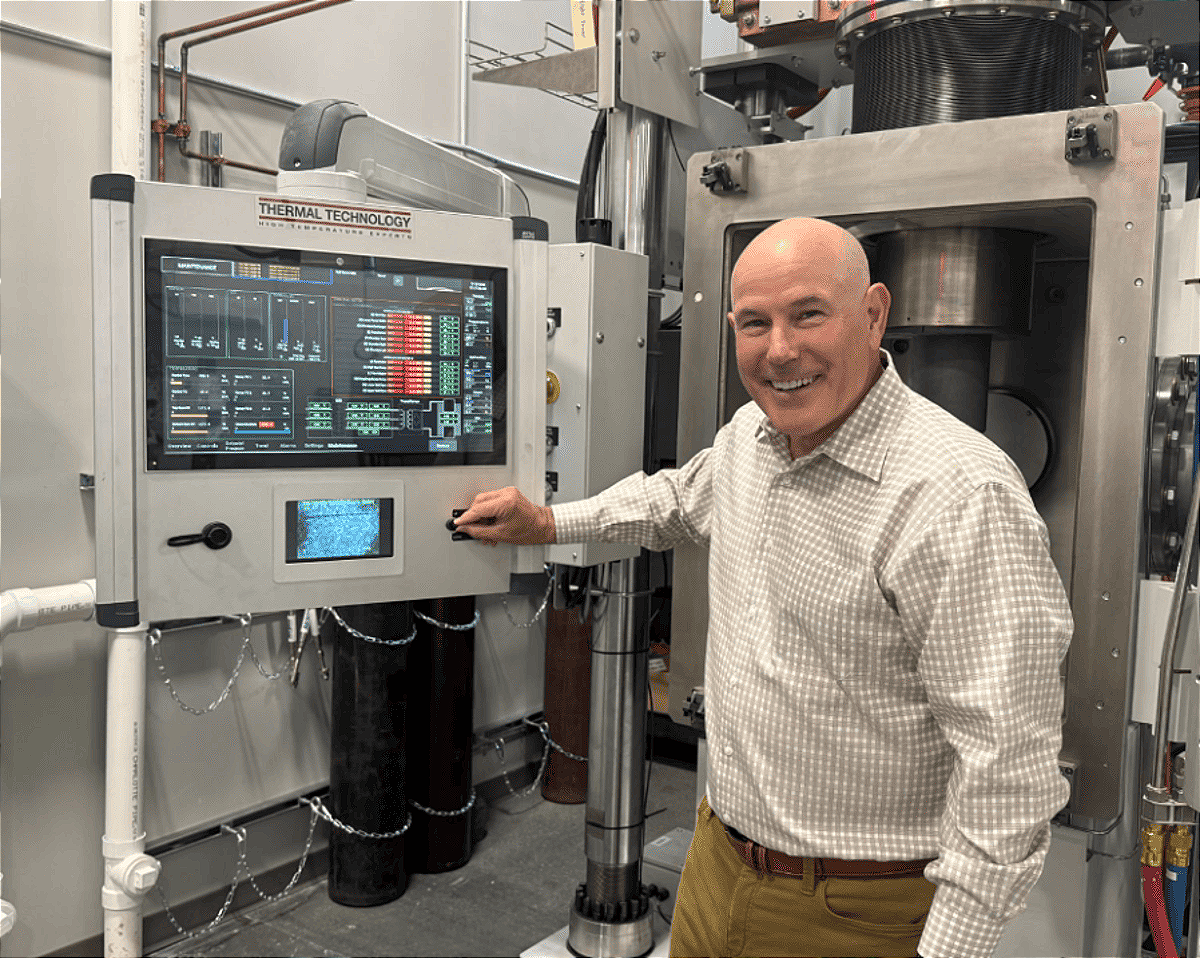
Guy Letendre, VP of Strategic Initiatives at 47G, stands beside MARS Center’s high-temperature processing equipment during the center’s open house to showcase advanced manufacturing capabilities and research in hypersonic materials, high-temperature composites and propulsion technologies at WSU's Falcon Hills Drive facility in Clearfield, Utah, September 18, 2026. Photo: Isabella Pedroza, Nucleus Institute - TechBuzz
Guy Letendre, vice president of strategic initiatives at 47G, compared the basic structure of a composite to fiberglass used in boats. The fiberglass provides the reinforcing fibers, while resin holds the material together.
For high-temperature composites, however, the material used to create the initial shape cannot necessarily survive the temperatures required of the finished component. The preform must undergo additional processing to create a material capable of operating in much hotter environments.
That processing can involve specialized equipment capable of reaching temperatures of about 2,500 degrees Celsius. The MARS open house gave visitors a look at the direct-current sintering equipment used for high-temperature materials processing.
“It’s very complicated and very expensive, which is why we wanted to build this center,” Letendre said.
The expense is part of the reason MARS exists. Aerospace companies may be reluctant to purchase specialized equipment and develop new manufacturing processes without first knowing whether the resulting technology can meet performance requirements and make economic sense.
MARS provides a place where those questions can be tested.
The center also provides Weber State students with hands-on experience working alongside the equipment and partners involved in that process. Garcia said MARS offers 25 to 35 summer internships each year and has had thus far 72 students participate in its internship program.
That workforce-development role was one of the themes of this week's open house. Weber State President Chris Mallett, who began his tenure in August, visited the center for the first time, and Garcia said he was particularly interested in the level of student engagement. The event also brought industry and government representatives to the facility, including members of MARS' technical advisory board.
The open house was timed to coincide with the Hypersonic Technology Systems Conference in Logan, allowing industry and government representatives already in Utah to visit the facility. Garcia said the event drew strong participation from industry, government, Hill Air Force Base and other organizations involved in the region's aerospace and defense ecosystem.
For MARS, the significance of the event was less about displaying individual pieces of equipment than demonstrating how they fit together.
The center is building a manufacturing environment where advanced materials can be developed, processed, tested and evaluated before companies make the larger investment required to produce them on their own.