Flying Blind: Why St. George Brothers Think Unmanned Aircraft Can Fix American Firefighting
After watching wildfire smoke close their only road home in 2017, brothers Michael and Jeff Baxter left aerospace careers at Boeing and SpaceX to build Dragonfly, an unmanned aircraft designed to make aerial firefighting safer, cheaper and possible at night.
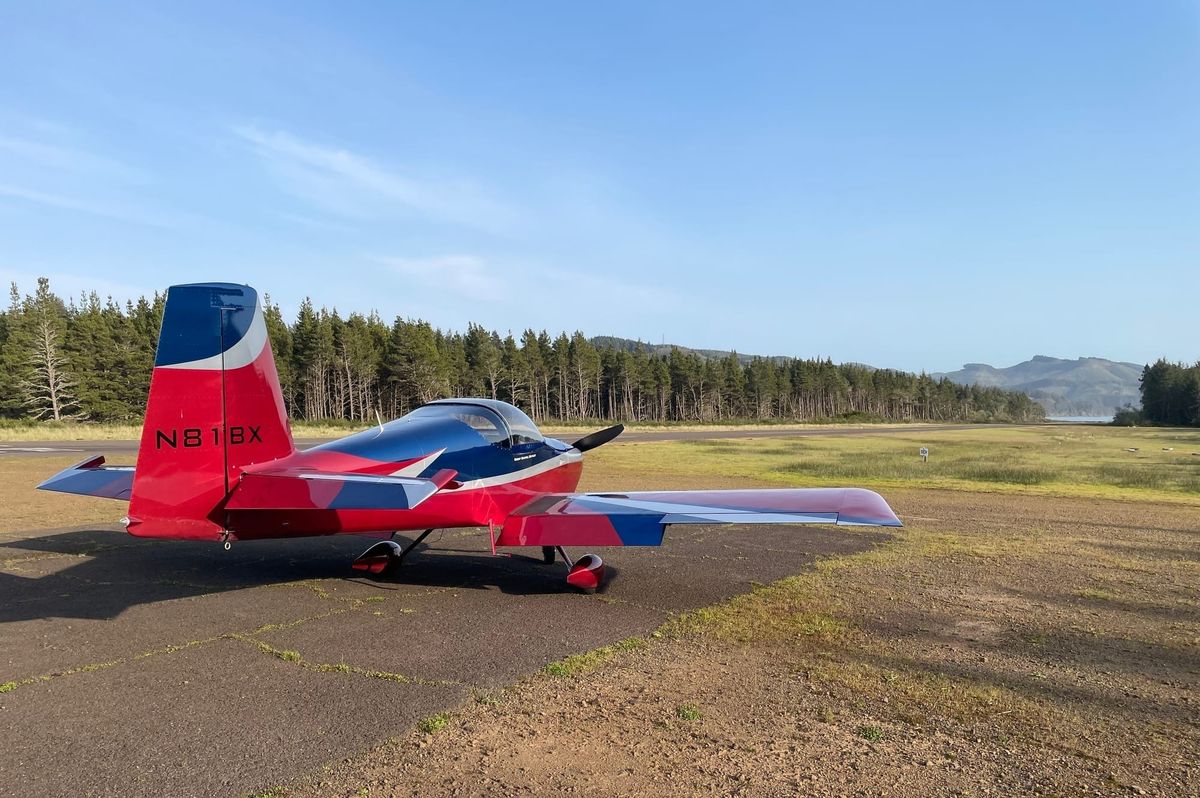
Michael and Jeff Baxter's hand-built two-seat aircraft, photographed at a small airstrip in Oregon. The brothers spent a decade constructing the plane as teenagers — an early bonding project that helped set both on the path to aerospace careers, and eventually, to founding Baxter Aerospace. Photo: Baxter Aerospace
Michael and Jeff Baxter's hand-built two-seat aircraft, photographed at a small airstrip in Oregon. The brothers spent a decade constructing the plane as teenagers — an early bonding project that helped set both on the path to aerospace careers, and eventually, to founding Baxter Aerospace. Photo: Baxter Aerospace
St. George, Utah — August 19, 2026
Michael Baxter, co-founder and CEO of Baxter Aerospace, was on a paddle boat with his kids on the Columbia River in September 2017 when they saw smoke rising over the only road home. Within hours, police ordered an evacuation, and the family was forced to camp in a tent at Long Beach State Park in Washington. The fire, Baxter later learned, was started by teenagers throwing fireworks into the Eagle Creek nature preserve.
"The problem is human-caused fires are not human put-outable," said his brother, Jeff Baxter, the company's co-founder. "We can't turn off the fires we turn on." Once his family was safe, Michael checked in with local crews and was stunned. As an aerospace engineer who had built long-endurance unmanned aircraft and supported deployed operations for the Air Force, Marines, and Navy, he thought the firefighters would have similar air support.
In the backcountry, with no cell service, crews navigated blind with walkie-talkies and hand-drawn maps. That gap pulled the brothers out of stable careers to create a business with a mission to clear the air. This business has grown from a humble start in a barn on their childhood farm in Oregon to a St. George manufacturing facility today, where they are building airborne satellite communication systems, components and systems for nuclear research, and unmanned aircraft they believe can change how America fights fire.
The company they founded, Baxter Aerospace, sits in Southern Utah's fast-growing aerospace corridor. This month, the state flew a hybrid-electric aircraft between Salt Lake City and Cedar City as part of its uFLY initiative, which is part of a broader statewide push toward advanced air mobility, TechBuzz News reported.
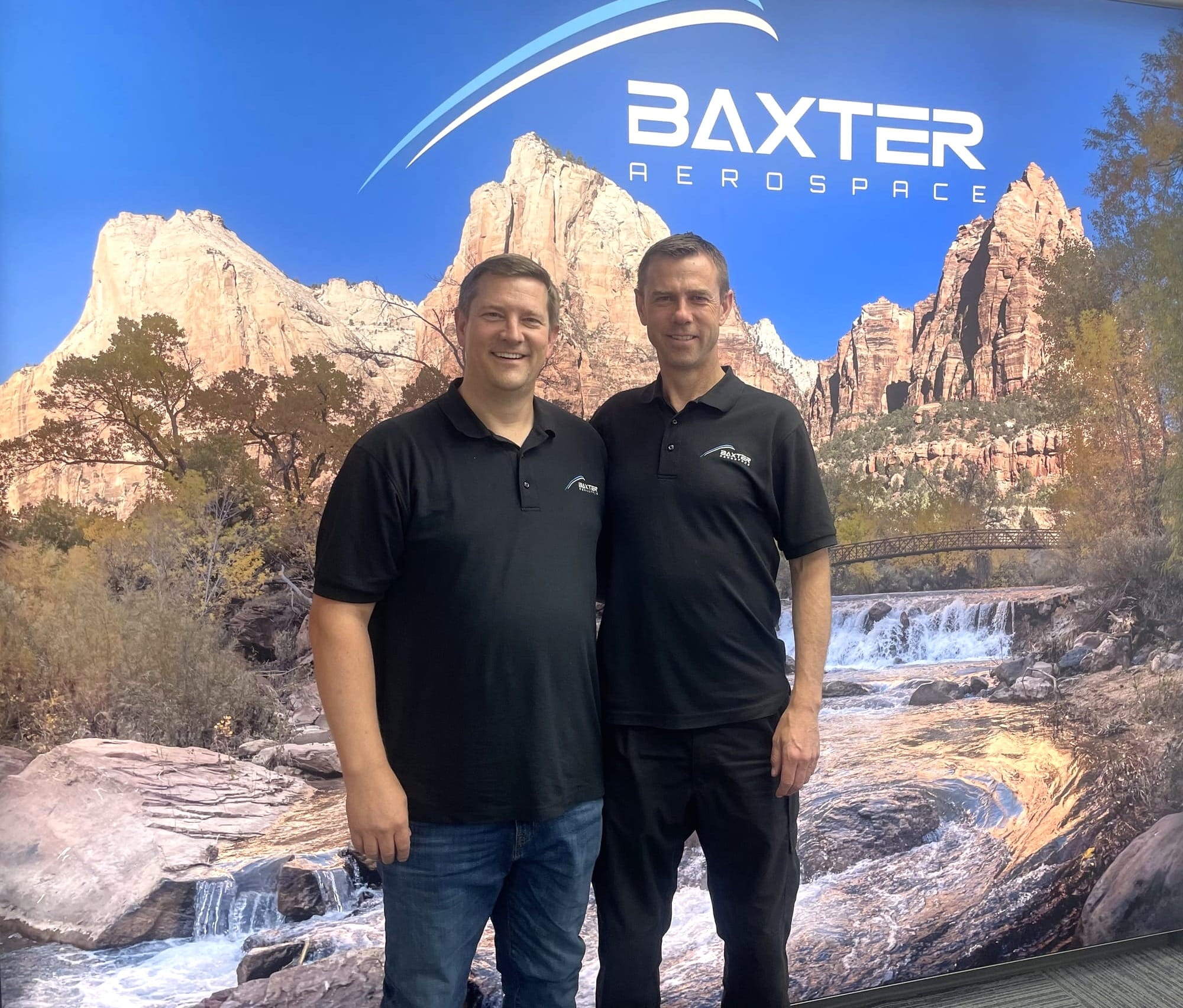
Jeff Baxter (left) and Michael Baxter, co-founders of Baxter Aerospace, at the company's St. George headquarters. The brothers left careers at SpaceX and Boeing, respectively, to build unmanned aircraft aimed at making aerial firefighting safer and more effective. Photo: Elainna Ciarmarella
Michael and Jeff Baxter grew up on a small farm in Oregon, raising cows, horses, and chickens under a father who valued manual labor. As teenagers, they spent a decade building a two-seat airplane Jeff proposed as a bonding project. At Brigham Young University, that mechanical instinct turned toward electric-vehicle racing. Jeff and Michael lead a team that built the streamliner "Electric Blue," which, per a BYU News release, averaged 204.9 mph on the Bonneville Salt Flats, setting an electric land-speed record that still stands today.
Both brothers built serious aerospace careers before founding the company. Michael earned a master's in mechanical engineering and an MBA, then joined Boeing. Jeff earned a master's in business, joined SpaceX shortly after its first Falcon 9 success, and worked on Falcon 9 and Dragon through to Falcon Heavy before joining Erickson Helicopter, where he developed the world's largest flying water cannon.
By 2019, the gap Michael glimpsed after Eagle Creek was confirmed again. While outfitting firefighting aircraft for the Oregon Department of Forestry, he heard a pilot joke that he'd draw on a map, wrap it around something heavy, and drop it from his cockpit to warn crews below. Major aerospace firms had little incentive to build hardware for cash-strapped firefighting agencies, the brothers concluded, so they decided to solve the problem themselves.
The stakes are stark: since 2020, at least 25 pilots and crew have died in 14 fatal aerial firefighting crashes in the U.S., according to aLos Angeles Times analysis of National Transportation Safety Board data. In that same period, not one of the country's 100,000-plus scheduled airline pilots has died in a crash.
Jeff Baxter said 15 pilots died in a single 47-day stretch around the company's launch. The aerial firefighting community has suffered several tragic losses in recent weeks, including a pilot killed while fighting Colorado’s Gold Mountain Fire in July and two pilots killed in a helicopter crash while battling Utah’s Widemouth 2 Fire in August. These deaths are a sobering reminder of the extraordinary risks aerial firefighters take to protect communities and support crews on the ground.
Utah's 2026 fire season has been among its most destructive on record. In June, three federal wildland firefighters, Emily Barker, 38; Nick Hutcherson, 27; and Sydney Watson, 27, were killed near the Utah-Colorado border when their crew was overrun while attempting to take emergency shelter, one of the deadliest incidents to hit the wildland firefighting community in years. The August 7 Widemouth 2 Fire helicopter crash referenced above killed pilots Chris Andersen, 64, and Miles Elliott, 50, both employed by U.S. Forest Service contractor Helicopter Transport Services.
Much of that risk stems from aging equipment, limited data, hazardous operating environments, and a lack of team coordination, among other factors. American aerial firefighting relies largely on refurbished ex-military aircraft, and flying those heavy planes through turbulent canyon winds, at low levels, in smoky conditions, and at max performance is dangerous.
Operations stop at sundown, even though night offers the calmest winds and highest humidity, the easiest conditions to extinguish a fire. "A gallon of water at 2 a.m. is way better than at 2 p.m.," Jeff Baxter said. Baxter Aerospace intends to address all these issues with their new unmanned Dragonfly and future firefighting aircraft.
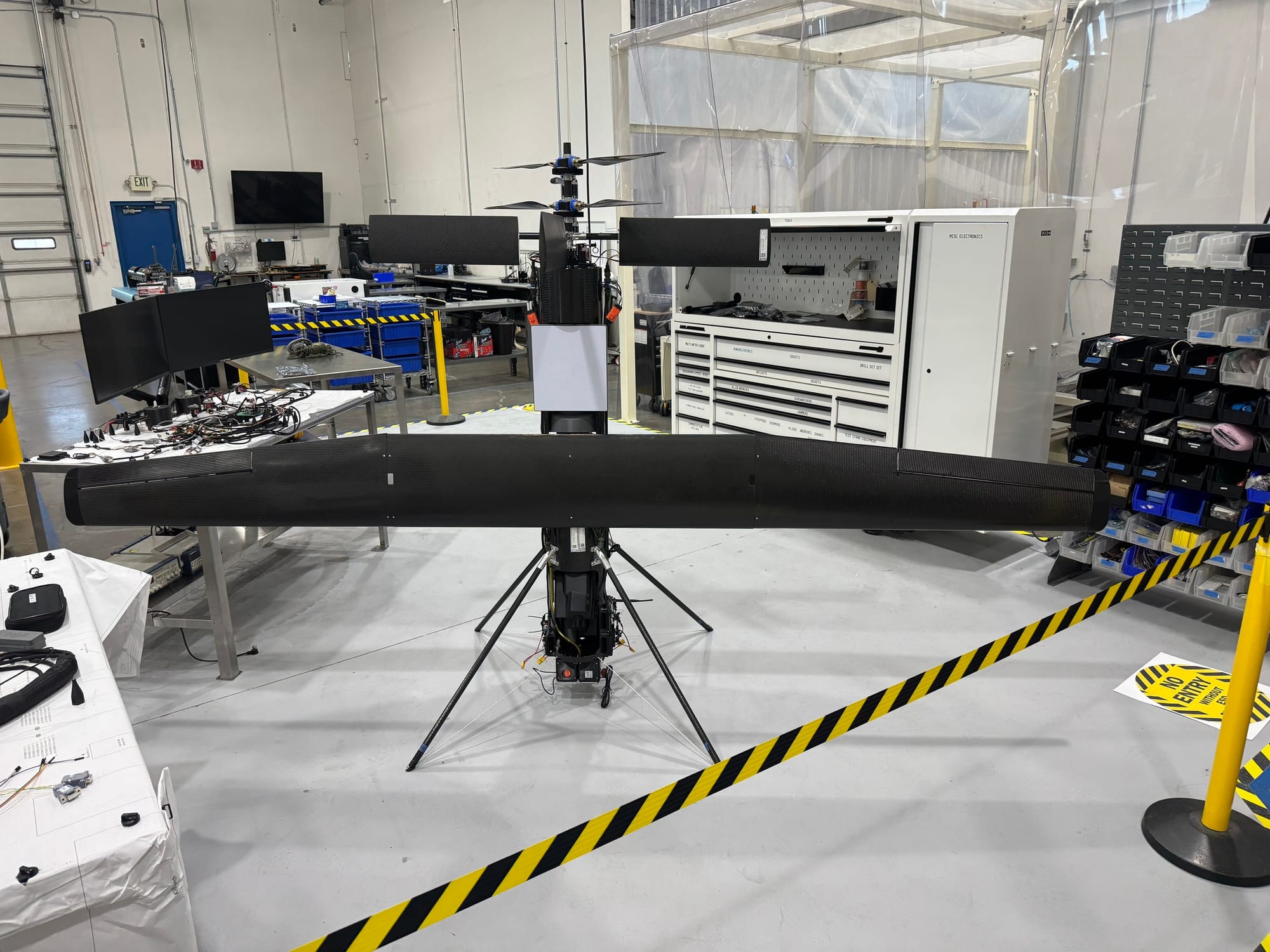
Baxter Aerospace's Dragonfly unmanned aircraft, shown here in its carbon-fiber fuselage during assembly at the company's St. George manufacturing facility. Engineered for tool-less assembly, the 80-pound aircraft is designed to launch by backing itself vertically off the ground before transitioning into wingborne flight. Photo: Baxter Aerospace
To fund Dragonfly's development, the brothers bootstrapped the company with three other business lines: satellite communications for the Air Force, systems and components for nuclear research including a Boston fusion reactor, and spacecraft structures for rocket manufacturers. Profits from that work go straight into firefighting research.
The company hires from local trade programs and hands new employees real responsibility fast. Bryce Christensen, 19, a Dixie Technical College graduate, is Dragonfly's lead CNC programmer. "It's a meritocracy in the sense that great people just rise to the top," Jeff Baxter said.
The product of that research is Dragonfly, engineered for tool-less assembly, so one person can deploy the 80-pound aircraft in remote backcountry. It launches by backing itself vertically off the ground before diving into wingborne flight, using a series-hybrid drive with just seven moving parts.
Similar military observation aircraft typically require about $1 million in launch-and-catch equipment; Dragonfly needs none and targets a price in the tens of thousands. It flies up to 12 hours, operates up to 18,000 feet, and covers 800 nautical miles one way, streaming infrared imagery to firefighters' phones over Starlink. Michael Baxter calls the resulting live map, "Google Maps on steroids for fire." Its software allows a single operator to monitor up to 15 aircraft.
Michael Baxter said Baxter Aerospace equipment was airborne over the January 2025 Palisades Fire in Los Angeles, feeding situational data to responders. Lives were lost, he said, but without it, "it could have been 100 times that."
Baxter Aerospace is now testing Dragonfly serial number three and building serial number four, with wingborne trials planned soon. To speed up testing in the national airspace, Baxter plans to fly Dragonfly inside temporary flight restrictions at night, when manned aircraft are grounded, and the airspace is fully deconflicted.
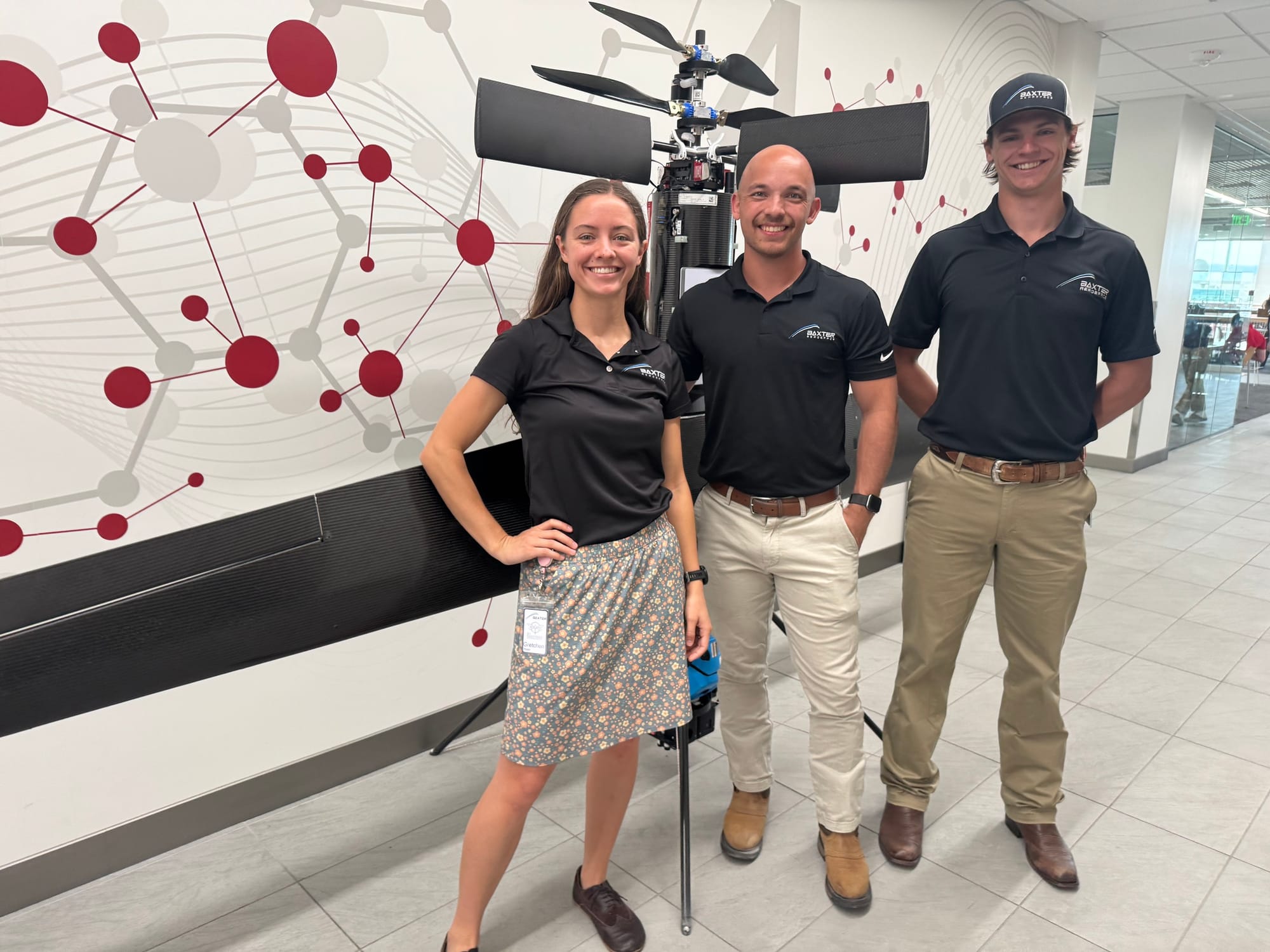
Baxter Aerospace team members pose with the Dragonfly aircraft at the company's facility. The trio reflects the company's practice of hiring young, hands-on talent and giving them real responsibility early — the kind of "meritocracy" culture Jeff Baxter described. Photo: Baxter Aerospace
"We're the U.S., we should be able to put out fires here," Jeff Baxter said. "We can light fires on the other side of the Earth from here, but we can't put out our own fires ... We should be much better at putting them out." The brothers are seeking partners willing to invest in building a larger, heavy-payload Dragonfly capable of autonomously dropping water and retardant at night, as well as forming a key node in a precision logistics and communication chain.
That statewide push includes 47G, Utah's aerospace and defense association, which convened the state's inaugural Project Alta Summit in May, touting Utah's selection as one of eight FAA eVTOL Integration Pilot Program sites, TechBuzz News reported. Baxter Aerospace will be a direct beneficiary of the expanded test flight range in Southern Utah.
At a regional aerospace partnership meeting this month, 47G, the Southern Utah Economic Alliance, Utah Tech University, Southern Utah University and county leaders signed a memorandum of understanding to build the workforce pipeline and flight infrastructure the industry needs, naming Baxter alongside SkyWest and RAM Aerospace as a company anchoring the region's supply chain.
Utah Tech University President Shane Smeed cited Baxter as an employer hiring the school's graduates directly off campus. Baxter said the goal is to prove "world-class aerospace innovation doesn't just happen near major metros" and to make Southern Utah the state's aerospace workforce hub.