Utah Bet on Going It Alone Against Meta. This Week, That Bet Paid Off.
Utah broke from the pack of 33 states to sue Meta separately in 2023. That bet paid off this week in a $12.2 billion national settlement — Utah's cut: $212 million over 10 years...with additional fine print incentives for more.
When state attorneys general coordinated a massive legal assault against Meta Platforms on October 24, 2023, over Instagram and Facebook's impact on kids, 33 states joined forces in a single federal lawsuit in Northern California. Utah didn't. Along with a handful of other jurisdictions, Utah's Division of Consumer Protection and Attorney General's office broke off and filed their own case in state court, built around the Utah Consumer Sales Practices Act.
Nearly three years later, that bet is paying out. On August 26, 2026, Utah joined 46 other states and four territories in a $12.2 billion landmark settlement with Meta—a massive child-safety deal that state officials are comparing to the 1990s Big Tobacco settlements.
Utah's share: $212 million over the next decade, with the potential to rise up to $301 million if other major platforms follow suit.
The fine print
While some headlines blared a "$17 billion" settlement, the reality is more nuanced. The guaranteed floor is $12.2 billion. The higher $17.1 billion figure is an incentive structure: it only triggers if platforms like Snap, TikTok, and YouTube agree to matching safety terms so Meta isn't left operating under a isolated disadvantage. Right now, that extra money is a hypothetical, not cash in hand.
Utah’s slice reflects that same fine print. Though touted as a $212 million victory, the cash won't arrive in a single block. Instead, it will trickle into state coffers in roughly $20 million annual installments over the next decade. For a legal battle launched in 2023, Utah has secured a steady revenue stream, just not the sudden windfall many initial announcements suggested.
The unsung team
The real engine of Utah’s Meta suit was a small team of state investigators and attorneys working behind the scenes at the Utah Department of Commerce, led by Executive Director Margaret Woolley Busse. Katherine Hass, Director of the Division of Consumer Protection, led the initial charge, supported by Blake Young (then DCP Assistant Director) and investigators Chantel Tonks and Kelsie Bowler.
Deputy Attorney General Douglas Crapo working alongside Assistant Attorneys General Carina Wells, Blake Erickson, Daniel Ruskin, Alexandra Butler, Michael Gadd, and Peishen Zhou led the legal representation. Nearly three years of granular discovery, subpoenas, and unglamorous negotiation by these public servants built the leverage that ultimately forced a tech titan to pay out $12.2 billion.
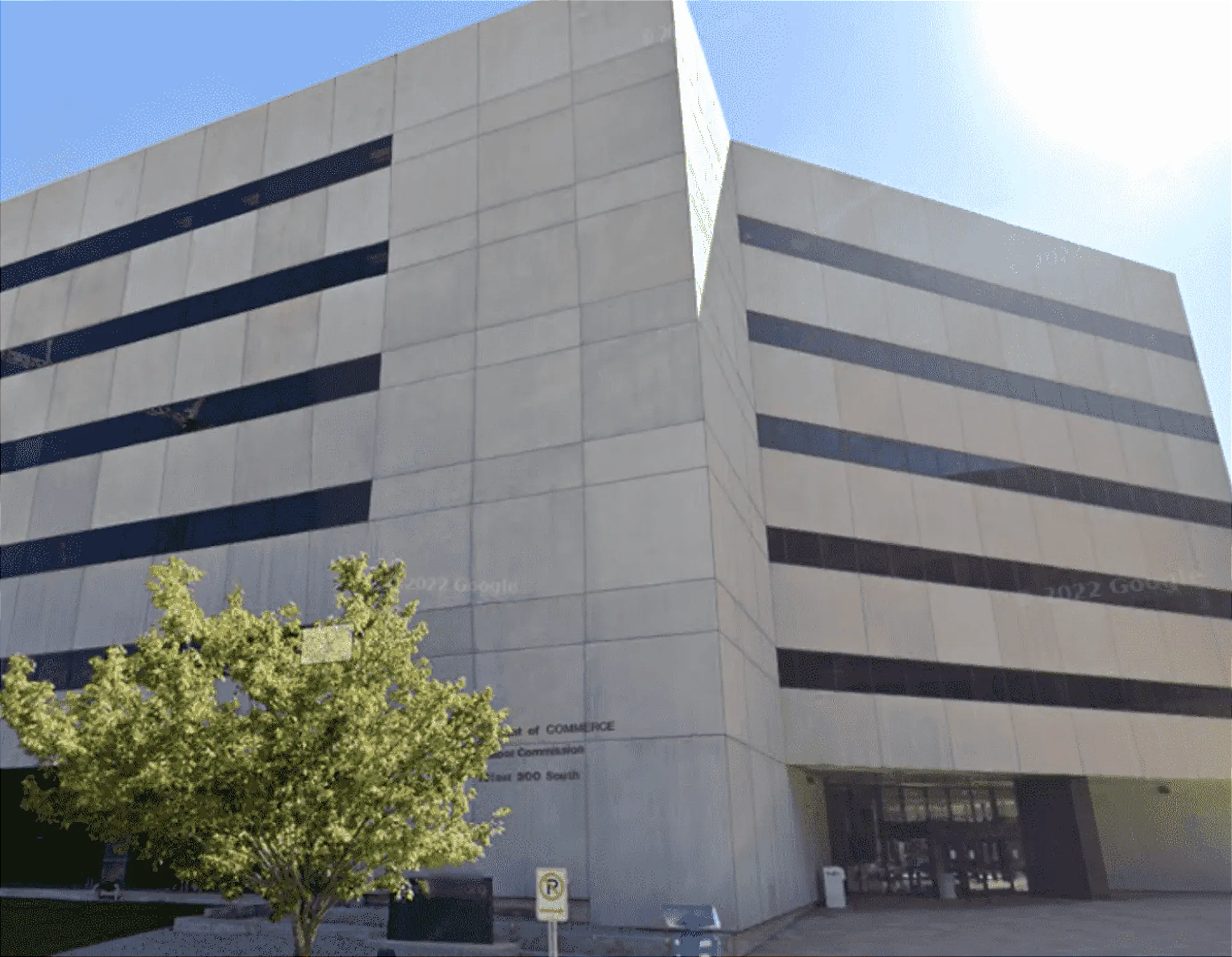
Utah Department of Commerce, downtown Salt Lake City.
A Broader Pattern, Not a One-Off
Meta may be the largest brand name to enter a structured settlement, but this victory is no isolated stroke of luck. Rather, it marks the latest payout from a broader enforcement apparatus that Utah’s Division of Consumer Protection has been running against Big Tech since 2023.
The Meta case is part of a deliberate multi-front campaign:
TikTok: In October 2023, Utah filed its first suit targeting TikTok’s addictive algorithms under the Utah Consumer Sales Practices Act. It escalated the fight in June 2024, suing the platform a second time over allegations it profited from live-streaming features that enabled the sexual exploitation of minors. That litigation continues to move forward in state court, even as Utah monitored the broader federal legal battles that led to appeals courts upholding federal ban legislation.
Snap Inc.: Expanding its crosshairs beyond ByteDance and Meta, the state filed a similar complaint against Snap Inc. in mid-2025, challenging Snapchat’s push notification dynamics and AI-driven features under state consumer protection statutes.
By declining to lump all its legal claims into passive national class actions, Utah built distinct state-court records against Meta, TikTok, and Snap. The $12.2 billion Meta result is the first major domino to fall in that playbook, but it won't be the last.
What Meta actually has to change
Beyond the monetary payouts, the deal enforces structural changes to how Facebook and Instagram operate for teens. Pending court approval, Meta must deploy an age-verification system subject to annual third-party audits, enforce a default two-hour daily limit across its apps with mandatory break prompts, block nighttime access between midnight and 6 a.m., and silence push notifications during school hours.
To combat mental health harms, the settlement rolls back psychological triggers tied to social comparison, such as banning beauty filters, hiding default like counts, and mandating non-personalized feed alternatives.
Crucially, the agreement also resolves lingering multi-state consumer claims over Meta’s handling of user data during the 2016 election and the Cambridge Analytica scandal.
Operationalizing the State's 'Pro-Human' Policy
Reacting to the settlement, AG Derek Brown called it a landmark agreement that, for the first time, forces Meta to place child safety above its business model.
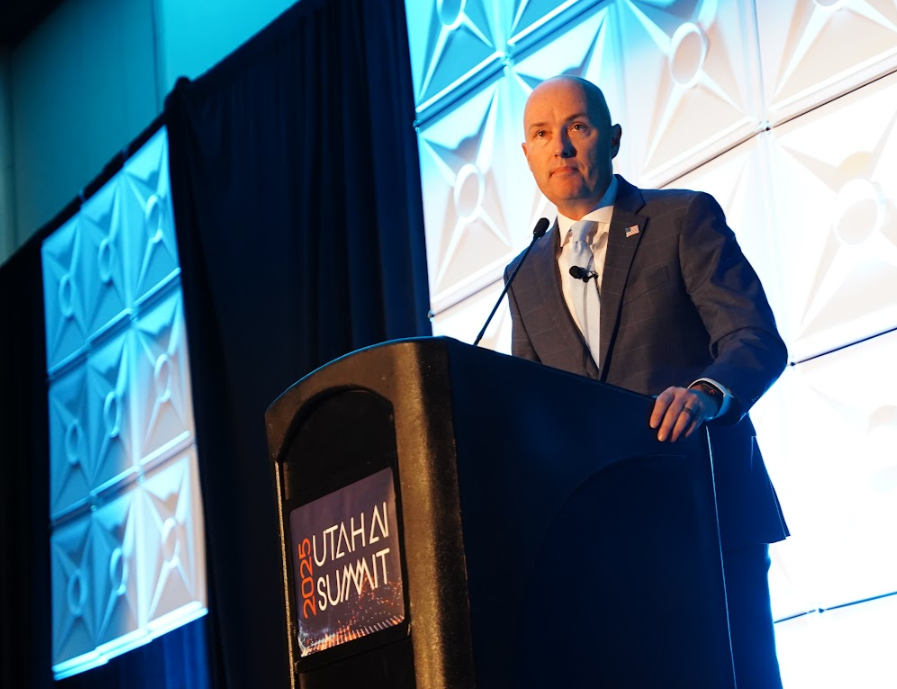
Gov. Spencer Cox addresses attendees at the 2025 Utah AI Summit, outlining the state's "pro-human" tech framework—a philosophy demanding that digital tools enhance human potential and protect youth rather than exploit them for engagement, Salt Palace, December 3, 2025. Photo: Mark Tullis, TechBuzz
Governor Spencer Cox framed the concessions as validation of warnings he has issued in public and in writing since 2023, that social media platforms would never voluntarily reform unless held legally and financially accountable.
Speaking at the 2025 Utah AI Summit, Cox candidly reflected on his own shift from early tech optimist to stark realist, admitting that social media platforms had been allowed to "strip mine our souls" and profit from teen anxiety and depression under the banner of connectivity. For Cox, holding Meta accountable in state court isn't just about recovering damages; it is part of Utah’s explicit "pro-human" mandate, a policy framework demanding that digital tools enhance human agency and protect youth rather than exploit them for engagement. As Cox put it, Utah chose to "make the future instead of letting it happen to us," proving that when states apply real legal pressure, tech giants can indeed be forced to reform.
That same philosophy will anchor the state's next major technology gathering, the 2026 Utah AI Summit that will take place on December 8, 2026, at the Grand America Hotel. It is centered on the theme: "The Age of Pro-Human Artificial Intelligence: Empowering innovation that is human-guided and human-enhancing." Featuring keynotes from Governor Cox, OpenAI Head of Strategic Futures Dean Ball, and former Indiana Governor Eric Holcomb, the sold-out summit's return signals that Utah isn't backing off. Whether through groundbreaking courtroom settlements or statewide policy frameworks, the state intends to ensure that the next era of technology is built to protect and empower people, not exploit them.
Share this article
The link has been copied!
Your link has expired. Please request a new one.
Your link has expired. Please request a new one.
Your link has expired. Please request a new one.
Great! You've successfully signed up.
Great! You've successfully signed up.
Welcome back! You've successfully signed in.
Success! You now have access to additional content.