The Tyler Robinson Hearing Revealed a Problem Bigger Than AI: Can We Trust Digital Evidence?
A Utah courtroom dispute over edited surveillance footage highlights a growing challenge: verifying digital authenticity. Mike Nelson from DigiCert (Lehi, UT) explains why AI-driven manipulation demands stronger provenance standards to establish trust in images, videos and digital evidence.
A judge’s skepticism over edited surveillance footage in the Tyler Robinson case illustrates a much larger challenge: proving authenticity in a world where digital content can be altered instantly.
Provo, Utah — July 27, 2026
During a preliminary hearing in a Utah courtroom earlier this month, a judge confronted a question that courts, businesses and consumers will increasingly face:
How do you know a digital file is what it claims to be?
The question emerged during proceedings involving Tyler Robinson, the man accused of killing Charlie Kirk at Utah Valley University. Prosecutors presented surveillance footage showing Robinson’s movements before and after the shooting, but defense attorneys challenged an edited compilation created from multiple campus surveillance cameras.
The video included enhancements designed to help viewers interpret the footage, including digital zooms and visual markers highlighting individuals and events. Defense attorneys argued that the compilation was not the original evidence and questioned whether the investigator presenting it could fully verify the extent of the modifications.
State District Judge Tony Graf sustained the objection and required prosecutors to provide the original, unaltered footage before proceeding. The issue was not whether the video was fake. It was whether the court could confidently understand what changes had been made to the original evidence.
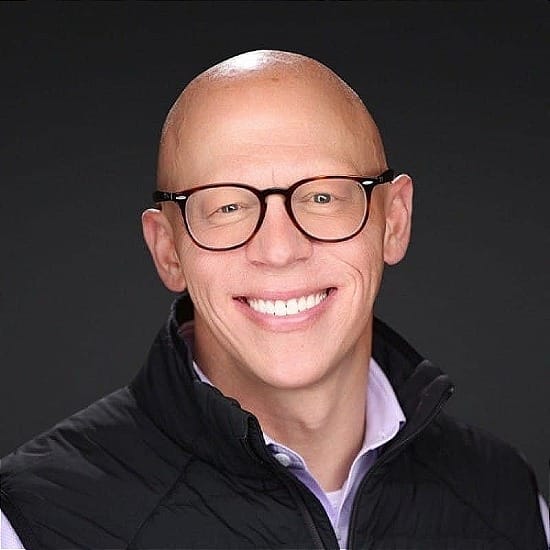
Mike Nelson, VP, Field CTO for DigiCert
For Mike Nelson, VP, Field CTO for DigiCert, the hearing illustrates a challenge extending far beyond one courtroom.
"The judge in the Tyler Robinson case brought up a really important question: How do I know what edits were made to the video that's being presented as evidence?" Nelson told Techbuzz in a recent interview. "How do I know the extent of the modifications that have been made?" Nelson said the judge's request was reasonable: provide the original video so the court could establish confidence in what it was seeing. "The judge said, 'Can you provide the original video so that I can see it? Because I feel like that is going to give me the confidence that I can trust the video.'"
The hearing was not a debate over artificial intelligence. The footage was not alleged to be AI-generated or fabricated. But it highlighted a problem that AI is accelerating: the growing difficulty of determining whether digital content is authentic, what changes have been made, and who made them.
The trust problem behind the AI revolution
Nelson argues that artificial intelligence is often blamed for a problem that existed long before generative AI became mainstream. "It's not an AI problem, in my opinion," Nelson said. "It's a trust problem. And trust problems can be solved."
Digital images, videos and documents have always been edited. News organizations edit interviews. Consumers enhance photographs. Businesses modify documents and presentations. The issue is not whether editing occurs. The issue is whether the history of those changes is transparent.
"The message isn't that you can't edit video," Nelson said. "The message has to be there needs to be a chain of trust of those edits." That chain should answer basic questions:
What edits were made? Who made them? When were they made? Were additional changes made afterward?
"Videos and photos are always going to be edited," Nelson said. "But consumers and now judges, doctors, insurance providers—there are so many situations where people are going to want verification that images have authenticity."
A digital file needs a history
For much of human history, authenticity was tied to physical objects. A signed document carried meaning because a signature could be examined. Evidence could be stored and tracked through a chain of custody. A photograph represented a moment captured by a physical device.
Digital technology changed that relationship. A digital file can be copied perfectly. A modified image can look identical to an original. A video can be enhanced, cropped, filtered or altered without obvious signs.
Metadata such as timestamps, GPS information and camera settings provide some context, but they do not tell the complete story. Nelson points out that existing metadata systems often stop at the moment of capture. "If I go edit the photo on my iPhone, it still will say that image was captured at that time and in that location," he said. "And it does not track the changes." That missing piece—the record of what happened after capture—is where digital provenance becomes important.
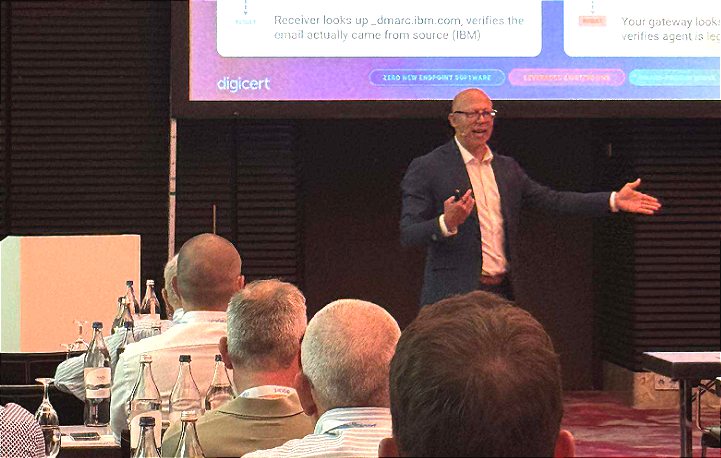
DigiCert's VP, Field CTO Mike Nelson presenting "Securing AI: Agent and Model Governance" a conference in Europe, June 2026
Creating a chain of custody for digital content
One emerging solution is a standard called C2PA (Coalition for Content Provenance and Authenticity), a framework designed to establish the origin and history of digital content.
The standard is being developed by a coalition of technology companies, camera manufacturers and software organizations to create a verifiable record of how digital content was created and modified.
Nelson compares it to a digital chain of custody. "When an image is captured, it is digitally signed with a digital certificate and a digital signature," he said. From there, modifications can be recorded. "If it is modified, it would be signed again and it would say it was modified by this person at this date, and these are the changes that were made."
In a courtroom scenario like the Utah hearing, a judge could potentially see not only the original footage but also a verified record of every modification. "The judge would be able to go in and say, 'The state of Utah made a modification on this date. They added a green circle here. They added a red circle here. They zoomed the video in,'" Nelson said. The technology does not prevent editing. It makes editing transparent.
Why now?
Digital provenance has existed as a concept for years. But adoption often follows a familiar pattern: organizations invest heavily only after the consequences become impossible to ignore.
Nelson said the industry is reaching that point. "We typically spend money where there's either significant pain or where there's significant opportunity," he said. "In this space, there really hasn't been a ton of pain yet."
That is changing.
Deepfake videos, synthetic voices and AI-generated images are creating uncertainty across politics, media, business and personal life. "We're now starting to hit a pain threshold where it matters," Nelson said. He points to situations ranging from elections and misinformation to personal harm caused by maliciously altered images. "If there's a photo of your child floating around, how do you know that it has integrity?" Nelson asked. "If there's a video of you doing something, how can you prove that it wasn't you doing it?"
Building trust into the next generation of technology
DigiCert's role in this emerging ecosystem builds on the company's existing work with digital certificates, cryptographic identity and authentication.
The company is working with device manufacturers to enable digital signatures at the point of capture, allowing images and videos to carry verifiable records of authenticity. But technology alone is not enough. Adoption requires manufacturers, software companies, governments, businesses and consumers to recognize the importance of digital provenance. Nelson believes the industry is entering a period where trust must become a deliberate feature of technology rather than an assumption. "We've deployed technology very rapidly and the trust model is not quite there yet," Nelson said. "We're playing catch-up."
The same pattern has appeared repeatedly throughout technology history. Innovation moves quickly. Safeguards often follow after problems emerge. The challenge now is building those safeguards before digital trust becomes a crisis. The Utah courtroom dispute offered a glimpse of that future. Judge Graf was not questioning whether digital evidence should be used. He was asking a more fundamental question:
Can we prove where it came from and what happened to it along the way?
In an increasingly digital world, that may become one of the most important questions we ask.
Share this article
The link has been copied!
Your link has expired. Please request a new one.
Your link has expired. Please request a new one.
Your link has expired. Please request a new one.
Great! You've successfully signed up.
Great! You've successfully signed up.
Welcome back! You've successfully signed in.
Success! You now have access to additional content.