University of Utah, XPRIZE Explore New Models for Tackling Utah’s Biggest Challenges
The University of Utah and XPRIZE are exploring incentive competitions as a model for tackling Utah challenges, including Great Salt Lake restoration, minerals, climate innovation, healthspan, and research commercialization, connecting researchers, entrepreneurs, investors, industry and government.
Utah is exploring whether one of the world's most ambitious innovation models can be applied to some of the state's most difficult problems — from a shrinking Great Salt Lake to critical-minerals supply chains and the future of healthy aging.
The University of Utah brought XPRIZE Foundation leaders, university researchers, philanthropists, investors and other members of Utah's innovation ecosystem together Tuesday at Cosm's immersive dome at Research Park for Utah Innovation Frontiers, an invitation-only gathering focused on the potential of incentive prizes to accelerate breakthrough innovation.
The premise behind XPRIZE is straightforward: Rather than funding research efforts and hoping they eventually produce a breakthrough, establish an audacious, measurable goal, put a significant prize behind it and invite innovators from around the world to compete to achieve it.
It is a model that XPRIZE says began with a $25,000 aviation prize offered in 1919 — and that ultimately helped inspire the organization's first competition, the $10 million Ansari XPRIZE for private spaceflight. Today, XPRIZE has expanded the model into health, climate, water, food and other global challenges.
For Utah, the question now is whether the same approach can help solve problems that conventional approaches have struggled to address.
Cosm's dome fills with what staff astronomer called the "cosmic butterfly," a real-time, wraparound map of the observable universe, with every point of light representing an entire galaxy. As Brandon the astronomer narrated during the tour: "We call it the butterfly thanks to that big gap in the center, and the wings on each side look like lobes — that's just thanks to the plane of the Milky Way galaxy. Our telescopes can't see through all the gas and dust in the Milky Way, so we're left with that big gap in the center there." He pointed out that the reddish-and-blue mottled background threaded through the image is the cosmic microwave background — "essentially the leftover light of the Big Bang itself" — and noted that Cosm's rendering incorporates data from DESI, the Dark Energy Spectroscopic Instrument, a project that also involves the University of Utah. Photo: Austen Diamond Photo + Film
From Lindbergh to SpaceShipOne
The story begins not with XPRIZE, but with an earlier incentive competition.
In 1919, hotelier Raymond Orteig offered a $25,000 prize to the first aviator to fly nonstop between New York and Paris. Charles Lindbergh won it eight years later with the Spirit of St. Louis, helping demonstrate the potential of long-distance commercial aviation. XPRIZE identifies the Orteig Prize as the inspiration for founder Peter Diamandis' vision of using a similar incentive to open spaceflight to private competitors.
Diamandis founded XPRIZE in 1994. In May 1996, XPRIZE launched its first competition: a $10 million challenge for privately financed teams to build a reliable, reusable spacecraft capable of carrying three people to 100 kilometers above Earth twice within two weeks.
The eventual result demonstrated the leverage of the model.
Twenty-six teams from seven countries competed. Together, the teams invested more than $100 million in research and development chasing a $10 million prize. On October 4, 2004, Mojave Aerospace Ventures, led by aerospace designer Burt Rutan's Scaled Composites and backed financially by Paul Allen, won the competition with SpaceShipOne.
The winning technology was subsequently licensed by Richard Branson to create Virgin Galactic.
The important number, however, was not simply the $10 million prize.
The competition generated more than $100 million in R&D investment around a $10 million incentive.
That is the basic proposition XPRIZE brought to Utah: A well-designed prize can mobilize talent, capital and collaboration far beyond the amount of money awarded to the eventual winner.
XPRIZE now describes the Ansari competition as the proof point for its broader model: establish an ambitious target, define a clear finish line and reward demonstrated results rather than simply funding ideas. The organization says it has since launched 30 competitions involving more than 35,000 innovators across 173 countries.
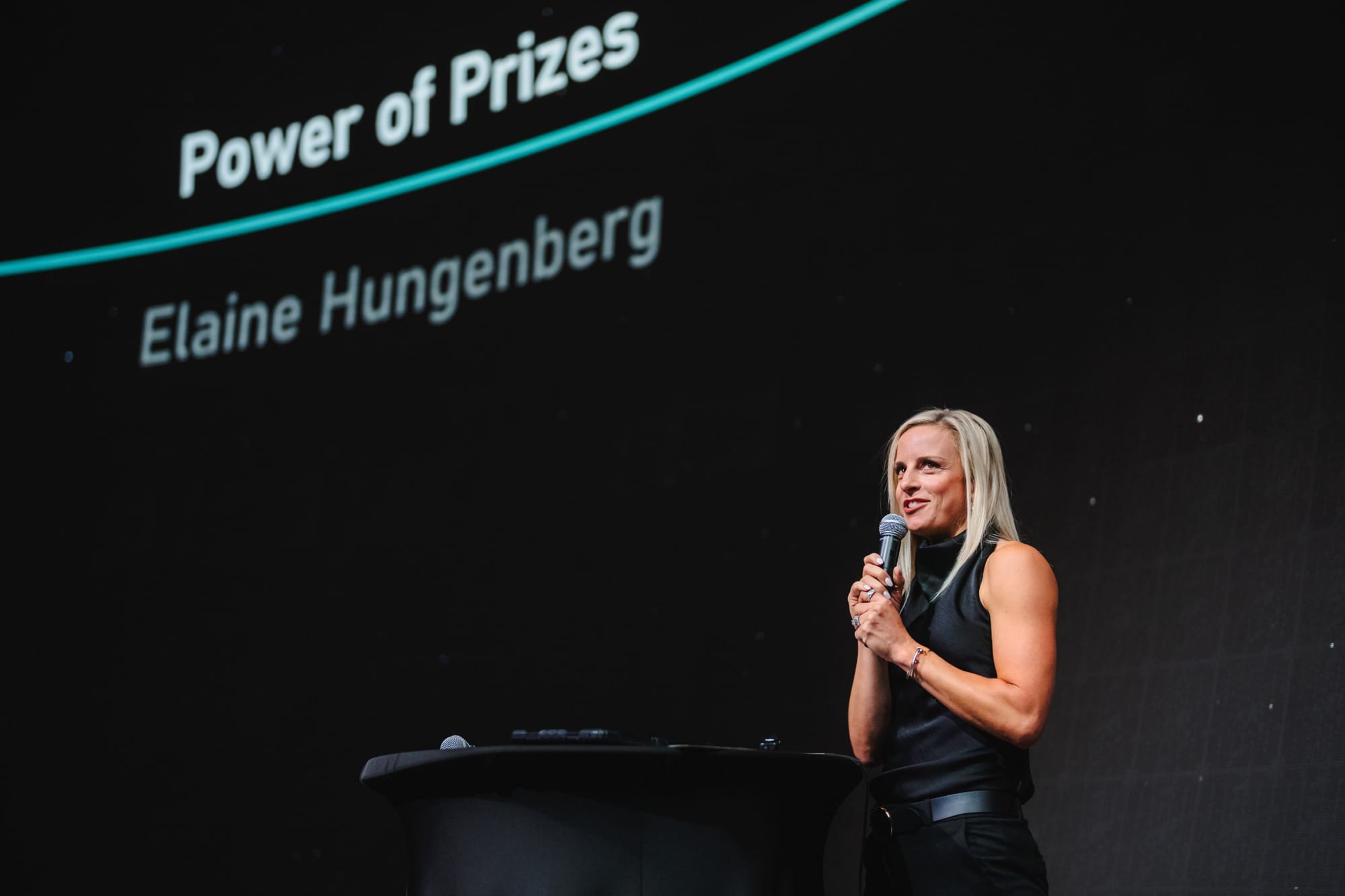
Elaine Hungenberg, XPRIZE's SVP of Partnerships & Impact, presents "Power of Prizes," tracing the Ansari XPRIZE's role in launching the commercial space race. Photo: Austen Diamond Photo + Film
"We have flipped philanthropy on its head. Instead of funding effort, we fund outcomes and impact," XPRIZE SVP of Partnerships & Impact Elaine Hungenberg told the Utah gathering.
Building an Innovation Ecosystem Around a Prize
That distinction was central to XPRIZE's presentation.
Chief Impact Officer Andrew Tauhert and Hungenberg argued that the prize itself is only one component of the model. The competition creates a focal point around which entrepreneurs, researchers, investors, mentors, corporations and potential customers can gather.
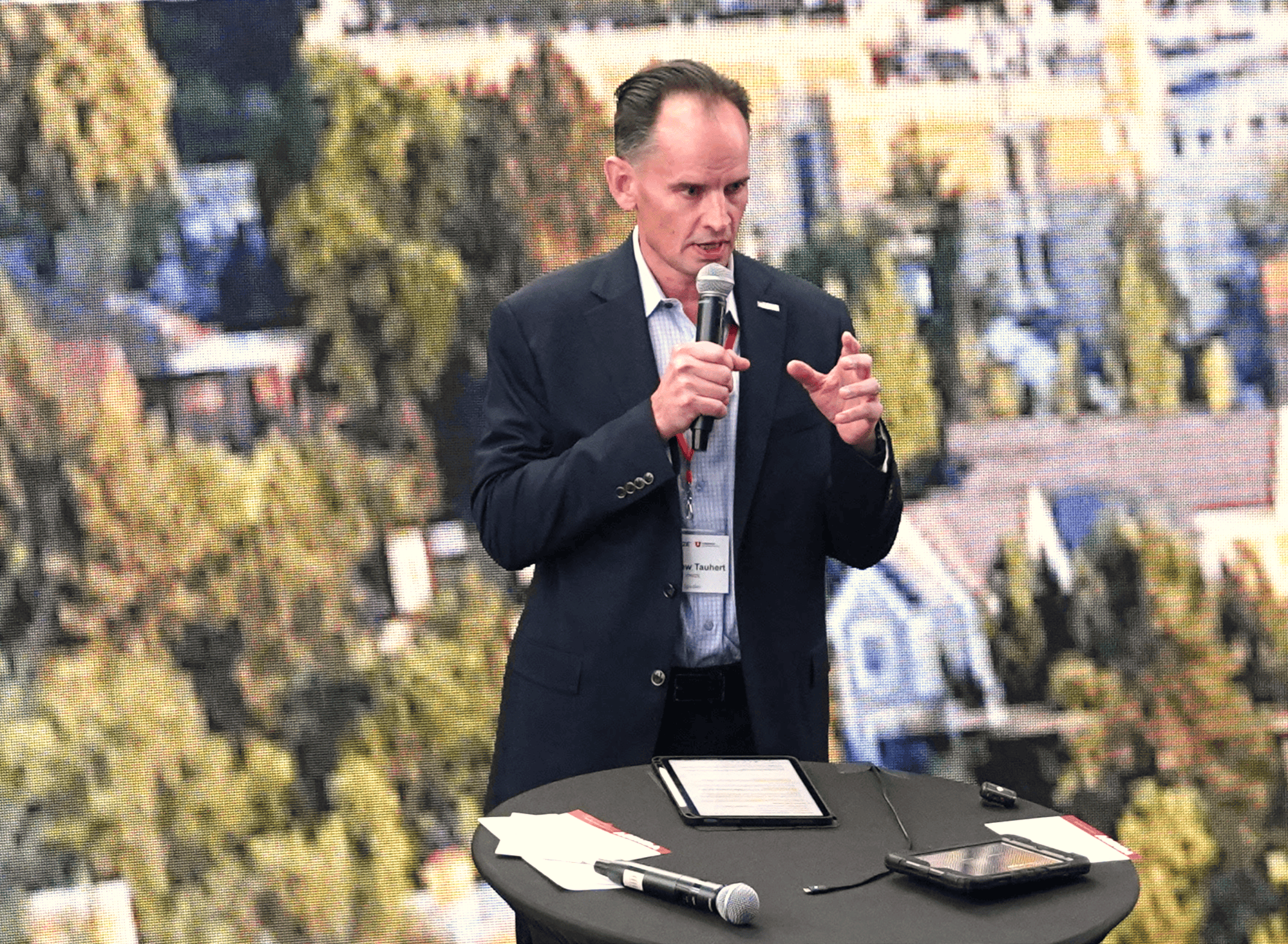
Tauhert put a finer point on what keeps innovators coming back: "It's not just innovation; it's the combination of innovation and collaboration. Ask any innovator who's participated in our prizes, and the thing they'd say they walked away with the most — other than potentially $10 million or $100 million — is actually the partners, the mentors, the investors, and the buyers who allow them to build what they need to build."
Andrew Tauhert, Chief Impact Officer at XPRIZE, addresses the audience at Cosm's Research Park dome, framing incentive competitions as a model for turning ambitious targets into real-world impact. Photo: Mark Tullis, TechBuzz
Hungenberg was specific about the University of Utah's role within that model: "The University of Utah has been a phenomenal partner of ours, helping us with wildfire activities, being a testing partner for our Healthspan Prize, and more recently finding collaboration between our efforts as a prize platform and the Wilkes Climate Prize."
The $101 million, seven-year XPRIZE Healthspan competition — one of the largest incentive prizes ever offered for a single scientific breakthrough — has the university doing more than testing: the University of Utah's Data Coordinating Center oversees trial and data management for finalist teams' clinical trials, which run from 2026 through 2029 ahead of a 2030 grand prize of up to $81 million. It's a concrete example of the university positioning itself not just as an XPRIZE partner but as connective infrastructure between competing teams' research and eventual commercialization.
The University of Utah sees an opportunity to apply that model locally.
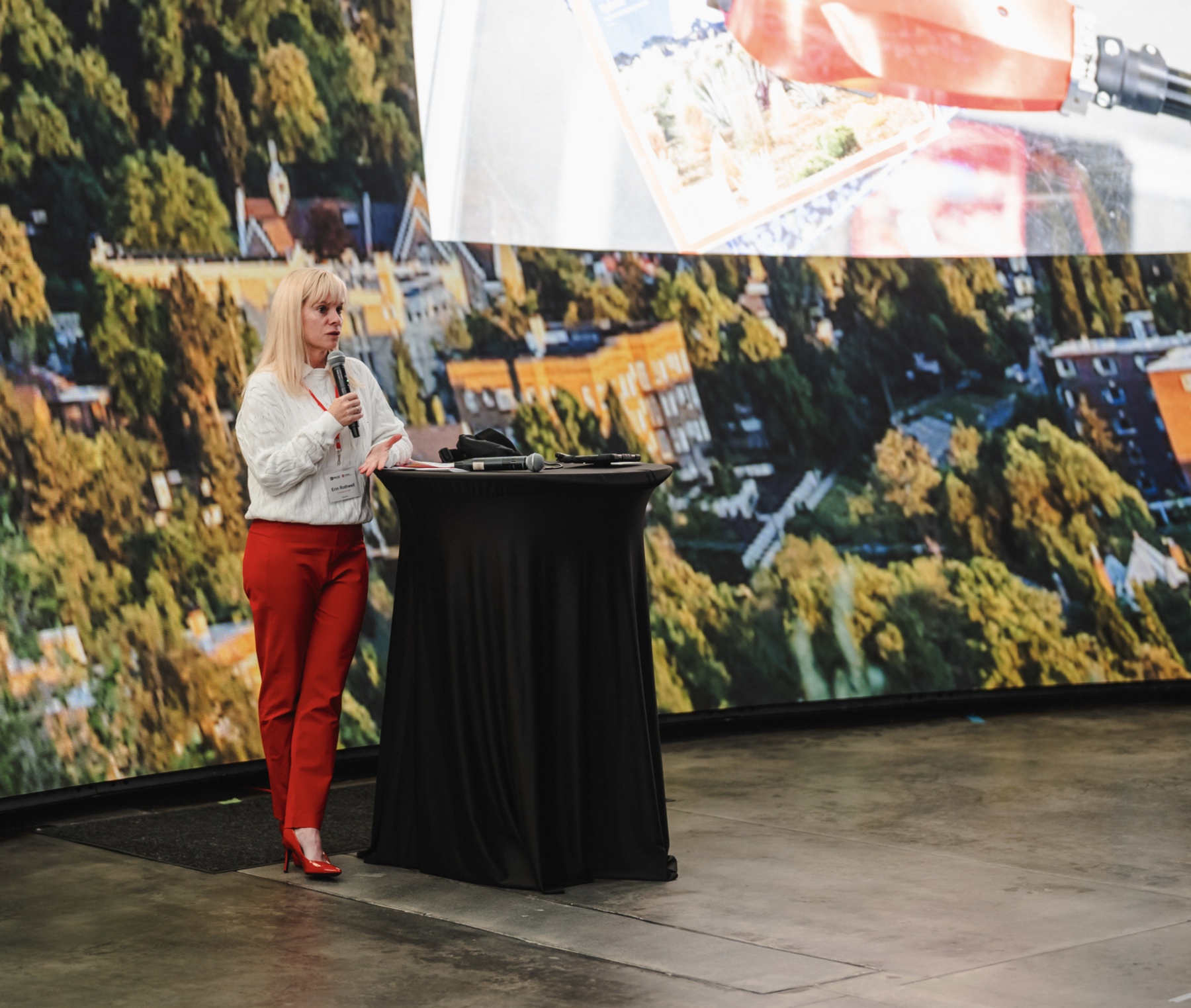
"We need resources, we need incentives, and we need to bring new people together to solve some of the greatest challenges," said Erin Rothwell, the university's senior vice president for research. "Entrepreneurs, researchers, industry, for-profit and nonprofit alike."
The question is what those challenges should be.
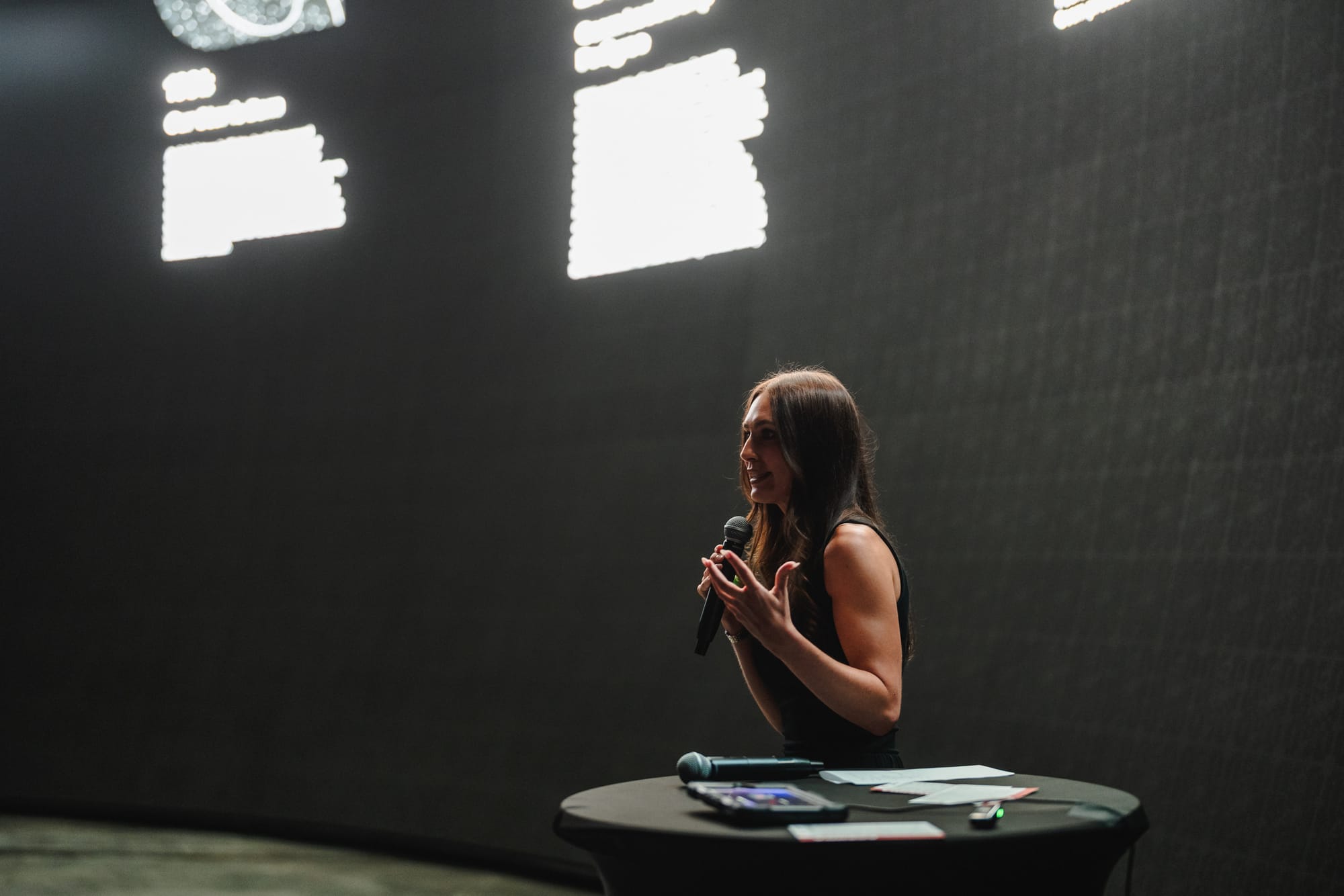
Erin Rothwell, Senior Vice President for Research at the University of Utah, addresses the audience beneath a dome display showcasing university research. Photo: Austen Diamond Photo + Film
A Potential XPRIZE for the Great Salt Lake
One of the clearest possibilities discussed at the event was the Great Salt Lake.
David Cumming, who co-chairs the Great Salt Lake Alliance board and leads the Cumming Foundation, framed the lake's decline as a system-level problem with consequences extending well beyond Utah.
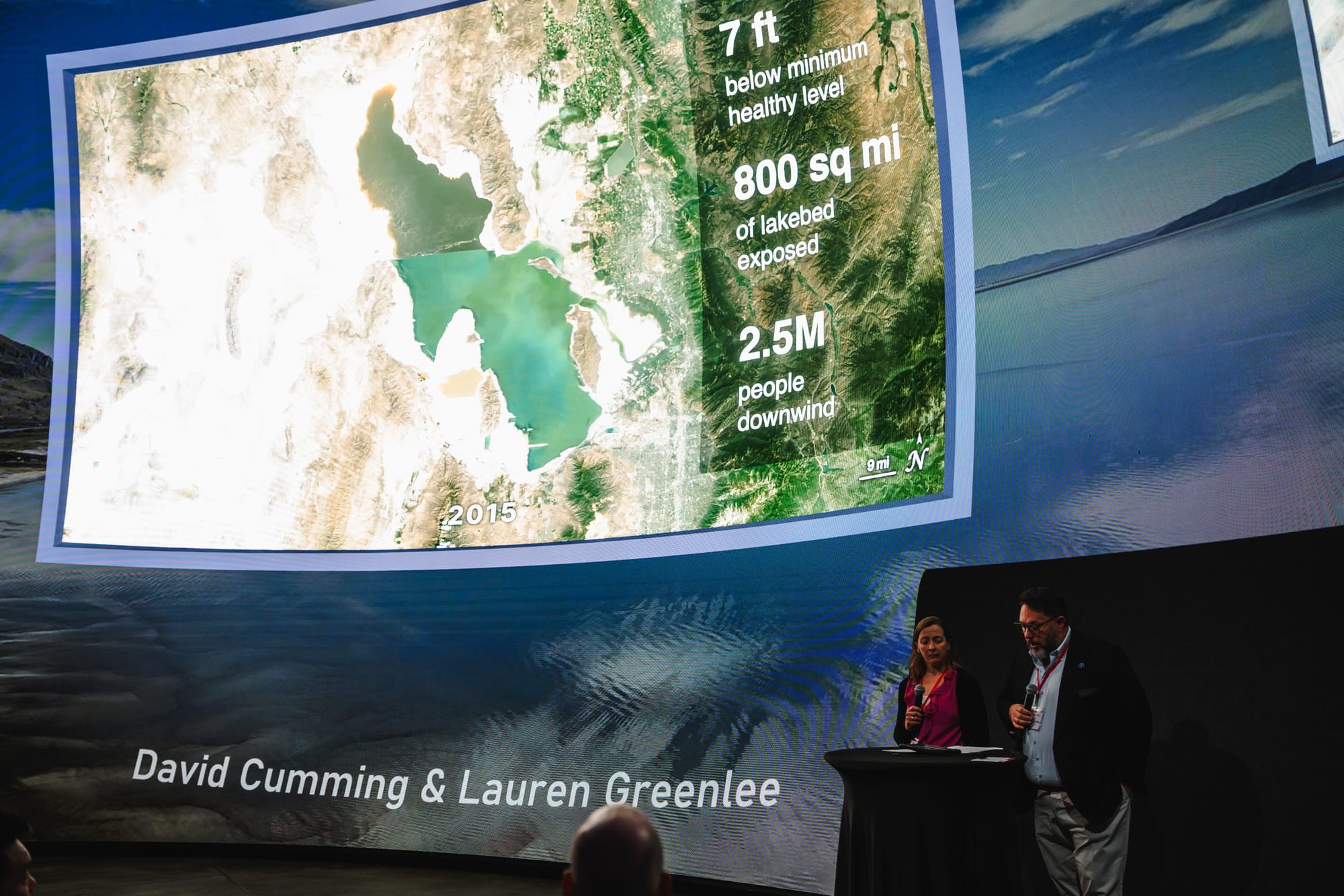
The lake is roughly seven feet below its healthy minimum level, Cumming said, exposing nearly 800 square miles of playa that can generate dust affecting an estimated 2.5 million people along the Wasatch Front.
David Cumming (right) of the Great Salt Lake Alliance and Cumming Foundation and Lauren Greenlee of XPRIZE laying out the Terminal Lakes XPRIZE concept aimed at restoring the Great Salt Lake. Photo: Austen Diamond Photo + Film
He compared the Great Salt Lake to other terminal-lake crises, including the Aral Sea and Iran's Lake Urmia. He also pointed to California's Owens Lake, where Los Angeles has spent more than $2.5 billion on dust mitigation without restoring the lake itself.
"We've made decisions. Communities, ecosystems, societies have made decisions, but that means we can make other decisions," Cumming said.
He described a framework built around what he called "three drops of water": capturing efficiency savings and returning them to streams, improving the tracking of conserved water so it actually reaches the lake, and developing entirely new sources through technology or policy.
Lauren Greenlee and David Cumming at Cosm presenting the Terminal Lakes XPRIZE concept. Photo: Austen Diamond Photo + Film
"The missing water from the Great Salt Lake is seen as a tremendous weakness to the widely accepted goals for beneficial growth in the state of Utah," Cumming said. "But working on restoring this turns that weakness into a strength."
XPRIZE Executive Vice President of Food + Water + Waste Lauren Greenlee then described early-stage discussions about a potential Terminal Lakes XPRIZE modeled in part on XPRIZE's ongoing Water Scarcity competition.
"Getting water back to the Great Salt Lake is fundamentally the kind of complex problem that the X Prize model is built to serve," Greenlee said. "We are in the early stages of developing direction for a Terminal Lakes XPRIZE. We invite all of you to join us."
That distinction is important.
A Great Salt Lake XPRIZE would not simply fund another study of the lake. The objective would be to define an ambitious, measurable outcome and create an incentive for innovators to find ways to achieve it.
That is essentially the experiment that began with SpaceShipOne.
Lindsie Smith, Executive Director of Love the Lake — the Great Salt Lake Alliance's public engagement initiative — mingles with attendees during the pre-event reception ahead of the Cosm/XPRIZE innovation showcase. Photo: Austen Diamond Photo + Film
Utah's Critical-Minerals Opportunity
Water was not the only Utah problem being considered for an XPRIZE-style approach.
Michael Free, professor of metallurgical engineering and director of the University of Utah's newly approved Institute for Critical and Strategic Minerals, described the state's opportunity to play a larger role in the domestic critical-minerals supply chain.
Michael Free, professor of metallurgical engineering and director of the University of Utah's Institute for Critical and Strategic Minerals, addresses attendees at Cosm's dome. Photo: Austen Diamond Photo + Film
Free said University of Utah research groups have attracted roughly $20 million in critical-minerals funding over the past six years. He argued that the strategic challenge extends beyond mining: China and Canada occupy dominant positions in portions of the global supply chain, particularly in mining, processing and downstream manufacturing of rare-earth elements.
"It's not about the money necessarily of the actual products," Free said. "It's the criticality. It's the strategic value of these in making the things that we really need today."
Utah's geology gives the state an unusual starting point.
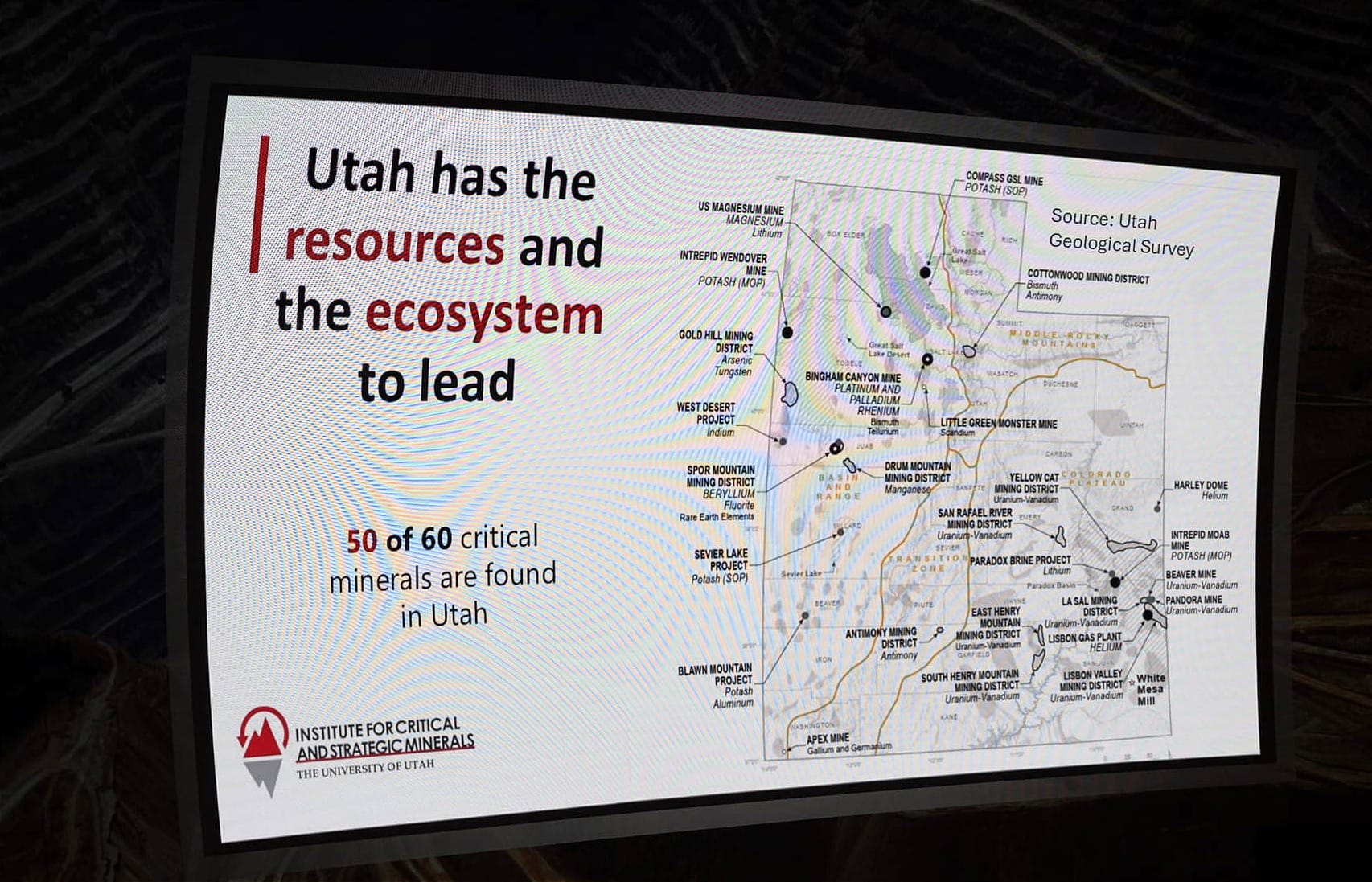
A presentation slide from Free's newly established Institute for Critical and Strategic Minerals, citing the Utah Geological Survey, showed 50 of the 60 critical minerals on the federal 2025 list occurring in Utah.
A slide from Michael Free's presentation shows the breadth of Utah's critical-minerals deposits, from the Bingham Canyon Mine's platinum, palladium, and rhenium to the Apex Mine's gallium and germanium. 50 of the 60 minerals on the federal critical minerals list are found somewhere in the state, according to Utah Geological Survey data cited by the University of Utah's new Institute for Critical and Strategic Minerals. Photo: Mark Tullis, TechBuzz
The Utah Geological Survey has since published the more precise formulation that "Utah hosts 50 of the 60 critical minerals on the 2025 list." UGS also distinguishes between minerals that are currently mined and processed, those with known resources or recent production, historical producers and minerals that occur at lower levels of enrichment with limited development potential.
That distinction matters: The figure does not mean Utah currently has economically viable mines for 50 critical minerals.
But it does illustrate the breadth of the state's geological resource base.
The sites represented on Free's presentation included the Bingham Canyon Mine, with platinum, palladium and rhenium; the Spor Mountain Mining District, with beryllium and rare earth elements; the US Magnesium Mine, with magnesium and lithium; and the Apex Mine, with gallium and germanium.
The Utah System of Higher Education approved the Institute for Critical and Strategic Minerals in the Spring of 2026. Free said the institute will address the entire value chain, from geological discovery and extraction through metallurgical separation, manufacturing and recycling, and will work with industry partners including Rio Tinto.
XPRIZE is looking at the same problem from a different direction.
Tauhert said XPRIZE has been developing a critical-minerals competition with Amazon since mid-2025. The competition is currently focused on what he called "feedstock intelligence" — creating the data infrastructure needed to identify where circularity and recovery technologies could be deployed across the supply chain.
The potential convergence is significant: Utah has the resources, the university research infrastructure and an emerging institute dedicated to critical minerals. XPRIZE brings a mechanism for attracting innovators from outside the traditional research and mining ecosystem.
The Prize Model Moves Into Health and Climate
The Utah event also demonstrated that XPRIZE's model is not limited to problems with obvious engineering solutions.
The Wilkes Climate Innovation Prize is now in its fourth cycle, with nine finalists competing for $250,000 in non-dilutive funding, organized across three categories:
Food, Agriculture & Land: Agros (solar irrigation and soil), Fabumin (food-waste protein), uCrop.it (ag fintech and traceability)
Industry & Energy: Gyre Energy (AI-driven thermal storage), Solidec (on-site clean chemicals), SolidSky (cleaner ethylene)
Buildings & Materials: UnBoxed (3D-printed passive housing), WAS Company (waste-to-construction), WoodSyn (fire-resistant timber panels)
A winner of the Wilkes Climate Innovation Prize will be announced September 23 in New York during Climate Week, with a simulcast watch party planned on the University of Utah campus.
Fielding Norton, managing director of the University of Utah's Wilkes Center for Climate Science & Policy, describing the Wilkes Climate Innovation Prize, said, "a prize can focus attention, draw talented people into the arena, and make an audacious outcome possible."
Fielding Norton, Managing Director of the Wilkes Center for Climate Science & Policy, outlined how the Wilkes Climate Innovation Prize turns early-stage ideas into real-world traction. Photo: Austen Diamond Photo + Film
He added that the prize itself is only the beginning. "I like to think of what we're doing as the spark plug, but we're really building an innovation engine that will be powered by, or sparked by, the prize."
He described a cycle in which credibility creates connections, connections open pathways to capital and pilot projects, pilots generate evidence, and evidence creates credibility that can lead to adoption and scale.
The same philosophy is behind XPRIZE's $101 million Healthspan competition, which seeks breakthroughs capable of restoring muscle, cognitive and immune function in aging people. The competition represents how far XPRIZE has expanded from its original spaceflight challenge: from a $10 million prize designed to put three people into space to a $101 million competition aimed at extending healthy human function by decades.
For the University of Utah, Healthspan is particularly relevant because the university is already participating in the competition and has positioned itself as a partner in XPRIZE's broader effort to connect research with commercialization.
Kelvyn Cullimore, President and CEO of BioUtah, mingles with attendees during the pre-event reception in Cosm's lobby ahead of the XPRIZE/University of Utah innovation showcase. Photo: Austen Diamond Photo + Film
Research With a Mission
The event also highlighted the university's Applied Medical & Engineering Lab, which is designed to connect researchers across disciplines with government and industry priorities.
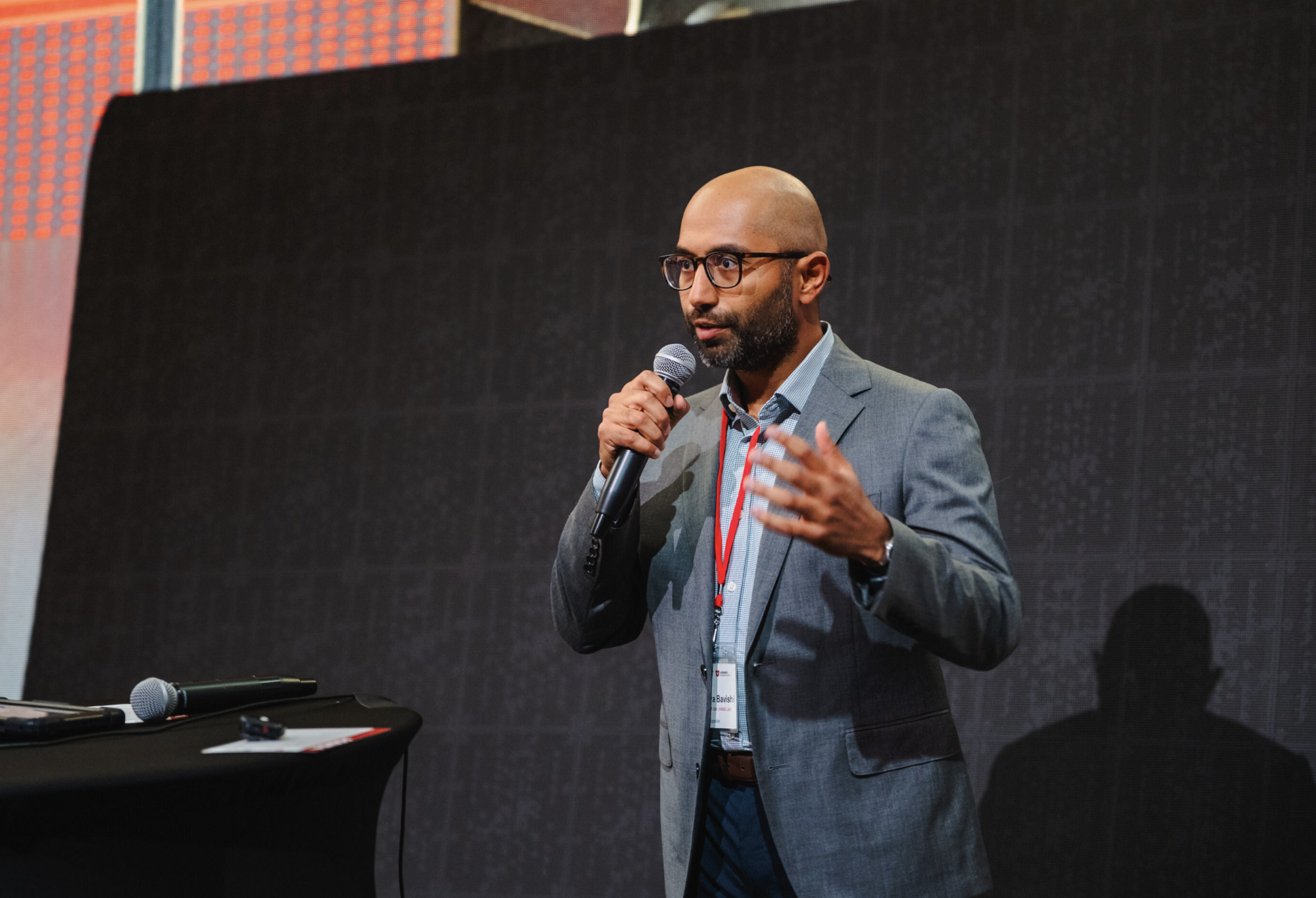
Parshva Bavishi, Associate Director of the AM&E Lab, emphasized that breakthrough research increasingly requires collaboration across disciplines.
Parshva Bavishi, Associate Director of the University of Utah's AM&E Lab, presents the lab's mission: turning applied research into field-ready solutions for the U.S. Department of War. Photo: Austen Diamond Photo + Film
"We feel that the best research and development ideas don't just come from one discipline; it's a combination," Bavishi said.
The lab, which operates under Rothwell's research organization, aligns university research with federal critical-technology priorities, including artificial intelligence, biomanufacturing, contested logistics, quantum and battlefield information dominance, directed energy and hypersonics.
The common thread among these programs is similar to the XPRIZE philosophy: identify a significant problem, bring together people with different capabilities and create mechanisms that move promising ideas beyond the laboratory.
A Fitting Place to Talk About Innovation
The venue itself provided a reminder that Utah has been part of this story before.
The event began with a tour of Cosm, led by Julie Chassé, the company's director of strategic partnerships. A presentation across Cosm's massive immersive dome traced the technology's roots to the University of Utah's early leadership in computer graphics.
Julie Chassé, Cosm's director of strategic partnerships, walks attendees through the storied history of company's Research Park dome and its decades-long technology foundation. Photo: Austen Diamond Photo + Film
Ivan Sutherland created Sketchpad, widely regarded as the first graphical user interface, in 1963. Around 1968 he developed the world's first VR headset, nicknamed the "Sword of Damocles," and co-founded Evans & Sutherland with Dave Evans in Salt Lake City.
The technology eventually evolved through Evans & Sutherland's planetarium business, Digistar, and the companies that ultimately became Cosm. As previously reported, Cosm combines immersive LED dome technology with real-time rendering and immersive, multi-channel live sports production.
Attendees relax in Cosm's dome-side lounge seating, watching Tokyo 2020 Olympics basketball, golf, and swimming coverage rendered across the venue's wraparound displays — the kind of live-sports "watch party" format the company has used to fill its Salt Lake City dome. Photo: Austen Diamond Photo + Film
Chassé described the company's mission as "the suspension of disbelief — when the technology disappears and you're left in an experience versus looking at an experience."
The setting was an appropriate one for an event about technological moonshots.
The University of Utah has a history of producing technologies and companies that once appeared improbable. XPRIZE's argument is that the state can deliberately create more environments in which improbable ideas have a reason to be attempted.
Attendees on Cosm's second-floor balcony take in a real-time "tour of the universe," rendered across the dome's more than 8,000 LED modules using the company's Digistar software. Photo: Mark Tullis, TechBuzz
Can Utah Build Its Own Innovation Flywheel?
That may ultimately be the larger opportunity presented at Utah Innovation Frontiers.
XPRIZE does not simply bring a check to a problem. Its model attempts to create a market around an outcome — attracting competitors, researchers, investors, corporate partners, customers and government agencies around a shared objective.
The Ansari XPRIZE demonstrated the leverage of that model. A $10 million prize attracted 26 teams that collectively invested more than $100 million in R&D. The winning technology helped launch Virgin Galactic and contributed to the emergence of an entirely new commercial space industry.
Now Utah is considering whether similar mechanisms could be applied to problems that are more local but no less difficult.
Can technology help restore the Great Salt Lake?
Can Utah convert its unusual concentration of critical-mineral resources into a stronger domestic supply chain?
Can university research be moved more quickly from laboratories into commercial applications?
Can incentive competitions attract innovators who otherwise would never have considered Utah's problems?
Those questions remain unanswered.
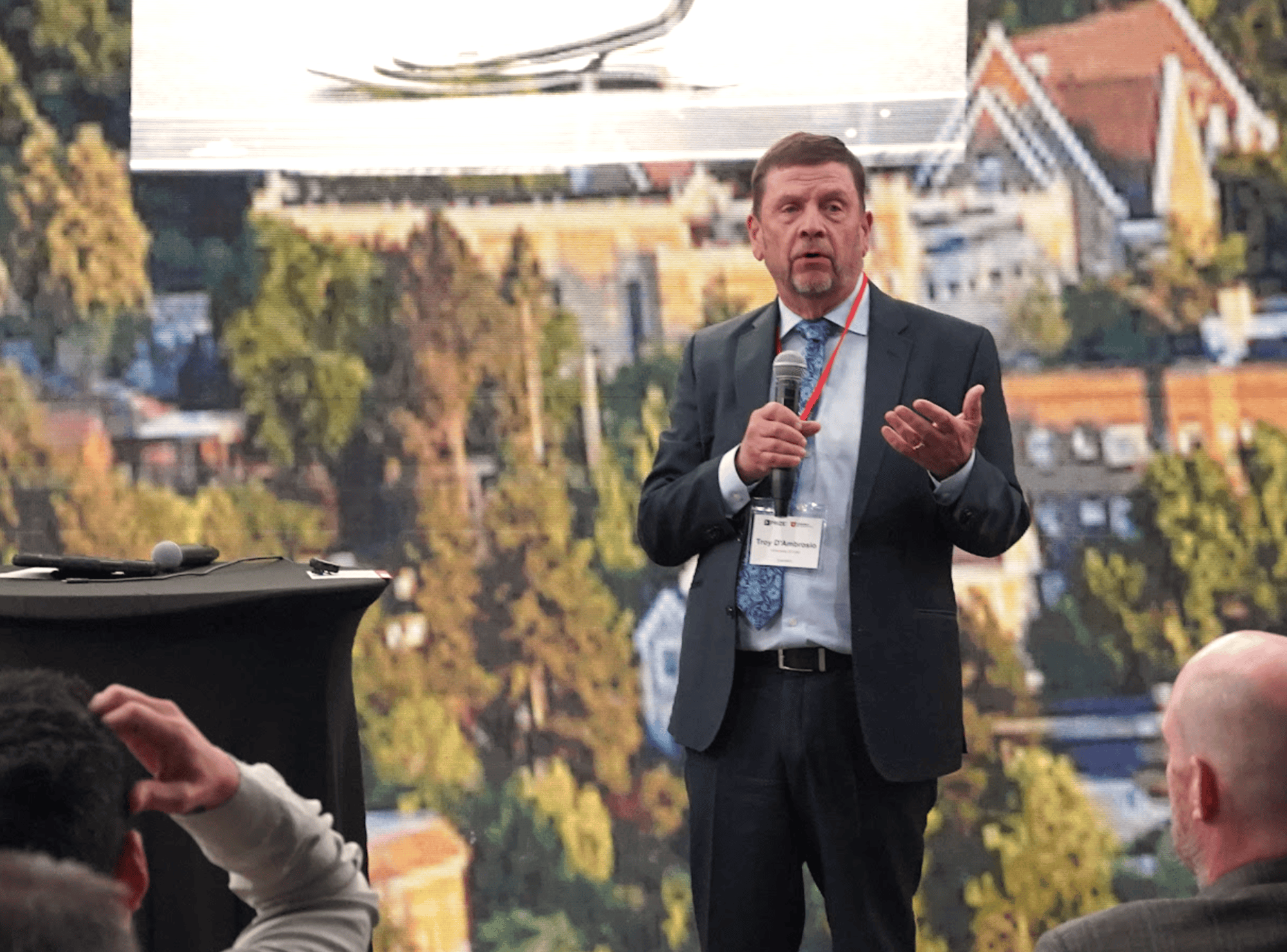
Troy D'Ambrosio, chief of staff and vice president for innovation in the University of Utah President's Office, offered perhaps the clearest explanation of why the university is interested in the model.
Troy D'Ambrosio, Chief of Staff and Vice President for Innovation in the University of Utah President's Office, closes out the Cosm/XPRIZE event, speaking on the collaboration required to tackle large-scale challenges. Photo: Mark Tullis, TechBuzz
"What I think the brilliance of the X Prize is, is that they bring those groups together and educate people on the importance of the challenges there," he said.
That may be the real opportunity for Utah.
The state does not lack difficult problems, research talent or entrepreneurial ambition. The challenge is bringing those pieces together around outcomes ambitious enough to attract people who otherwise would never enter the arena.
XPRIZE has spent three decades trying to prove that a clearly defined goal, an audacious target and a meaningful incentive can do exactly that.
Utah now appears interested in seeing what happens when the same formula is applied at home.