iHub Graduation: Eight Companies Building Their Way Out
iHub's Innovation Forge graduated eight startups at a Provo luncheon featuring a keynote from Vivint founder Todd Pedersen, whose near-death experience sharpened a blunt message: build revenue or die.
A graduation ceremony, a near-death survivor's keynote, an AI-powered dirty soda operation, and eight companies that built their way out of the room. iHub's latest graduating class made the case that Provo's startup scene is more serious than most people realize.
PROVO, Utah — May 29, 2026
The luncheon was underway, a keynote was in progress, and eight companies were being celebrated for outgrowing their home. But out in the parking lot, founders were still on their phones. Inside, others were on Zoom. In the commercial kitchen, Brigham Shellenberg had already produced 15,000 units that morning and was planning 3,000 more before he left.
Nobody told him to stop. That is the culture iHub was built around.
Last Thursday, the Innovation Hub of Utah held a graduation luncheon honoring eight startup companies that have outgrown the 50,000-square-foot incubator on Freedom Boulevard in Provo. The event, marked by remarks from industry veterans and a keynote from one of Utah's most recognized entrepreneurs, was one of the clearest signs yet of what the two-year-old nonprofit has become: a place where companies don't just survive their early years. They outgrow the room.
What iHub Is
iHub was founded in April 2024 by Corbin Church, a BYU Marriott School of Business adjunct professor and serial entrepreneur, who located it near BYU and UVU campuses intentionally — because, as he puts it, "Utah County breeds entrepreneurship."
In under two years, the organization has supported more than 491 founders, helped launch more than 300 companies, and seen its members collectively raise over $25 million. It charges no monthly dues, operating as a 501(c)(3) nonprofit, and draws on a mentor network of more than 350 industry veterans.
Its core program, the Innovation Forge, moves founders through three defined stages. Blueprint — eight to sixteen weeks — is for validating an idea and landing first customers. Foundation, running four to ten months, focuses on repeatable revenue and unit economics. Elevation takes companies to $1 million in annual recurring revenue and positions them to raise outside capital. Each stage has dedicated mentors and defined milestones. Founders always know what they are supposed to be building next.
What separates iHub from most incubators is what it looks like inside. Beyond coworking desks and meeting rooms, the facility houses a fully licensed commercial kitchen for food and beverage startups, a maker space equipped with 3D printers and rapid prototyping tools, and warehouse space with a loading dock — resources that would otherwise require separate leases and months of overhead before a company ships its first product.
"Before iHub, I spent over a year trying to figure it out alone. Since joining, everything's changed," said Nic Blosil, a BYU graduate and founding partner of Dental Property Group, a Utah-based real estate company serving dental support organizations.
Thursday's graduation was opened by Spencer Rogers, iHub's co-director, who welcomed attendees before introducing the day's keynote speaker, Todd Pedersen. TechBuzz was also greeted with a walkthrough of the facility: the maker space, the commercial kitchen, the warehouse floor.
Spencer Rogers, co-director of the Innovation Hub of Utah, opens the iHub Founder Graduation luncheon on May 21, 2026, at iHub's 50,000-square-foot facility on Freedom Boulevard in Provo.
Todd Pedersen: Build Revenue or Die
Todd Pedersen needs little introduction in Utah business circles. He built Vivint from a pest-control operation running out of a single-wide trailer in 1992 into one of the largest residential security and home automation companies in North America. Fast Company named Vivint one of the World's 50 Most Innovative Companies. In 2012, Blackstone Group acquired the company for more than $2 billion, the largest tech buyout in Utah history at the time. Pedersen was honored as Ernst & Young Entrepreneur of the Year in 2010, named Utah's Entrepreneur of the Year by the Mountain West Capital Network in 2013, and later inducted into the David Eccles School of Business Hall of Fame.
On Thursday, he spoke off the cuff, and with the weight of someone recently reminded how little time there is to waste. His remarks opened with something unexpected: a recent near-death experience that had returned him with a sharpened sense of what matters. What followed was thirty years of hard-won perspective delivered without slides, without notes, and without hedging.
On the most common trap founders fall into, Pedersen did not soften his words:
"The biggest pitfall that you can fall into in starting a company is raising money. Without revenue, you're dead. It is usually a death nail... You have money in the bank, and it alleviates that stress and that pressure to create. That's the most important ingredient in a business. Never ever take your hands off of creating revenue, ever."
On what it actually takes to lead a company through its early years:
"You need to know how to do every single role inside of your company, and do it as long as you can. If you want to truly succeed, you need to be everything, and the things that you're not capable of, or you don't have, from a skill set perspective, or personality, you need to work on it and develop it."
And on the standard a company has to hold itself to:
"You must have revenue, you must have margin, you must have product differentiation, you must deliver a great service, and by the way, you must treat others around you with not just respect, but priority in helping them learn and grow and gain confidence and skills."
The room was quiet for most of it. These were founders who had heard plenty of motivational language. This was something different: a man who built a $2 billion company from a trailer, nearly died, and came back with a clear opinion about what matters. They listened accordingly.
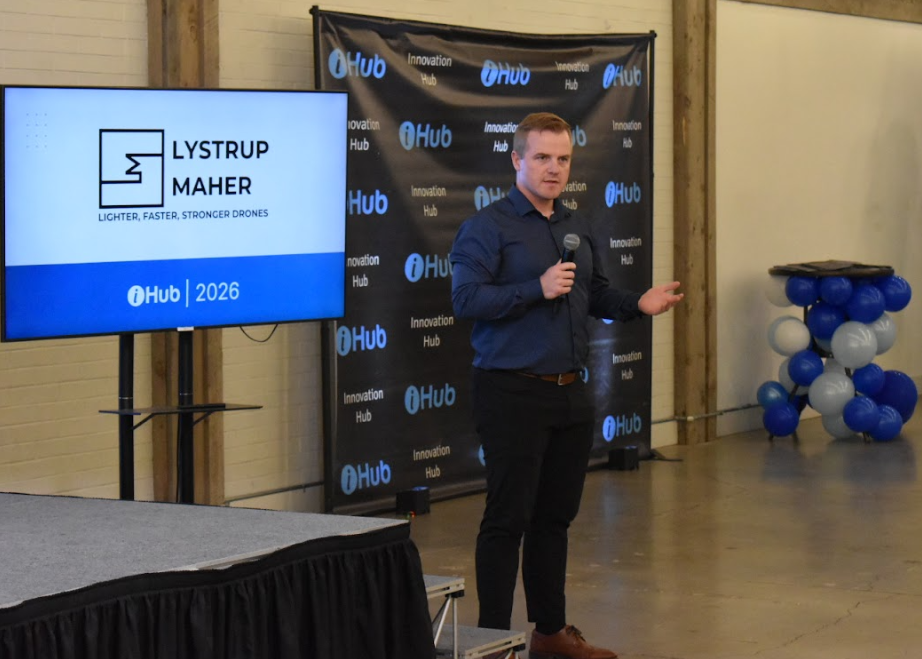
Caleb Lystrup, Founder and CEO, Lystrup Maher
The Mentors in the Room
The mentors present Thursday were not there as figureheads. Most have built and exited companies of their own, and they mentor at iHub because Utah has a specific culture around giving that experience back.
"We've got this mentality in Utah of serving that doesn't exist elsewhere," Church has said. "I'm capitalizing on students who are accustomed to serving their neighbor and tapping into their entrepreneurial spirit."
Clint Argyle is a prime example. A serial entrepreneur, Argyle's first venture took him from food service into garbage collection with a company called Country Garbage. He sold it, reinvested the proceeds, and founded Keystone Learning Systems, a software training company that grew from two partners to 85 employees and into a multimillion-dollar enterprise. He now mentors iHub founders on go-to-market strategy, competitive positioning, and the decisions that tend to determine whether a growing startup stalls or scales.
The Building Never Stopped
While the ceremony unfolded in the main event space, the rest of the building was still running.
Founders were on Zoom. Others were in the parking lot working through deals. In the commercial kitchen, Brigham Shellenberg was deep into a production run that had started well before the first plate was set.
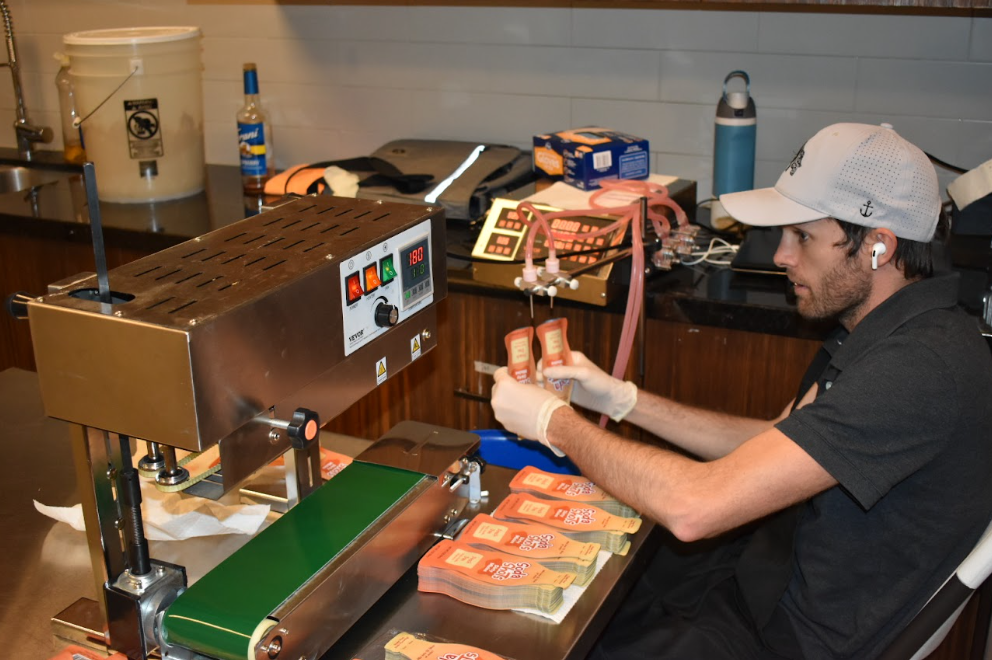
Brigham Shellenberg running a SodaShots production line in iHub's commercial kitchen during the May 21 graduation luncheon — having already produced 15,000 units that day with 3,000 more to go before calling it a night.
Brigham was there on behalf of his brother Bryson Shellenberg, the founder of SodaShots, a premade dirty soda product in squeezable, single-serving form. Bryson engineered a device powered by artificial intelligence that measures ingredients to one one-thousandth of a gram, giving each shot a level of consistency that manual production cannot match. By the time Pedersen took the stage, Brigham had already produced 15,000 units. He was planning 3,000 more before leaving.
The commercial kitchen is one of several maker spaces inside iHub that founders can access without a separate lease. SodaShots is one of the clearest illustrations of what that space makes possible, and on Thursday, it was also a fitting symbol of what iHub is. A graduation was happening in one room. A company was scaling in another. The building does not slow down for ceremony.
A Graduate: Ryan Ward and Outifi
Among the eight companies recognized Thursday was Outifi, founded and led by Ryan Ward and Joel Eves.
Todd Pedersen (left), Outifi co-founders, Ryan Ward (CEO) and Joel Eves, and iHub co-director, Spencer Rogers present the graduation banner to the Outifi team during the iHub Founder Graduation luncheon on May 21, 2026, in Provo, Utah
Outifi operates on a crowdfunding model designed for small municipalities, a category historically underserved by the technology sector. When a broad enough group of residents opts in and shares relevant data, the platform can identify infrastructure problems with a precision that traditional methods cannot reach. Ward and his team used the model to pinpoint an error and locate a blown fuse within a brief timeframe.
Ward's company is representative of what iHub has quietly been producing, not consumer apps or social platforms, but solutions to genuine, unglamorous problems that affect real communities.
Eight Companies That Built Their Way Out
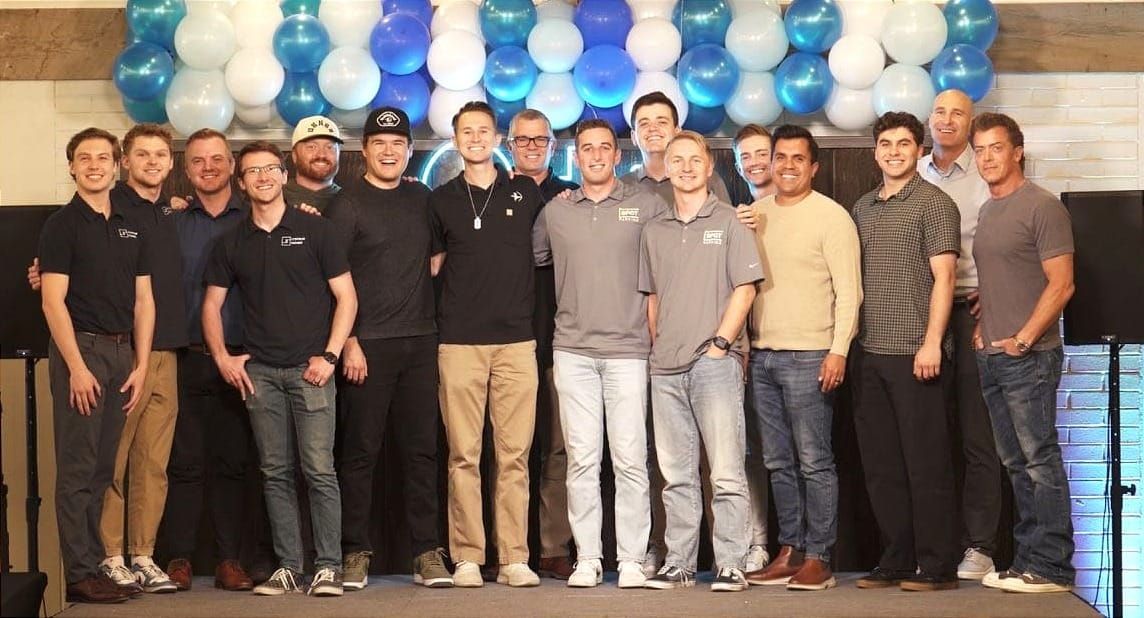
Vamo, Bin Blasters, Monovo, Spot Parking, Tarifflo, Robinhood Roofing, Outifi, and Lystrup Mayer were recognized as the latest graduating class of iHub's Innovation Forge. Each entered the program at its earliest stage. Each built its way out of the space.
Church has described the founders who come through iHub as people with a work ethic and a willingness to face rejection that most people their age would not endure: "overcoming very difficult things that most young adults their age would curl up and cry over."
Thursday's graduates were the proof of that.
The seats they leave behind will not stay empty for long. iHub reviews applications within 48 hours. No pitch deck is required to apply. The next class is already filling the Founders Floor, already on the phone in the parking lot, already in the commercial kitchen with work left to do.
The building never really stops.
The iHub graduation luncheon was held Thursday, May 21, 2026, at the Innovation Hub of Utah, 50,000 sq ft on Freedom Boulevard in Provo. Founders interested in applying can visit ihubutah.org.
Share this article
The link has been copied!
Your link has expired. Please request a new one.
Your link has expired. Please request a new one.
Your link has expired. Please request a new one.
Great! You've successfully signed up.
Great! You've successfully signed up.
Welcome back! You've successfully signed in.
Success! You now have access to additional content.