UVU Students Beat Khan Academy to the Question — Now They're Racing to Stay Ahead of the Answer
Utah Valley University students developed an AI-driven framework urging universities to replace lectures with AI tutoring and prioritize mentorship, collaboration, and human connection as higher education faces accelerating disruption.
In April 2026, Khan Academy founder Sal Khan announced the Khan TED Institute — a joint venture with TED and testing giant ETS, backed by Google, Microsoft, McKinsey, Bain, and Accenture — offering a Bachelor's in Applied AI for under $10,000, with a launch window of 12 to 24 months. The institute describes its target student plainly: "Anyone who wants access to a rigorous, career-relevant undergraduate education at a low cost — aspiring knowledge workers who want to work in technology, consulting, finance, product management, or any AI-powered generalist role."
"Iconic AI prophecy books such as The Coming Wave have been talking about this for years. We just didn’t know exactly when it would come to pass. This new price tag of a $10,000 bachelor degree will likely span the entire range of academic degree programs," said Tyler Small, the Senior Director of the Kahlert Applied AI Institute.
Tyler Small, the Senior Director of the Kahlert Applied AI Institute
The announcement from Khan Academy moved their timeline up to 2026.
"Our original pitch was: what does higher education look like in 2035," said Tyson Smith, a Utah Valley University (UVU) entrepreneurship student and one of the class's core contributors. "Now we're asking what it looks like in 2027."
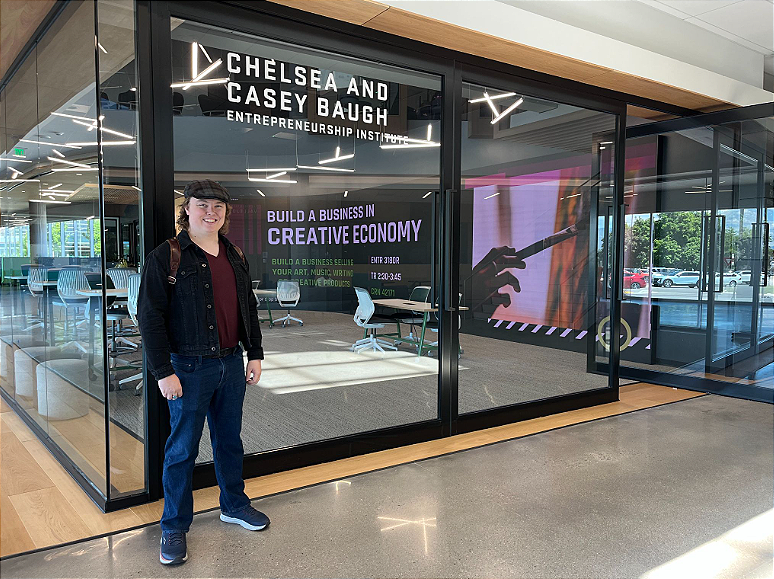
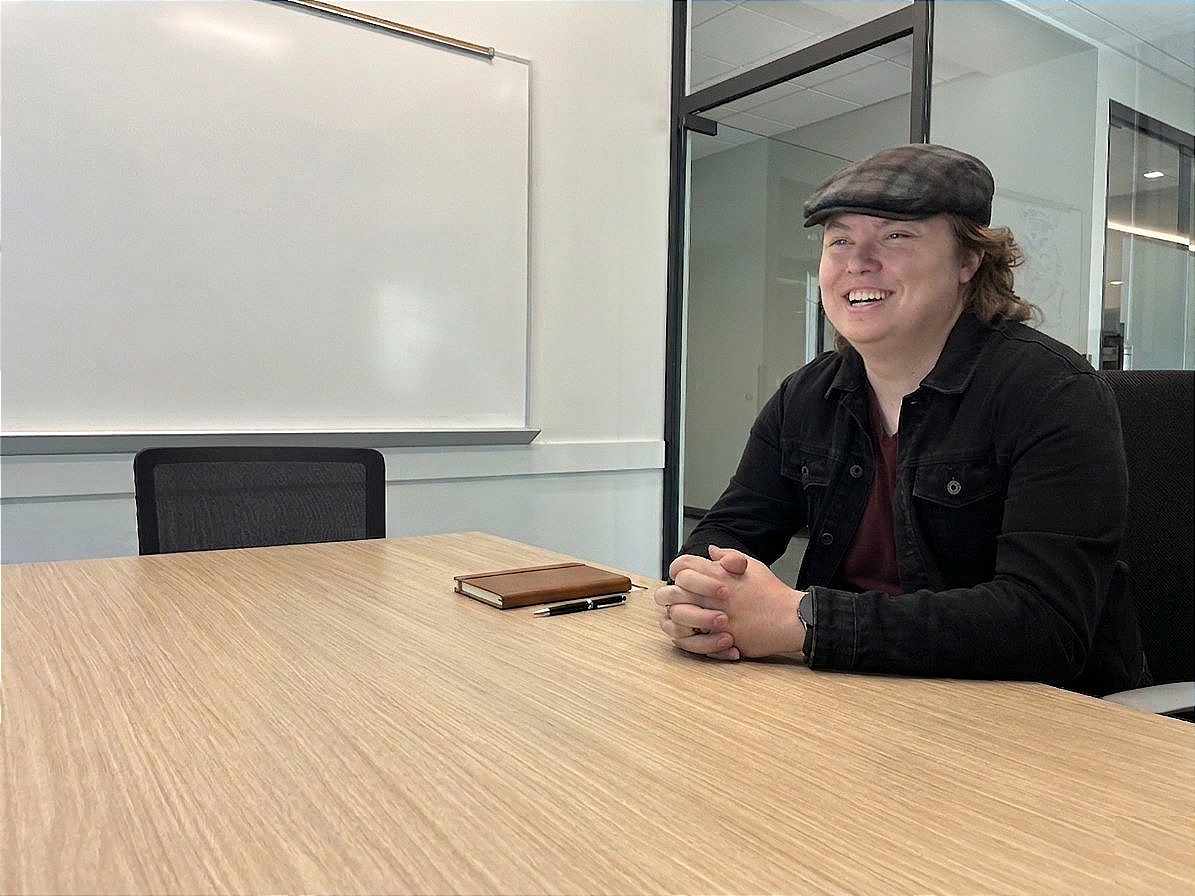
Tyson Smith, a student and entrepreneur studying at UVU. Smith is the co-founder of Hobby Goblin Games, a company built around enhancing Dungeons and Dragons gameplay for both players and dungeon masters. Photo: Mason Butler, Kahlert Applied AI Institute, UVU
Why it matters
Higher education is a trillion-dollar industry facing a structural challenge it has not yet fully named. More than 42 million Americans carry federal student loan debt, with the average borrower owing nearly $40,000. The unemployment rate for recent college graduates sits at 5.6 percent, and 42.5 percent are working jobs that don't require their degree. In a recent Indeed survey, just over half of Gen Z graduates said they regret going to college.
The Baugh Entrepreneurship Building at Utah Valley University. Photo: Mason Butler
The mechanism at the center of that dissatisfaction — the lecture — was already losing before Khan made his announcement.
A2014 study published in Science found that undergraduate students in traditional lecture courses are1.5 times more likely to fail than peers in active learning classrooms. Asubsequent Harvard study found students in small-group active learning scored 10 percentage points higher on tests than lecture peers, despite rating lectures as more engaging.
Then, in arandomized controlled trial published in Scientific Reports in 2025, Harvard researchers found students using an AI tutor achieved more than double the learning gains of peers in active learning classrooms — and did so in less time. "Students learn significantly more in less time when using the AI tutor, compared with the in-class active learning," the authors wrote. "They also feel more engaged and more motivated."
"The lecture format is 100% replaceable by AI," Smith said. "The interpersonal connection is what we really need to focus on."
"Way back in 1984, experiments by Benjamin S. Bloom showed that lecturing was far inferior to one-on-one tutoring. In fact, he showed that students who learned from one-on-one tutoring performed two standard deviations higher than students who were lectured to. However, at the time, this wasn’t seen as a solution because it wasn’t economical to have every student tutored. So, they called it The 2 Sigma Problem. Now, AI is helping us solve it. Economic one-on-one tutoring has been the holy grail of instructional strategy for over 40 years," Small said.
The Khan TED Institute announcement did not create the problem. It put a name, a price tag, and a deadline on one that was already arriving.
The class
Seth Jenson, Sr. Director of UVU's Baugh Entrepreneurship Institute, runs a course officially catalogued as New Venture Consulting, ENTR 4455. Students know it by the name Jenson gave it at the semester's outset: the ‘Mission Impossible’ class.
"It's been one part PhD seminar, one part startup, and one part Bain Consulting project," Jenson said.
The premise is deliberately unusual. There is no textbook problem set, no professor-assigned case study. The class identifies a real problem in the community, collectively decides how to address it, and goes to work. Jenson functions less as an instructor and more as a connector, linking students to the resources, mentors, and audiences their work needs to reach.
"This isn't like an ordinary class," Jenson said. "This is the type of thing where the homework isn't graded, but you have to come prepared. Otherwise we can't move this project forward. It's much more a work environment where we're relying on each other to move it forward."
This was the first time the class was deployed. "It was totally an experimental class," Jenson said. "We weren't really sure how it was going to go, but we were really pleased with how it turned out. The goal was: let’s learn entrepreneurship and networking and that whole entrepreneurial skillset. We help people build real businesses.That’s always been our ethos. You could think of it as the ultimate group project."
"The goals are to develop deep expertise in a short period of time and then deploy that expertise in doing something real in the world," he said.
At HITLAB's recent World Cup and Hackathon at UVU, Jenson spoke about what sets the university apart for innovators.
"UVU has a unique drive and mission to have students have real outcomes," Jenson said. "It's not just about learning how to do it. It's about building real things that have value in the marketplace."
The cohort that chose to tackle AI in higher education spanned freshman to senior, with backgrounds ranging from marketing to political science to theater and creative writing. No shared major, no shared prerequisite.
"If there was one connective tissue between everyone," Smith said, "I think we were all ambitious in some way."
The skeptic
Tyson Smith runs a tabletop gaming business and hand-pours custom dice — specialty products he nearly sold out within two hours at a 1,400-person convention event. He works closely with artists and entry-level programmers, communities that have absorbed AI's first wave of displacement directly. He did not walk into ENTR 4455 as a believer.
Hand-poured custom dice that Smith creates and sells at conventions. Smith originally started a kickstarter for his business, then learned to make income through the Creative Economy Class hosted at UVU. Photo: Mason Butler, Kahlert Applied AI Institute, UVU
"I went into this class with a very negative view of AI," Smith said. "I work with a lot of artists, a lot of entry-level programmers — a lot of people who have been very disenfranchised by AI. In my own business, one of our core tenets is we don't use AI for any of our products."
What shifted was not a single argument but a semester of research and structured disagreement. The class's range of perspectives — some students used AI for everything, others had barely engaged with it — forced the framework to account for its most skeptical users. That range, Smith argued, made the final product more honest.
"As I learned a lot more, learned why AI is being used the way it is, it shifted and evolved that opinion," he said. "But that opinion was my opinion going into it. And I think that really did help a lot with informing how we can build something that will appeal to a lot of different people."
The proof of concept
Before the class built its framework, they studied the most concrete example of the model it was proposing. Alpha School is a high-end K–12 program where students spend roughly two hours daily working one-on-one with an AI tutor to master core academic content, then spend the rest of the school day on self-directed projects — writing musicals, building software, pursuing whatever they are drawn to. Early results suggest those two AI-powered hours put Alpha students academically ahead of peers in traditional public schools.
It is the existence proof for the class's central argument: AI can deliver content better than a lecture hall. So the lecture hall has to become something else.
Sal Khan, whose own writing anticipated the shift, described the mechanism in Brave New Words: How AI Will Revolutionize Education (and Why That's a Good Thing): Khan illustrates how AI can personalize learning by adapting to each student's individual pace and style, identifying strengths and areas for improvement, and offering tailored support and feedback to complement traditional classroom instruction.
Smith put the same idea in starker terms.
"You can't compete with an AI tutor that you can talk to till 3 a.m. about something super niche that knows you personally," he said. "Interpersonal connections are something it can't compete with us on. So that's where we need to focus a lot of our efforts."
The framework
The class's answer is a flipped classroom model. AI handles content delivery. Campus time is reserved for the human experiences AI cannot replicate — mentorship, peer connection, industry relationships, the face-to-face moments that justify the cost of showing up.
"AI isn't going to break higher education," Jenson stated. "It's going to hold it to account to how it's already broken."
"At any given university at any given time, there's a 90% chance that in the classroom, there's a professor with slides at the front talking through slides," Jenson said. "Now we've known for a long time that this is not the most effective way for learning."
For UVU specifically, as an open-enrollment commuter school, the argument carries particular weight. Its prospective students are already weighing a real alternative.
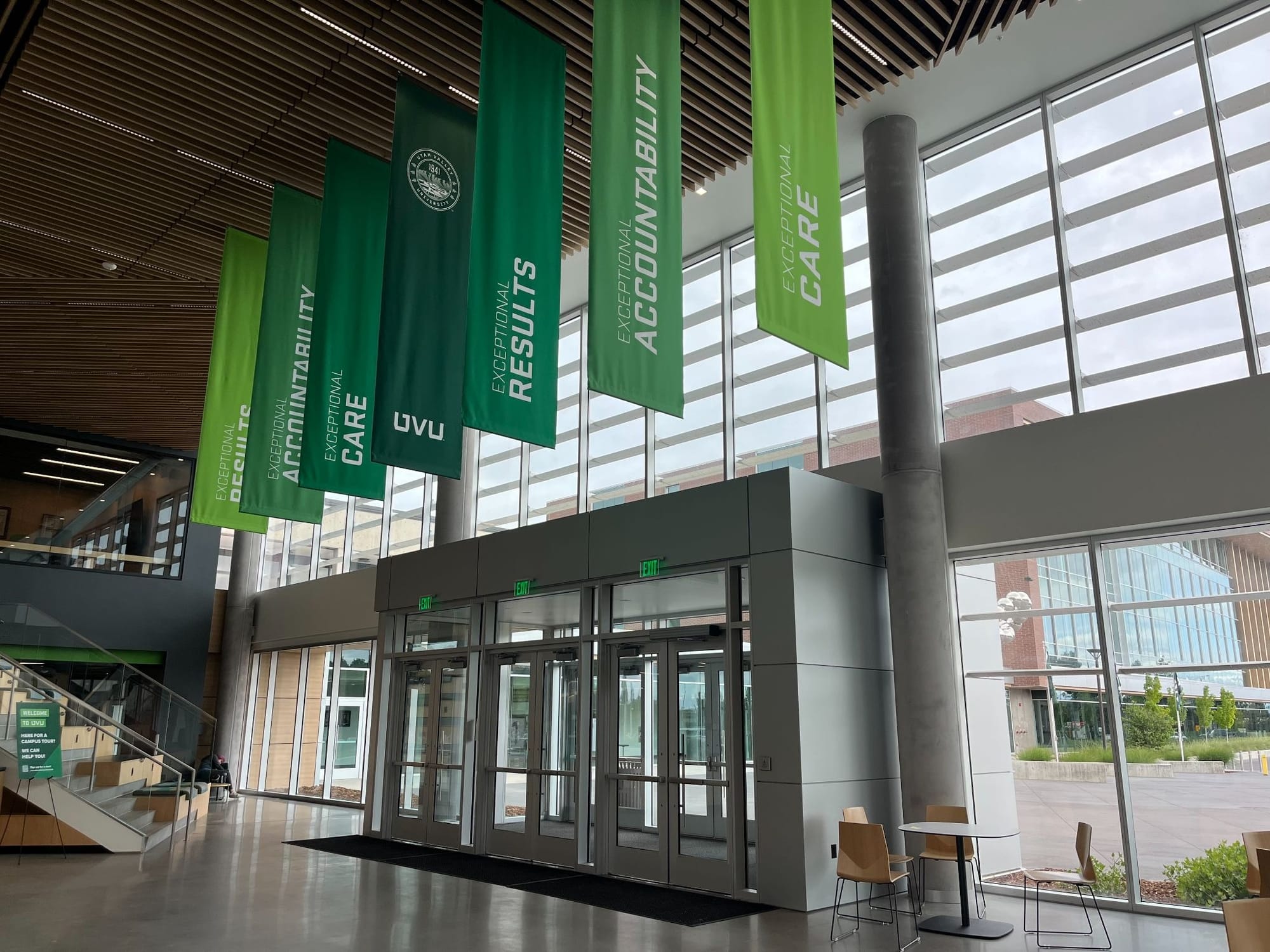
Utah Valley University’s front entrance through the Fugal Gateway, named after Utah business leader and UVU alumnus Brandon Fugal. Photo: Mason Butler, Kahlert Applied AI Institute, UVU
"Let's use AI to make it easier to transition to different modalities," Jenson said. "One classic example is the flipped classroom — let's have students do the learning outside of class so that they can do the application and the kind of comprehension testing during class."
"With open enrollment, a lot of our customer base is debating between: do I go to school, or do I not?" Smith said. "With AI being introduced into this market, it becomes: do I want to go to UVU, take time out of my day — or do I want an AI tutor that can cater exactly to me, on my own schedule? If you're just going for the education, the AI is going to feed you the information better. What UVU has to offer that AI can't is that connection — connecting with other students, networking, all that stuff."
Small takes a slightly different approach. "Personally, I don’t think connection alone is going to save higher ed. A desire for deep human connection didn’t save switchboard operators from modern phone routing technology, bank tellers from ATMs, and locally owned mom-and-pop grocery stores from Walmart. But I think there’s something that does have enormous staying power in the face of AI competition in combination with connection: Faculty mentorship. AI isn’t going to save students from missteps in their real-life projects, but faculty can. Faculty are infinitely better positioned to guide students in creating value for society. AI can’t do that."
"If your goal is fluency with AI, that's kind of like saying, we exist as a university to help people be good at computers," Jenson said. "That's a given. That's table stakes."
The framework the group created is intentionally general. A philosophy course would implement it differently than a mathematics course. The class designed it as a starting point, not a prescription, leaving subject-matter experts to determine how the principles translate to their specific curriculum.
"We want the experts in those fields — the professors — to decide how that growth translates to their specific subject," Smith said. "Department by department, that's going to look very different."
The class's first formal audience for that argument was Barclay Burns, UVU's chief AI officer. Burns was direct about where he sees the competitive line.
Barclay Burns, Chief AI Officer at UVU and Assistant Dean at UVU’s Smith College of Engineering and Technology Photo: Greg Tullis, Kahlert Applied AI Institute, UVU
"UVU continues to innovate teaching and learning for the success of students. UVU is focused on integrating AI literacy into academic disciplines, employable skills, and value in the workforce. Khan Academy ultimately won’t deliver that student experience and those success outcomes," Burns said.
The timeline problem
Between the class's first pitch to the Kahlert Applied AI Institute and its presentation one week later to the Woodbury School of Business Dean's Office, Khan made his announcement. The class had built its urgency case around a three-to-five-year window. The Khan TED Institute put a named, funded, partnered competitor in the market within 24 months.
"It's happening within the next year," Smith said. "Even if that fails, higher education is a trillion-dollar industry; there's going to be something else that comes up to take a big bite out of that."
Jenson's estimate is slightly more measured. "It's going to take at least five years to transition over to this kind of new AI-empowered paradigm," he said. "There is going to be more competition in higher ed for the first time, and not every university is going to be fully prepared for it."
The acceleration is the point the class kept returning to. Smith cited Demis Hassabis, CEO of Google DeepMind, and his framing of an approaching "age of radical abundance" driven by AI — a shift so significant that society itself will have to evolve to absorb it.
"Even 20 or 30 years ago, I think we had a better concept of what the future would look like," Smith said. "Innovation and advancement has just continued to accelerate faster and faster. In 2016, the general wisdom was: get a computer science degree, that's something everyone's always going to need. Then AI happened, and now entry-level programmers are struggling to find a job. Who's to say the problems we face today might be trivial tomorrow?"
The audience — and a moment of validation
Despite having no formal organizational structure, no budget, and no institutional mandate beyond the course itself, the class brought its work to three significant rooms: the Kahlert Applied AI Institute, the Woodbury School of Business Dean's Office, and UVU President Astrid Tuminez's full cabinet. Tuminez was present for the cabinet presentation, praised the work, and directed the rest of the cabinet to take it seriously.
"President Tuminez was very excited about it — but she's stepping down," Smith said. "A lot of her advice was to the rest of the cabinet: you all need to get on this, you all need to learn more about this, start adopting this kind of thing."
Jenson confirmed the scope of the class's reach. "We did it with the deans, a group of deans at the university, and we did it with the cabinet, including President Tuminez and her VPs over the university," he said. "So we were really successful in UVU and locally."
Whether the cabinet acts on that advice without her in the room is the institutional question the class cannot answer.
Who stayed
"All but one student raised their hand and wanted to continue working on that," Jenson said. "They're not getting a grade if they're working after the class is over. It's only if they're really intrinsically motivated and excited."
"I think only one or two of them aren't continuing, just for logistical reasons like scheduling," Smith said. "The rest of us are excited about it — and I think that's a testament both to the education style and to the impact we know we can make."
What continuing looks like is already coming into focus. The framework is not a product, and the flipped classroom model is not a patent — but the expertise the class built over the semester is. "A group of the students are planning on building a consulting firm that's going to specialize in this and help work with universities and higher ed institutions to make this transition," Jenson said.
The Scott C. Keller Building has been home to UVU's Woodbury School of Business since 2022, made possible in part by a $10 million gift from lead donors Scott and Karen Keller. Photo: Mason Butler, Kahlert Applied AI Institute, UVU
“This is a fight for survival for higher education,” Smith said.
The decision about what comes next belongs to Jenson and whoever joins the effort. What the class has to offer any institution willing to listen is the framework itself — and the argument, now sharper than when they started, that the window for acting on it is shorter than anyone planned for.
"Whether that means our work at UVU is shifting into an advisory role, or we've done what we were here to do and we're going to start applying it elsewhere — I'm not sure," Smith said. "A lot of the growth is going to be reactionary as things are moving so quickly."
What's next
The class is actively seeking its next audience. Universities and departments interested in engaging with the New Venture Consulting framework can contact Seth Jenson at the Baugh Entrepreneurship Institute at Utah Valley University.
Jenson said the class will run again, likely in the spring.
"We're going to continue this moving forward," Jenson said. "We're definitely excited to see what version two looks like."
Smith put the uncertainty in the only terms that felt honest.
"If you want to make God laugh, make a plan," he said. "We have an idea of what this framework looks like in action. We think it's pretty well future-proofed for what we know right now. But a lot of it is: society is going to be shifting, and we'll have to wait and see."
Editor's note: The Khan TED Institute is expected to launch its first programs within the next 12 to 24 months. Interviews conducted with Tyson Smith were conducted May 19 and with Seth Jenson June 10, 2026. UVU's New Venture Consulting course, ENTR 4455, is expected to run again in the spring.
TechBuzz will continue to follow this story as it develops.
Share this article
The link has been copied!
Your link has expired. Please request a new one.
Your link has expired. Please request a new one.
Your link has expired. Please request a new one.
Great! You've successfully signed up.
Great! You've successfully signed up.
Welcome back! You've successfully signed in.
Success! You now have access to additional content.