Utah Breaks Ground on The Point, Launching a $2.3 Billion District on the Site of the Former State Prison
Utah broke ground today on The Point, a $2.3 billion mixed-use district in Draper built on the former state prison site, launching the vertical part of Phase 1 of a 600-acre development projected to generate 46,500 jobs.
Less than a decade after Utah legislators voted to relocate the state prison, the land it occupied broke ground Monday on a development unlike anything the state has built before. State and local leaders, development partners, and business executives gathered on what is still an active construction site at the base of the Wasatch Front to celebrate the start of vertical construction at The Point — a 600-acre mixed-use district designed to reshape the geographic center of Utah’s population for generations.
Phase one launches with $2.3 billion in private funding committed by The Point Partners, a joint venture of Lincoln Property Company, Colmena Group, and Wadsworth Development Group, backed by a $165 million infrastructure investment from the Utah Legislature. First buildings are expected to open in 2028.
“This groundbreaking is more than the start of construction,” said Patrick Gilligan, senior executive vice president for Lincoln Property Company. “It is the moment The Point moves from a generational vision into a place people can see and experience.”
Speaker of the House Mike Schultz; Senate President, Stuart Adams; Former Utah Governor Gary Herbert; and current Governor Spencer Cox turning soil at The Point ground breaking ceremony, June 29, 2026, Draper, Utah. Photo: Juan Escudero, Kahlert Applied AI Institute, UVU
What’s Being Built
The 104-acre downtown core that breaks ground today is the opening chapter of a broader 600-acre vision. Phase one’s immediate components include a 5,000-seat event center, now named the Mountain America Event Center following a multi-year naming rights agreement with Mountain America Credit Union, a 363-unit multifamily residential complex called Chroma with 42,000 square feet of ground-floor retail, and The Promenade, a 2,000-foot walkable main street designed for dining, shopping, and gathering.
Oak View Group (OVG), the global venue management and live entertainment company, will operate the Mountain America Event Center and provide food and hospitality services. The venue is intended to be the largest of its kind in the South Salt Lake Valley.
“Mountain America Credit Union is pleased to partner with the state of Utah, The Point Partners and Oak View Group to introduce the Mountain America Event Center,” said Sterling Nielsen, president and CEO of Mountain America Credit Union. “As a cornerstone of the largest development project in Utah’s history, the Mountain America Event Center will be a powerful driver of economic growth and a vibrant gathering place for the community.”
Mountain America Credit Union President and CEO Sterling Nielsen speaks at The Point groundbreaking ceremony Monday in Draper, where a multi-year naming rights agreement was announced making Mountain America the namesake of the development's planned 5,000-seat event center. Photo: Juan Escudero, Kahlert Applied AI Institute, UVU
Later this year, the Utah System of Higher Education will break ground on Convergence Hall, a building at The Point that will represent all of Utah’s state universities under one roof — creating what organizers describe as a hub for innovation, collaboration, and talent development.
Kip Wadsworth, CEO of Wadsworth Development Group, who grew up in Draper and still lives there, described the district’s design logic. “This is not a traditional land sale or typical private development,” he said. “Utah retains ownership of the land and receives long-term ground-lease payments, and through this public and private partnership we have the opportunity to create long-term public value while delivering a place people use and enjoy every day.”
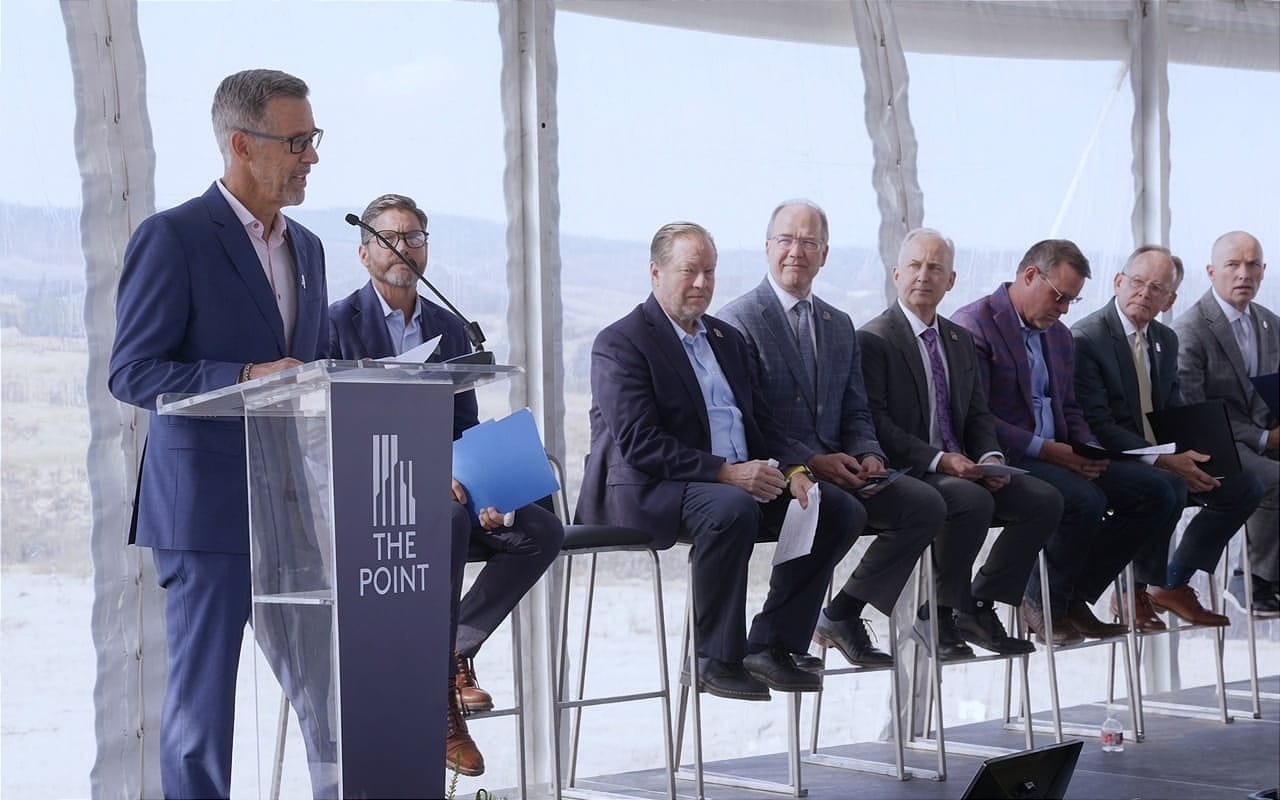
Kip Wadsworth, CEO of Wadsworth Development Group, addresses attendees at The Point groundbreaking ceremony Monday in Draper, with state and project leaders seated behind him on the stage. Wadsworth, who grew up in Draper, said Phase 1 construction activity will be visible across the site within 30 days. Photo: Mark Tullis/TechBuzz
Within 30 days, Wadsworth said, heavy equipment will be visible across the site and vertical construction will begin to take shape alongside ongoing road, utility, and public-space work.
A Hospital Joins the District
One of the most significant recent announcements surrounding The Point is a University of Utah Health campus planned for 46 acres at the northeast corner of the site. The location is deliberate: emergency vehicle access, ambulance routing, and air ambulance operations factored into the placement.
Gina Hawley, System Associate Chief Operating Officer for University of Utah Health, at The Point groundbreaking site Monday in Draper. Hawley said that the U's planned 46-acre campus at the northeast corner of The Point would likely include a full hospital, emergency room, clinics, and mental health services. She said building design and full list of services have not yet been finalized. Photo: Mark Tullis/TechBuzz
Gina Hawley, System Associate Chief Operating Officer for University of Utah Health, said that conversations came together quickly once U Health saw the land. "We actually did a first site visit last October and saw the land, and just initially thought, wow," she told TechBuzz. The location, 46 acres at the northeast corner of the site, made immediate sense. Salt Lake and Utah counties are among the fastest-growing in the region, she noted, and the corner placement gives the campus direct access for ambulances, emergency vehicles, and air ambulance operations. "Our patients want to be closer to their loved ones when accessing care," she said. "It just made a lot of sense."
The campus likely would include a full hospital, clinics, an emergency room, and mental health services. Clinical programming will need to be finalized through a market need and other analyses, with an eye toward the region’s aging population and rapid growth. Design has not yet begun.
The Point’s groundbreaking press release described the U Health campus as a “catalytic anchor for a broader health innovation district,” a signal that medical and research uses are expected to cluster around the university presence over time.
A Decade of Political Will
Monday’s ceremony was as much a reunion as a groundbreaking. Draper Mayor Troy Walker, who has served in city government for 18 years, recalled standing in front of news cameras 16 years ago trying to explain what the Point of the Mountain could become, and being asked whether he was crazy.
Draper Mayor Troy Walker speaks at The Point groundbreaking ceremony Monday, June 28, 2026, drawing laughter from the audience and fellow stage guests. Photo: Mark Tullis/TechBuzz
“Today we’re talking about what’s for sure going to be here, and that’s exciting,” Walker said. He credited a long line of leaders who caught the vision across multiple administrations: then-Speaker Greg Hughes, Governor Gary Herbert, then-Lieutenant Governor Spencer Cox, Senate President Wayne Niederhauser, Stuart Adams, Speaker Brad Wilson, and Mike Schultz.
Senate President Stuart Adams anchored the economic case. Adams cited data released the same morning showing Utah's average household income has reached $93,000, which he called the fastest-growing in the nation, a claim broadly supported by Kem C. Gardner Policy Institute research ranking Utah's median household income first in the country when adjusted for cost of living. “That doesn’t happen by chance,” Adams said. “Projects like this are the reason why it does happen.”
Senate President Stuart Adams speaking at The Point groundbreaking ceremony Monday, June 28, 2026 Photo: Juan Escudero, Kahlert Applied AI Institute, UVU
Adams pointed to Silicon Slopes, the 2034 Winter Olympics, and the convergence of aerospace, defense, and technology industries as evidence that Utah has moved beyond regional relevance. “When I talk to people around the world, Silicon Valley is history,” he said. “The future is Silicon Slopes.”
Governor Spencer Cox closed the program by reading directly from the legislation that created the Point of the Mountain State Land Authority — a passage that mandates not just economic return, but air quality, open space, transit, housing affordability, and a research presence. The breadth of the mandate, he argued, is what makes The Point different from a conventional real estate play.
Governor Spencer Cox addresses the crowd at The Point groundbreaking ceremony Monday in Draper, Utah. Cox closed the program by reading directly from the legislation creating the Point of the Mountain State Land Authority, arguing the project's mandate — spanning jobs, transit, housing, air quality, and open space — sets it apart from conventional real estate development. Photo: Juan Escudero, Kahlert Applied AI Institute, UVU
“Everybody thinks that all we care about is making money,” Cox said. “Certainly, making money is important, but you’ll see that was not just the focus of this plan.”
Cox invoked what he called a “y-axis” frame for evaluating leadership: not left versus right, but builders versus destroyers. “We’re in a room today filled with builders,” he said. “We have people involved in politics who don’t just think about the next election — we’re actually thinking 2040, 60 years down the road.”
Cox also noted that Utah is effectively debt-free, with more in its rainy-day fund than it carries in outstanding debt — a fiscal position he credited with enabling projects of this scale without burdening future taxpayers. “This place is real,” he said. “It’s incredible, but it’s also a metaphor for our state.”
Governor Spencer Cox speaking at The Point groundbreaking ceremony in Draper, Utah, June 29, 2026 Photo: Juan Escudero, Kahlert Applied AI Institute, UVU
The Public-Private Model
The Point’s structure is unusual by national standards. Utah retains ownership of the land; The Point Partners pay long-term ground leases rather than purchasing the underlying property. Infrastructure investment flows from the state; vertical development is privately funded and privately delivered.
“The Point represents a different model for growth in Utah, one that brings together state stewardship, private-sector execution and a long-term commitment to public value,” said Lance Bullen, partner and CEO of Colmena Group. “On behalf of The Point Partners, we are extremely honored to be a part of bringing this to life.”
The man overseeing that infrastructure from the public side is Michael Ambre, executive director of The Point since 2024. Before taking the role, Ambre spent 24 years as director of Utah’s Division of Facilities Construction and Management — where he oversaw construction of the North Capitol Complex, the new Utah State Correctional Facility, and the demolition of the former Utah State Prison. He is, in a real sense, building what the prison made possible.
South Jordan Mayor Dawn Ramsey (center in red)mingles with attendees, including Kelvyn Cullimore, President & CEO of BioUtah (on right), following The Point groundbreaking ceremony Monday June 29, 2026, in Draper Utah Juan Escudero, Kahlert Applied AI Institute, UVU
The Numbers at Buildout
At full buildout, The Point is projected to support 46,500 jobs, $4.4 billion in annual earnings, and $7 billion in annual GDP. The 600-acre vision calls for more than 3 million square feet of residential property, 2 million square feet of commercial space, 500,000 square feet of retail, 16 acres of parks and trails, and the 5,000-seat Mountain America Event Center.
The timeline is measured in years, not months. The first Phase 1 buildings are anticipated to open in 2028, with the broader vision extending well beyond the decade. The 2034 Winter Olympics — which Adams singled out as a global showcase moment — fall squarely within the early operational window.
Attendees at The Point groundbreaking ceremony Monday in Draper, Utah Photo: Juan Escudero, Kahlert Applied AI Institute, UVU