LoanPro Says AI Will Only Go as Fast as Lenders Trust the Brakes
LoanPro (Farmington, UT) launched payments processing, a virtual Mastercard for loan disbursement and an AI servicing suite at its Salt Flats Summit, arguing that compliance guardrails, not model power, will decide who wins in regulated lending AI.
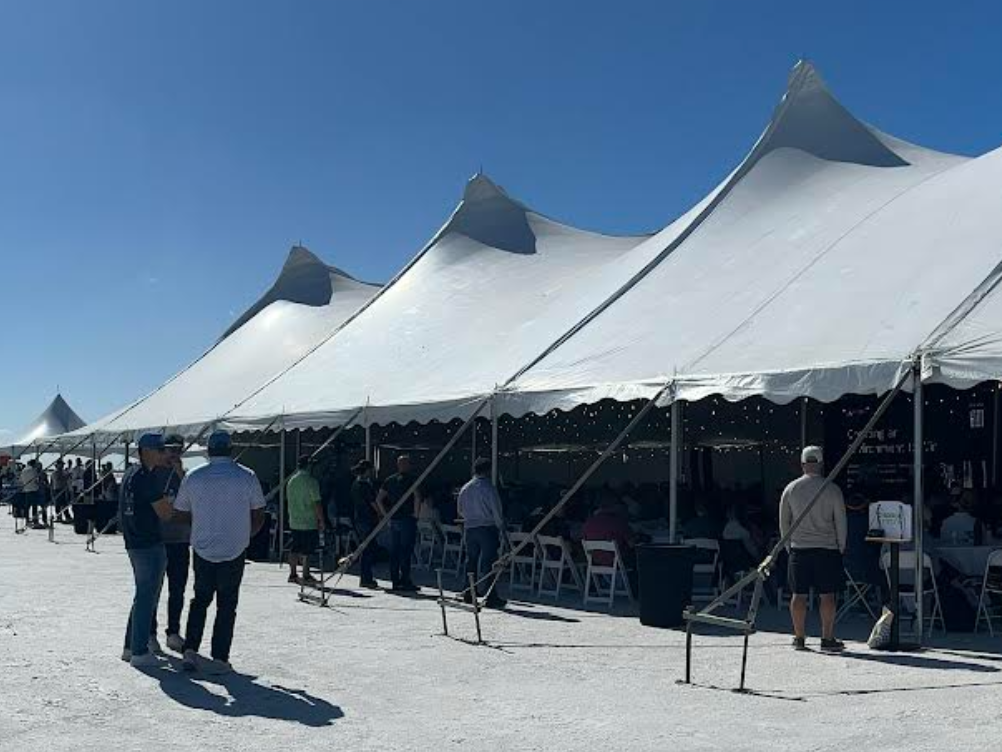
Main tent at the 2026 LoanPro Salt Flats Summit on the Bonneville Salt Flats. Photo: LoanPro
Main tent at the 2026 LoanPro Salt Flats Summit on the Bonneville Salt Flats. Photo: LoanPro
Wendover, Utah — September 24, 2026
LoanPro unveiled new products spanning payments, card-based loan disbursement and AI-assisted servicing at its recent Salt Flats Summit, held on the windswept Bonneville Salt Flats a few miles west of the famed Bonneville Salt Flats near Wendover, where it demonstrated them live on stage to roughly 500 lending executives.
A salt desert is an unlikely venue for a fintech conference, and this year's edition tempted fate. Rainstorms hit the day before and the day after, and the flats are rarely calm. LoanPro rolled the dice on late-summer weather and got a windy but dry and sunny event. Chief Product Officer Colin Terry told TechBuzz that attendance has grown from roughly 150 to 200 last year to nearly 500, and that doubling a crowd multiplies the operational load far more than it multiplies the guest list.
LoanPro Salt Flats Summit attendees assembled in the main tent for panels and sessions at the September 17 event on the Bonneville Salt Flats. Photo: LoanPro
What LoanPro launched
The launches include LoanPro DirectPay, payment processing LoanPro built and integrated across its platform, and Beyond Credit™, a virtual Mastercard that lets installment lenders disburse loan funds to a borrower's Apple Pay or Google Pay wallet around the clock, including weekends and holidays when ACH doesn't run. The card doesn't revolve and carries no fees or interest; those terms stay on the loan in LoanPro. LoanPro also renamed its payment suite LoanPro Payments and added Moov as the first processor customers can buy directly through LoanPro, and CheckAlt for lockbox processing. LoanPro says it moves about $4 billion a month in loan repayments and disbursements.
On the servicing side, LoanPro introduced the AI Account Briefing and the LoanPro MCP, which connects AI agents to LoanPro under the same access controls and compliance guardrails lenders use for human agents.
"Payment processing, real-time card disbursement and AI guardrails are now built into LoanPro's core, and all of it is live today," said CEO and co-founder Rhett Roberts. "A lender can now get funds to a borrower on a Friday night or have an AI agent help service an account, and all of it stays inside LoanPro."
An attendee at the LoanPro Salt Flats Summit. Photo: LoanPro
Why the brakes matter
In an interview at the summit, Terry framed the AI strategy with a Formula One analogy he credits to AWS: races are won not by top speed but by whoever brakes last.
In his version, the AI model is the engine. LoanPro's loan data supplies the context, and its ability to take actions, such as processing a payment, is the drive shaft. "We also are the brakes," Terry said.
"You will only ever drive as fast as you trust your brakes to stop you," Terry said in LoanPro's release. "Lenders have spent years building controls around their human agents, and the LoanPro MCP runs through those same role-based access controls and compliance guardrails. We bring the context, the action and the trust. You bring the thinking, and you have an AI strategy in a box."
Anyone can connect an AI to an API endpoint, Terry told TechBuzz. What LoanPro's MCP adds is a layer in the middle: every request passes through the role-based access controls the platform has had since its early days, and compliance guardrails at the API level can block actions outside a lender's regulatory limits. An agent can reach only what the human user it works for can reach, and each action is recorded in the audit trail under that person's name.
Colin Terry, Chief Product Officer, LoanPro sitting down with the author at the 2026 LoanPro Salt Flats Summit. Photo: Coco Tullis, TechBuzz
"The most non-deterministic asset you have in your company is your human workforce," Terry said, arguing that AI needs the same trust, oversight and empowerment.
That echoes what he described to TechBuzz in July, when he walked through LoanPro's MCP-based AI gateway and compared its layered compliance rules to stacked overhead-projector transparencies, with the overlap left in the middle being where a lender can act.
Phase one of the MCP is live and supports pulling account context and history, processing payments, setting up autopay and recording promises to pay. A second phase will add broader servicing, including borrower communications. A third phase, planned for next year, will extend the MCP to every LoanPro service.
Lenders choose their own model, Terry said, from open models run inside their own AWS account, where customer data has no ingress or egress, to more powerful frontier models. They can also dial an agent's access from read-only to fully agentic. Because actions are logged and reversible, and the agent can be switched off, he said, a lender can "turn the AI meter" up gradually. "Lenders will have the option to go fully from 'I'm going to use your AI-powered tools' to 'I am going to a built a full agentic workforce,'" said Terry.
A regulatory tailwind
Terry said the timing was fortuitous. The day before the interview, the Conference of State Bank Supervisors released its AI Supervisory Framework that provides clarity about the general approach, types of questions and information a state examiner may request. CSBS says its framework covers state-chartered banks and state-licensed nonbank financial institutions. It is directly relevant to the broader fintech ecosystem and not simply a bank-examination document. Industry press reports the framework covers generative and agentic AI, and that state agencies supervise 3,355 of the country's 4,233 FDIC-insured banks and savings institutions.
LoanPro Salt Flats Summit attendees take turns hitting golf balls on the Bonneville Salt Flats during the September 17, 2026 event. Photo: LoanPro
Terry said examiners will expect lenders to know where AI operates in their systems, to have a documented owner for each feature, and to be able to turn it off, and that a lender can't point at its vendor. He also described requirements for documented permitted actions, human checkpoints, reversibility and the ability to halt a tool.
Terry cited a section called GE-8, “Agentic AI Controls,” in the framework's examiner work program. The section gives examiners a way to examine AI systems that can take actions with limited human direction. Among the areas they may review are what actions an agent is permitted to take, where human intervention is required, whether the system maintains adequate logs, whether its actions can be reversed, and whether the institution can restrict or shut it down.
The framework is notable because it addresses a category of AI that existing banking guidance has not fully addressed. On April 17, 2026, the Federal Reserve, Office of the Comptroller of the Currency and Federal Deposit Insurance Corp. issued revised model-risk guidance but explicitly excluded generative and agentic AI from its scope, describing the technologies as novel and rapidly evolving.
CSBS describes its framework differently from a new regulation. It calls the document a discretionary supervisory tool that state examiners can use to identify AI deployments, assess associated risks and determine whether a deeper review is warranted. It does not itself create new legal obligations or supervisory requirements. Each state financial regulatory agency decides how extensively to incorporate the framework into its own supervisory program.
The framework is intended for both banks and state-licensed nonbank financial institutions. CSBS says institutions can use it themselves to assess their AI programs, establish governance and risk-management practices, and prepare for examinations. The framework is designed to scale according to an institution's size, complexity, risk profile and use of AI.
That makes GE-8 less a new rule than a preview of the questions financial institutions increasingly can expect regulators to ask about autonomous AI: What can it do? Who is responsible for it? What did it do? Can a human intervene? And if it makes a mistake, can the action be undone or the system stopped?
Colin Terry, Chief Product Officer, LoanPro sitting down with the Mark Tullis at the 2026 LoanPro Salt Flats Summit. Photo: Coco Tullis, TechBuzz
The numbers
In a LoanPro survey of lenders on its platform, agents spent an average of 20% of each servicing call looking for information. In LoanPro's testing, the AI Account Briefing cut that up to 15% of a call and even to 5% of a call. It gives agents a plain-language summary of each account, with health indicators, recent activity and suggested next steps based on how that lender handles similar situations.
The briefing builds on the AI-native interface LoanPro developed with AllCloud and AWS, built on Anthropic's Claude, which the company says cut customer call times by up to 15%. LoanPro says the briefing runs on models post-trained by LoanPro and deployed inside each customer's own AWS environment.
These are two separate measures, share of a call spent searching versus total call time. LoanPro's earlier claim was about total call time.
Attendees at LoanPro Salt Flats Summit. Photo: LoanPro
Positioning against legacy cores
Asked if the MCP sets a standard for the industry. Terry replied, "I would hope so." He went on to say LoanPro believes its approach could establish a benchmark for how core financial platforms should prepare for AI. He contrasted LoanPro's cloud-native, API-first architecture with older core systems built on legacy infrastructure, where making systems “AI ready” can require first building the APIs and other underlying capabilities. In his view, being technically AI-ready is different from actually being AI-native: the latter requires the governance and controls necessary to deploy AI safely. LoanPro's architecture made that transition easier, Terry said, allowing the company to focus on putting controls in place before releasing AI capabilities publicly. He hopes that approach becomes a standard others follow.
The company's goal, Terry summarized, is that by choosing LoanPro a lender can tell its board, investors and customers it has an AI strategy.
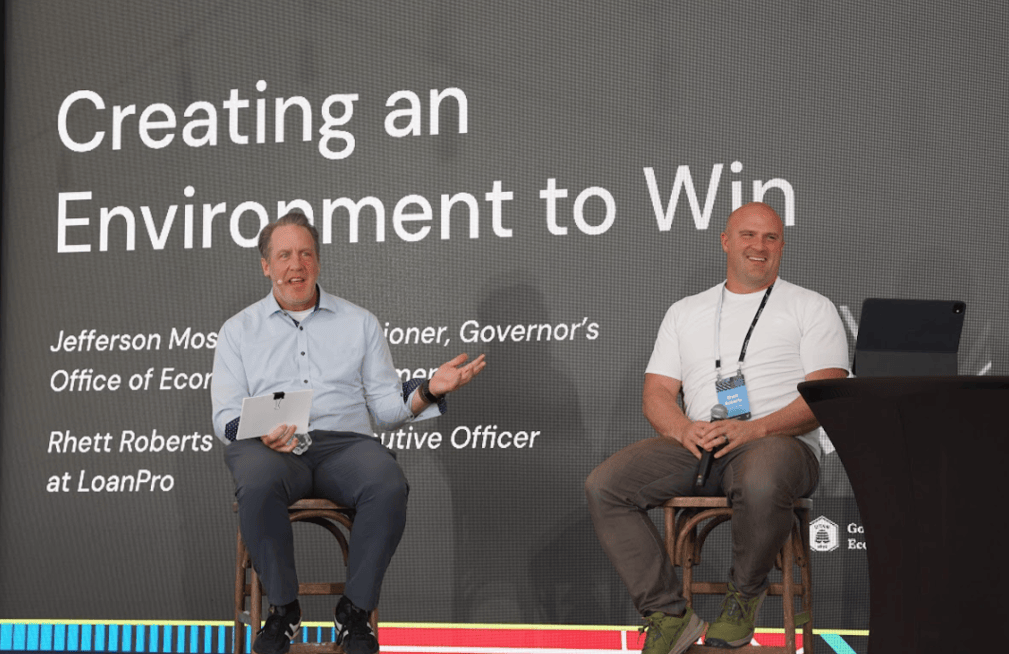
Creating an environment to win
Roberts opened the summit by telling attendees that LoanPro is a pure technology company that doesn't make loans, and so depends on its customers' success. Jefferson Moss, Executive Director of the Governor's Office of Economic Opportunity and CEO of Nucleus Institute, joined Roberts in the opening session. The conversation moved beyond LoanPro and into a larger question: What does it take to create an environment in which companies can win?
Jefferson Moss, executive director of the Utah Governor’s Office of Economic Development, and LoanPro co-founder and CEO Rhett Roberts discuss “Creating an Environment to Win” during the main morning session of LoanPro’s Salt Flats Summit on Sept. 17, 2026. Photo: Coco Tullis, TechBuzz
Moss described Utah’s economic-development strategy as increasingly dependent on collaboration among government, education and industry. As technologies such as AI blur traditional boundaries between industries, he said, those connections become more important—not less.
For Moss, collaboration is not simply about getting people into the same room. It is about understanding what businesses and citizens actually need, defining the problem clearly and then building solutions around it. He described a design-thinking approach to policymaking: identify the customer, talk to the people experiencing the problem, understand the constraints and only then begin developing a solution.
Roberts recognized a similar problem inside financial institutions. Banks and other lenders can become divided into product lines and organizational silos, with each group operating its own technology stack. A customer who moves from one financial product to another may effectively have to be “reacquired” because the systems and teams serving that customer do not work together.
The parallel was clear: organizational structure matters because it determines what an organization is capable of delivering. Companies periodically need to step back and ask whether their teams, systems and processes are actually organized around the customer and the outcome they are trying to achieve.
Jefferson Moss, executive director of the Utah Governor’s Office of Economic Development, with LoanPro co-founder and CEO Rhett Roberts at LoanPro’s Salt Flats Summit on Sept. 17, 2026. Photo: Coco Tullis, TechBuzz
The same principle, the conversation suggested, applies to regulation.
Roberts said regulatory uncertainty has become a practical concern for financial-technology companies operating in a rapidly changing environment. Moss said regulatory stability has become increasingly important to companies deciding where to invest and locate. Utah's objective, he said, is to provide greater consistency and clarity so entrepreneurs and investors can make long-term decisions with greater confidence.
That philosophy mirrors LoanPro's own approach to stability. Roberts said the company deliberately prioritized profitability rather than pursuing growth at any cost. For customers building critical lending operations on LoanPro's platform, he argued, knowing the company will still be there tomorrow is part of the product. Business stability can therefore become a competitive advantage in the same way that technology, features or price can.
Roberts broadened the conversation to focus on infrastructure. He said infrastructure is impossible to ignore. He pointed to the Salt Flats Summit as an obvious example that everyone sanding on ancient salt beds under the tent could relate to. An event in the middle of the desert requires water, electricity, internet connectivity, transportation and dozens of other systems to work together. The same is true of a technology company or a modern economy. Capital, talent, technology, regulation, housing and other supporting systems all become dependencies that have to be understood and managed.
Moss connected that idea to Utah's next stage of growth. The state has to think not only about economic output and job creation, he said, but also about housing, water and quality of life. Utah's Utah Elevated strategy reflects that broader view through three areas of emphasis: innovation, capital and quality of life.
The message from the morning session was ultimately broader than a discussion about how to build a successful fintech company.
Dusk at LoanPro Salt Flats Summit. Photo: LoanPro
Winning is an outcome of the environment you create.
For LoanPro, that means building stable systems, a durable business and products that solve real customer problems. For Utah, Moss described a similar challenge at a much larger scale: connect government, universities, entrepreneurs and capital; understand problems before prescribing solutions; provide stability where possible; and build the infrastructure required for the next generation of growth.
Roberts brought the idea back to the people inside the company. Winning, he said, is not simply about financial results. It also means creating an environment in which employees can grow, develop their skills and be rewarded for the value they create.
That may be the most fitting conclusion to a summit built around the idea of winning. The objective isn't simply to win a particular race. It is to build the people, systems, partnerships and infrastructure that make sustained performance possible.