Built to Be Put Down: How Scribbi Is Reclaiming Kid-Tech from the Dopamine Engine
Scribbi (Provo, UT) is challenging gamified ed-tech with a screen-free, e-ink tablet for kids. By prioritizing handwriting over typing, founders Keller and Katarina Seamons offer a calm alternative rooted in cognitive research and distraction-free learning.
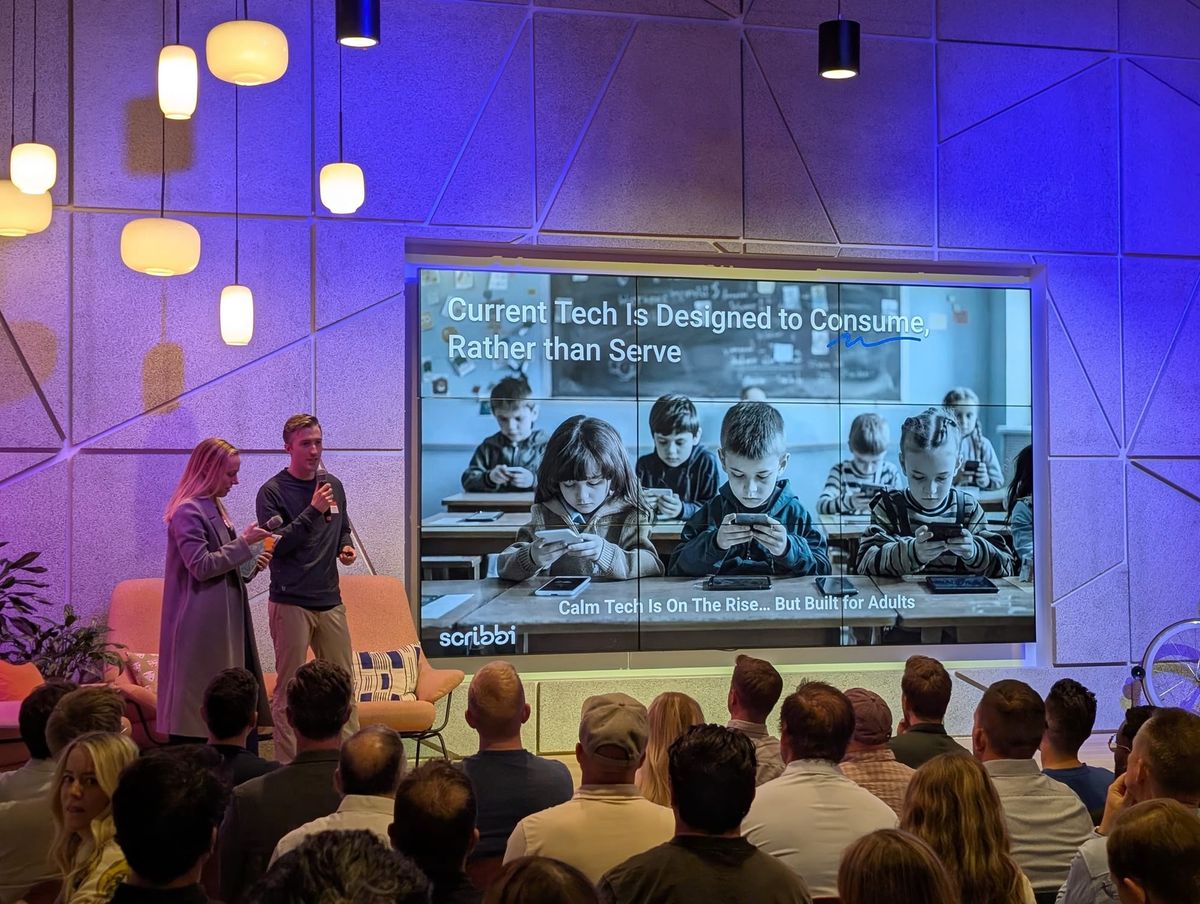
Katarina and Keller Seamons pitching Scribbi earlier this year at Kiln Lehi. Photo: Scribbi
Katarina and Keller Seamons pitching Scribbi earlier this year at Kiln Lehi. Photo: Scribbi
Provo, Utah — September 23, 2026
A few months ago, a potential investor sat across from Katarina and Keller Seamons and told them exactly how to make their company more valuable: make it more addictive.
The Seamonses said no. Not "we'll think about it" — no. "You are not right for us," Katarina remembers telling them. "We're going a different direction." It was, by her own account, a hard thing to walk away from — a "cool group" with real money on the table, offering the thing every early-stage founder is supposed to want. They turned it down anyway, because addiction was never the plan. It was the exact problem they'd built their company to solve.
Their daughter writes her S's backwards. On a screen, that's an error. Most handwriting-recognition software would read it as a Z and mark it wrong. On Scribbi, the device the Seamonses have spent the last two years building in their Provo-based startup, it's treated as data. The system is designed to recognize that a specific child writes her twos like fives or her S's like Z's, quietly flag the pattern for a parent, and help her fix it — without ever telling her, in the moment, that she got the answer wrong. It's a small design choice, but it captures the whole thesis behind the company: that a child's mistakes are information worth paying attention to, not noise to be corrected and forgotten by an algorithm built for someone else.
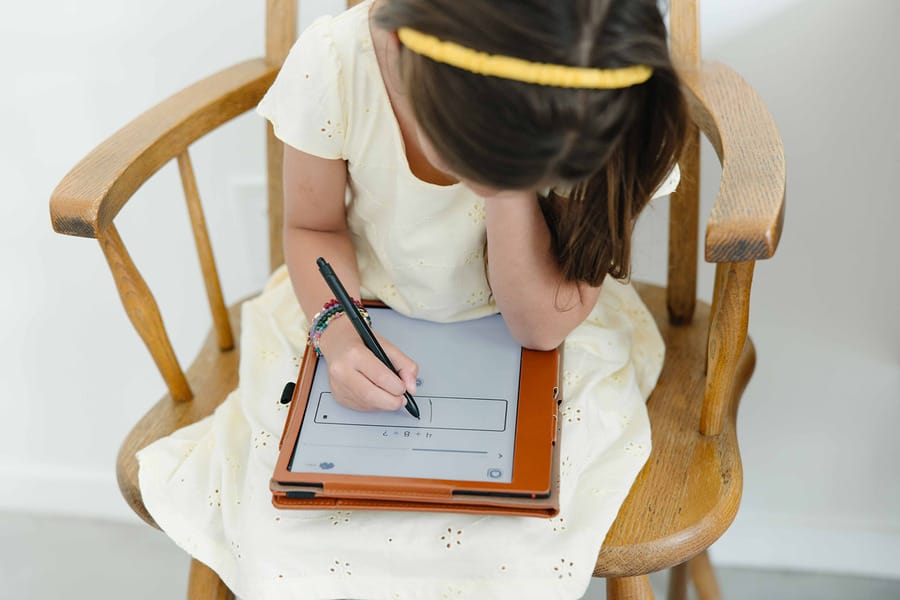
Scribbi is an e-ink tablet — closer in spirit to a Kindle or a reMarkable than an iPad — built specifically for kids, with no browser, no app store, no games, no videos. Everything on it involves a stylus and a sheet of digital "paper": math problems solved by writing the answer instead of tapping it, worksheets uploaded as PDFs, a patent-pending system that learns a child's individual handwriting the way a fingerprint reader learns a thumb. It's the kind of product that only makes sense once you understand what its founders were actually trying to get away from.
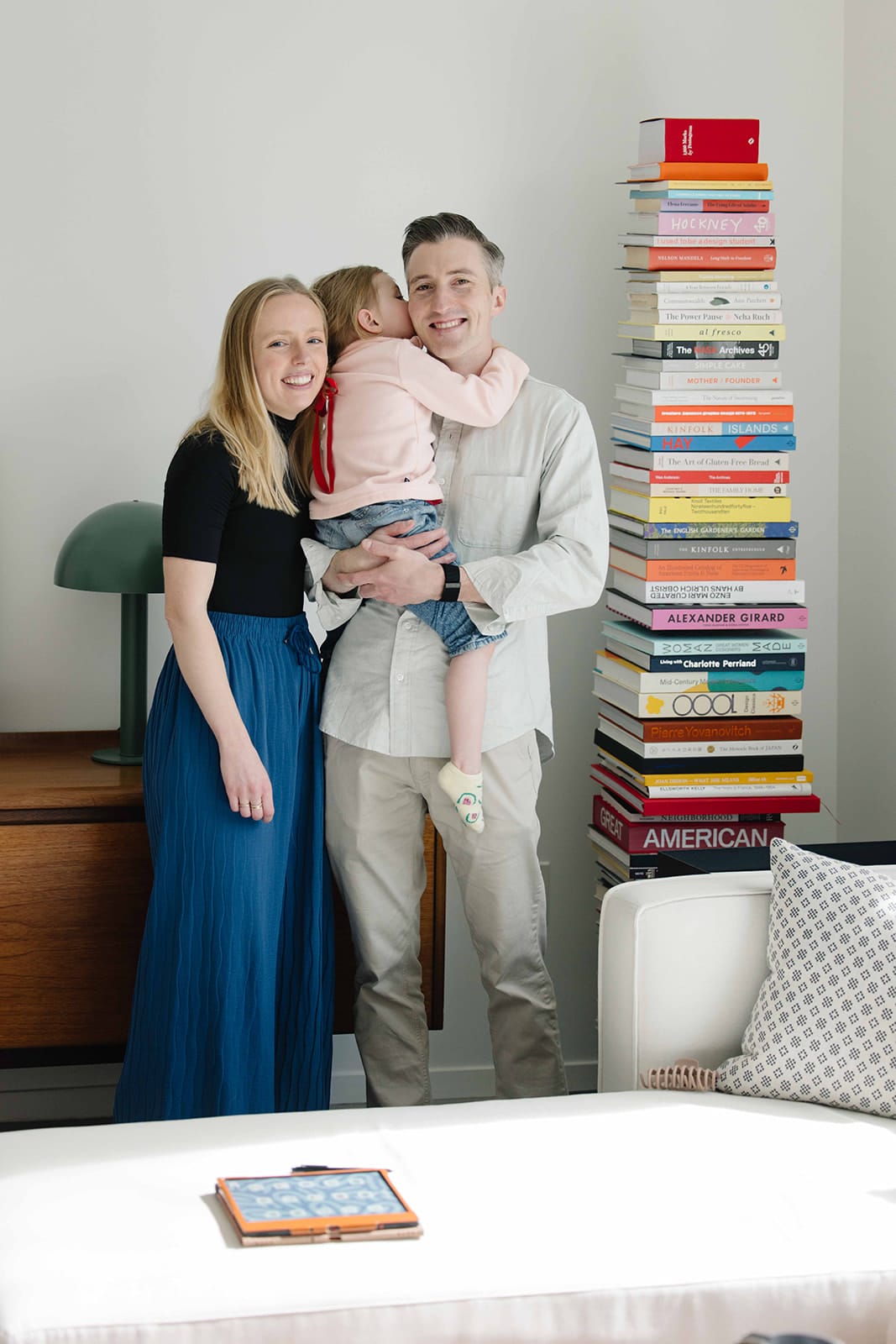
The Katarina and Keller Seamons family. Photo: Scribbi
The Moment in France
The idea started, unglamorously, in France. Katarina and Keller were living there, both working remote jobs, and — as she describes it — found themselves "just glued to technology." It wasn't a crisis so much as a slow, familiar realization: their kids had noticed. Their four-year-old and two-year-old had started reaching for the phones and laptops the same way their parents did.
That was the moment that made them start looking for alternatives, and finding a gap. They tried a Toniebox, a screen-free storytelling gadget, and felt good about it. But when it came to anything with a screen, nothing struck them as safe. An iPad or anything with internet access, games, or video produced the same low-grade anxiety in them as parents that it seemed to produce in their kids. So, in the way a lot of startups start, they began building the thing they couldn't find.
Keller had already fallen for e-ink on his own — he uses a reMarkable tablet for work and had noticed something in himself: when he switched from typing to handwriting, he read more, wrote more, and felt calmer doing it. That personal experience became a design brief. They wanted a device with no blue light, no video, nothing that behaved like the attention-optimized products both of them recognized from their previous careers in investment banking and private equity — careers spent, ironically, doing their best thinking with a pen on a whiteboard or a Post-it note, not inside a piece of software.
Built to Be Put Down
The research backs up the instinct, and the Seamonses lean on it deliberately. Their advisory board includes Sophia Vinci-Booher, PhD, a Notre Dame researcher who studies the difference between handwriting and typing in brain development. Her research demonstrates that physically forming letters by hand triggers unique sensorimotor and parietal brain connectivity networks that typing simply bypasses. The fluid visual spatial variation produced during handwriting engages the visual-spatial and motor systems simultaneously, helping children recognize letters faster and build stronger neural foundations for reading acquisition. Typing, by contrast, reduces every letter to an identical keystroke, skipping that crucial developmental step.
There's a second piece of research the Seamonses talk about with more urgency: reading and math scores nationally have been declining, and they believe gamified ed-tech is part of the reason.: reading and math scores nationally have been declining, and they believe gamified ed-tech is part of the reason. Studies on educational gamification support their skepticism, showing that while points, badges, and streaks boost short-term engagement, they often substitute extrinsic rewards for intrinsic motivation, leading to surface-level task completion rather than deep conceptual learning. When a child learns a math concept through a game, they argue, the child isn't really learning math; the child is learning to play the game, chasing streaks and points and the small dopamine hit of a celebration animation. Strip the game away at test time, and the material often doesn't stick. Scribbi is built to produce the other kind of dopamine hit, one that comes from struggling through something hard and actually getting it. It is built this way on purpose, and it omits the celebratory bells and whistles that make that shortcut so tempting to build.
Photo: Scribbi
That principle shaped a decision that, on paper, looks like it's leaving money on the table: Scribbi isn't an app, and it never will be. Everyone the Seamonses talked to early on — friends, family, potential backers — asked the obvious question: why not just build this as an iPad app? Their answer is about association, not access. Kids already know what an iPad is for. Handing a child a fully capable device and then trying to restrict what they do with it turns the parent into the enemy — the one saying no to something the device could easily do. Handing a child a device that was only ever built for one purpose removes the argument entirely. "This device kind of becomes the bad guy instead of the parent," is how the idea was put to me; it is not a fight anyone has to have, because there's nothing on it to fight about.
Proof, Not Just a Pitch
None of this would matter much as a magazine story if nobody wanted it, so it's worth pausing on what's actually happened since the Seamonses started shipping. A pilot with about twenty Utah homeschooling families shaped most of the device's early features. This is a rhythm and productive feedback loop the company has kept, building and pushing out updates within days of hearing what a specific family wanted. Utah's Fits All scholarship program approved Scribbi as an educational material rather than a technology purchase, meaning it doesn't eat into the tech allowance homeschooling families are often working around.
A Kickstarter campaign pitched simply as "a calm learning device for young minds" set out to raise $20,000 and ended up pulling in $134,684 across 234 backers — with roughly $80,000 of it raised in the first 48 hours — with backers spread fairly evenly across California, Texas, Utah, and Florida, almost entirely through word of mouth.
The number that seems to matter most to the Seamonses, though, isn't a dollar figure. One of their earliest beta units went to a mother preparing to deploy, who wanted a way to stay close to her kids at bedtime while she was away. The Seamonses got her a device before the Kickstarter had even technically shipped. She used Scribbi's Pen Pal feature — letters written by hand, back and forth, the same way a person might have written to a grandparent a generation ago — to send her children notes about her day while she was in training. She wrote back afterward to say it had made a hard week easier. It's the kind of message that doesn't show up in a pitch deck, but it's the one Katarina brings up first when asked what the company has learned so far.
There's a line she returns to that explains why that particular story landed the way it did. In an age when artificial intelligence can imitate a person's voice, their writing style, even their likeness, she says the one thing that's still authentically hers is her handwriting. A text could be from anyone. A typed note could be generated by anything. A handwritten letter is unmistakably, provably from the person who wrote it.
What Comes Next
The startup is still small — two founders hand-packaging every device, with a handwritten note tucked into every box, alongside CMO Karen Peterson, a veteran of brands including Ancestry and Chatbooks. Their near-term goal is unglamorous: fulfill every Kickstarter order themselves before scaling up, although they are looking into other Utah-based fulfillment options. Beyond that, the roadmap includes bringing outside curriculum onto the device for homeschoolers, building out the parent-insight features the handwriting recognition makes possible, and — eventually, carefully — exploring how a device like this might fit into public schools, where the politics of technology in the classroom are shifting fast in the other direction as more states pass strict phone and device restrictions in classrooms.
That last part is where the Seamonses' timing might be working in their favor. They are exploring how a device like this might fit into public schools, where laptop programs are facing new scrutiny nationally as studies link excessive classroom screen time to lower reading comprehension and test scores. Into that gap steps a startup whose entire pitch is that it isn't trying to hook anyone. Since switching most of their kids' screen time to Scribbi, the Seamonses say their children's overall screen use has dropped by roughly 80 to 90 percent, and the tantrums that used to follow a TV show — the ones that first worried them enough to start building — have largely disappeared.
It's an unusual thing to hear from two people running a technology startup: that their long-term goal is for their product to matter less over time, not more — for a kid to pick it up, use it, put it down, and go do something else entirely. That's not the incentive structure that got them $134,684 on Kickstarter or a room full of interested investors. It's the one they turned an investor down to protect.
Further Reading: The Science Behind Calm Learning & Handwriting
Brain Connectivity & Memory: Peer-reviewed EEG studies show that physically forming letters by hand activates neural pathways in sensorimotor regions vital for memory far more than keyboarding (PubMed).
Literacy & Early Development: Scientific American breaks down why handwriting engages visual-spatial systems simultaneously, strengthening recall (Scientific American).
Classroom Literacy Impact: NPR’s overview on how tactile writing builds foundational reading readiness in young children compared to tapping screens (NPR Health Shots).
The Gamification Trade-Off: Research analyzing how extrinsic rewards in educational apps displace intrinsic motivation, favoring short-term play over long-term retention (ScienceDirect).