Utah's AI Industry Is Trading Demos for Discipline — And the Metaphors Have Changed Too
Utah AI Convergence's Industry Panel brought ChipNexus, Enzy, Lease End, Google, and Cisco's Outshift together to detail how calibrated, robust, human-centric multi-agent systems move from demos into high-stakes production deployment.
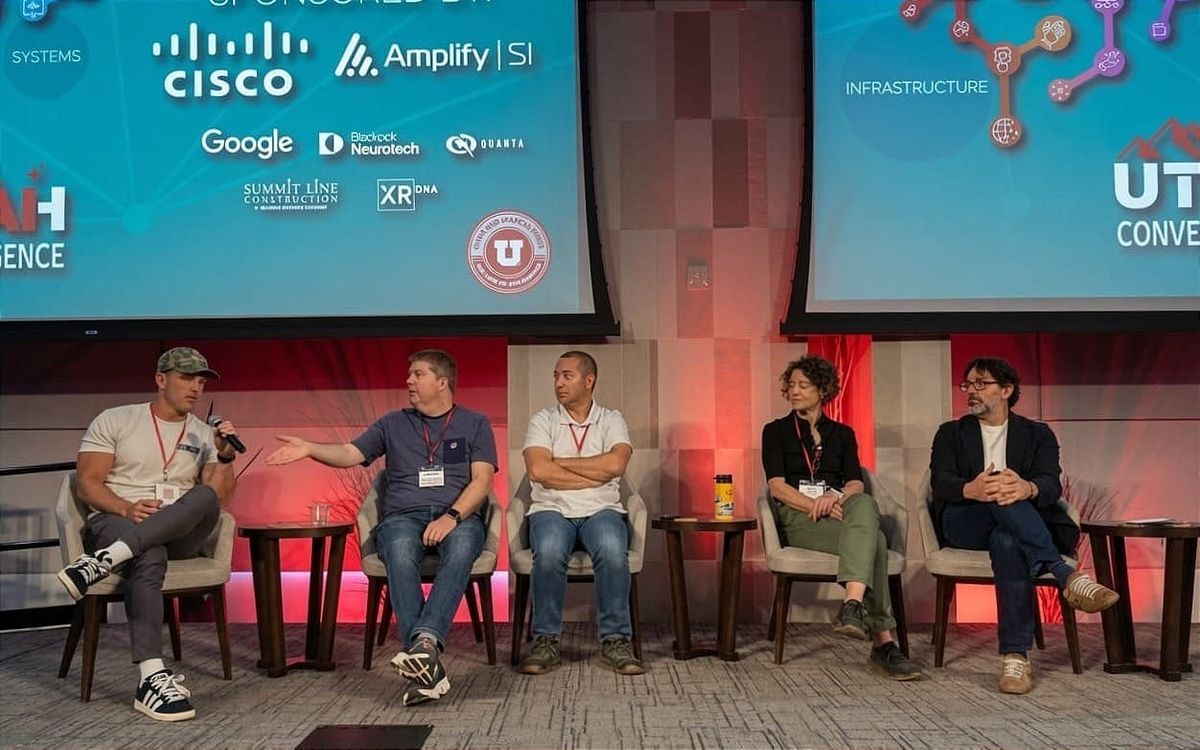
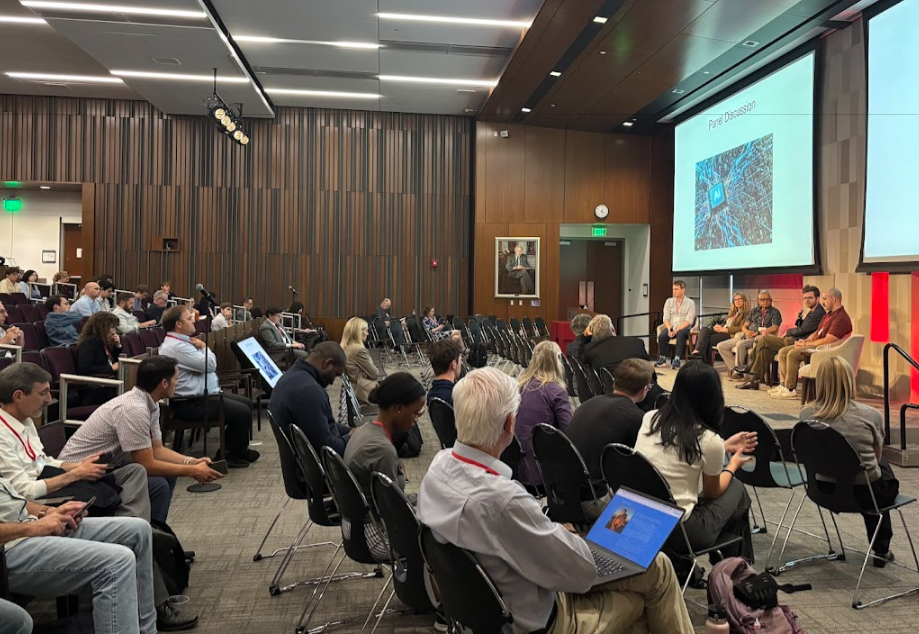
The June 24 Industry Panel during the 2026 Utah AI Convergence, held at the University of Utah's SJ Quinney College of Law Moot Courtroom in Salt Lake City, brought together executives from ChipNexus (Salt Lake City, UT), Enzy (Lehi, UT), Lease End (Lehi, UT), Google, and Cisco's Outshift to outline practical approaches to building calibrated, robust, and human-centric multi-agent AI systems for semiconductors, sales operations, and cybersecurity. Over 90 minutes, five industry practitioners described what it actually takes to move AI agents from conference demos into production environments where errors cost millions of dollars — or, in at least one case, a life.
The panel, part of the two-day 2026 Utah AI Convergence hosted by the John and Marcia Price College of Engineering, made one point repeatedly: frontier models are advancing quickly, but the hard work lies in orchestration, uncertainty handling, data grounding, and coordination across specialized agents.
Porter Jenkins, director of AI at Enzy in Lehi, opened the substantive stakes-setting with two cautionary examples. In 2021, Zillow tried to fully automate home-flipping decisions with AI and lost $881 million. In 2024, a man in South Korea died after a robot arm misidentified him as a box. "Uncertainty matters, whether you're building your own models or whether you're working with LLMs," Jenkins said. It's a problem he's spent his career on — first as chief scientist at retail computer-vision company Delicious AI, now building performance systems for sales teams at Enzy.
Jenkins argued real-world AI requires three disciplines: calibrated systems that quantify their own uncertainty, robust hybrid pipelines, and human-centric design that amplifies rather than replaces people. He walked through probabilistic modeling work published at ICML 2025, including the Deep Double Poisson Network, which he co-authored with Spencer Young, Longchao Da, Jeffrey Dotson, and Hua Wei. The model predicts both central tendency and spread for discrete counts instead of forcing a single point estimate. In production inventory systems, this lets customers know which shelf snapshots the model is confident about and which need human review.
On the robustness side, Jenkins described a custom hybrid pipeline called Price Lens that initially outperformed frontier vision-language models on spatial price-tag attribution tasks, only to see Google's Gemini 3.1 close the gap within a year, while still carrying far higher inference costs, on the order of $36.60 per 1,000 images versus less than $1 for the in-house system. "You have to consider this Pareto frontier of cost and performance," Jenkins said. His takeaway: hybrid systems built today may not be future-proof, and any investment in one needs to be justified by unit economics, not just performance.
Pierre-Emmanuel Gaillardon, co-founder and CEO of Salt Lake City-based ChipNexus, made the case for the semiconductor industry as fertile ground for multi-agent AI. Chip design now involves more than 100 billion moving pieces on a 12-month cycle, with a single bug capable of forcing a complete tape-out that costs millions. "The semiconductor industry is particularly interesting as a target for AI-based solutions because the industry, while making a ton of money… [is] in a deep crisis from talent shortage," Gaillardon said. "It is very hard to find highly skilled chip designers that can push forward complex GPU projects."
Gaillardon described ChipNexus's product Next as a multi-agent system built explicitly on top of existing electronic design automation (EDA) flows rather than replacing them, using in-context learning to capture both general "tribal knowledge" and customer-specific workflows. The system layers narrow task agents (code exploration, linting) beneath domain agents (which take a spec and produce reviewed code) and manager agents that orchestrate across architecture, verification, and physical design teams. "We want to capture the tribal knowledge of design teams… so you can apply the same process that their engineers are using in order for them to gain confidence on the quality of the results," he said.
David Williams, chief product and technology officer at Lease End in Lehi, described an internal enterprise agent harness called Top Bot that connects Slack, email, voice, and other channels to the company's data lakehouse. Configurable agents carry memory, context, external event triggers, and scheduled "heartbeats" that let them act autonomously rather than waiting on a human prompt.
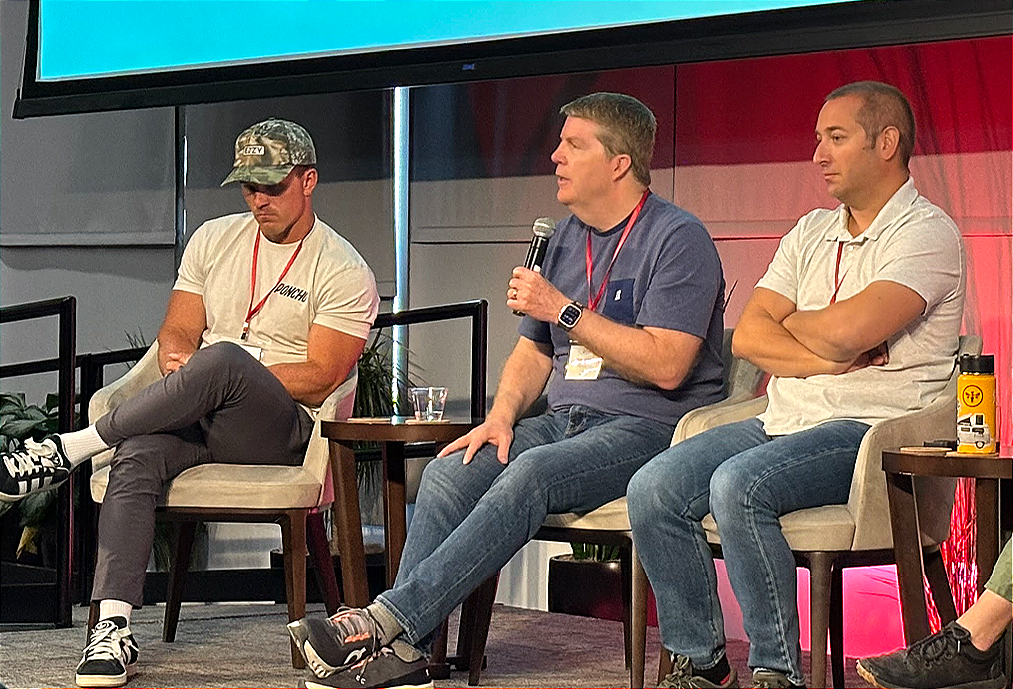
We've not let anyone go in our business because of AI," David Williams (center), CPTO of Lease End, told the Industry Panel at the 2026 Utah AI Convergence in Salt Lake City. Also pictured: Porter Jenkins of Enzy (left) and Pierre-Emmanuel Gaillardon of ChipNexus (right). Photo: Satwik Chavakula
Williams made a case that cuts against the industry's more anxious narratives about AI and headcount: senior engineers, he said, remain more effective at directing these systems than juniors, because they already understand architecture and can set proper guardrails — which has changed how the company thinks about junior hiring, not eliminated it. "We've not let anyone go in our business because of AI," Williams said. "We've shifted their mindset from thinking about, hey, I'm an engineer trying to write code, to I'm an engineer trying to solve a problem for the business."
Royal Hansen, vice president at Google, closed the semiconductor-to-security arc with a reframing of how AI-era risk should be managed. Static, bridge-like risk models — built once, inspected, expected to hold for decades — don't work, he argued, when systems change hourly. Instead, he pointed to biological and ecological metaphors: immune systems that mutate rapidly to detect novel threats, and the idea of living with "poison fruit" rather than expecting a perfectly sanitized internet. Hansen highlighted existing Google systems that already block 99.9% of Gmail spam and fraud and scan 125 billion app-device combinations daily through Play Protect, describing a coming contest between defensive agents that clean up unused privileges and stale data overnight, and offensive agents built by attackers to do the opposite.
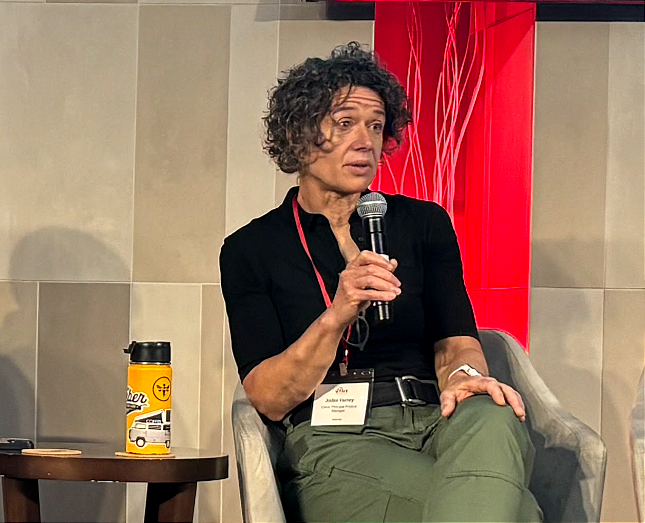
Jodee Varney, Principal Product Manager of Outshift, Cisco's incubation arm, closed the prepared remarks with the coordination problem that emerges once organizations move beyond single orchestrated workflows into genuine swarms of independent agents with no shared context. Her team's open-source project, Mycelium, gives agents persistent shared "rooms," markdown-based memory, and a structured negotiation protocol so agents from different systems can identify the handful of issues that actually matter and converge on options without talking past each other.
Jodee Varney, Principal Product Manager of Outshift, Cisco's incubation arm, discusses agent coordination during the Industry Panel at the 2026 Utah AI Convergence in Salt Lake City. Varney's team built Mycelium, an open-source project that gives independent AI agents shared memory and a structured negotiation protocol to align before acting. "The protocol helped these agents become a team before they started to act," Varney said.
In a demo Varney walked through, two agents — one focused on fast incident resolution, the other on avoiding notification fatigue — negotiated an on-call paging policy by iteratively trading proposals until both could live with the outcome. "The protocol helped these agents become a team before they started to act," she said.
What the room asked back
The audience Q&A that followed pushed the panel toward the questions students and early-career engineers in the room actually wanted answered. Asked where entry-level talent fits in an industry chasing skilled labor, Jenkins offered a framework: "The evolution of software has gone from humans doing a lot of generation of code to humans doing a lot of discrimination of code… we still need really skilled people for us to be able to discriminate what's good and what's bad." He named two other durable skills — systems-level thinking as software abstraction keeps climbing, and comfort reasoning about software statistically rather than deterministically.
Williams offered a complementary note from the employer's side: junior engineers at Lease End are still expected to learn architecture and design fundamentals rather than lean on AI as a substitute, precisely because that judgment is what makes senior engineers more effective AI directors later.
Another questioner asked how much theory-of-mind and social-science research belongs in agent design. Varney's answer doubled as an admission about hiring: Outshift, with roughly 40 engineers, has specifically recruited people with theory-of-mind backgrounds because the coordination problem her team is solving is, at root, a social one.
The infrastructure underneath it
Later that afternoon, William Miller, senior director for research computing and data at the University of Utah, and Greg Jones, director of corporate engagement for scientific computing, technology and AI, laid out the infrastructure investment supporting this work. Miller described the Center for High Performance Computing's roughly 60-petabyte storage environment, high-speed connections through the Utah Education and Telehealth Network (UETN), and a new $50 million AI factory partnership.
Those capabilities sit alongside the university's $100 million Responsible AI initiative, launched in October 2023, which has already funded more than 50 faculty members and postdocs and built a cross-campus consortium focused on translational AI impact in environment, healthcare, and education. Miller also connected the university's build-out to federal efforts including the Department of Energy's Genesis Mission and the NSF's National Artificial Intelligence Research Resource pilot, both of which are shaping how research computing capacity gets allocated nationally.
Luis Garcia (U of U Kahlert School of Computing), Mary Hall (U of U Kahlert School of Computing), Ganesh Gopalakrishnan (U of U Kahlert School of Computing), and Jacob Austin (Anthropic), speaking at Utah AI Convergence, University of Utah's SJ Quinney College of Law Moot Courtroom, June 23 and 24, 2026
The takeaway
Taken together, the panel and its Q&A pointed to the same conclusion from five different directions: Utah's AI industry has moved past the initial excitement of large language models and into the slower, more disciplined work of production deployment in domains where failure is expensive, uncertainty has to be modeled rather than assumed away, and coordination across specialized agents, and across company boundaries, is no longer optional.