From Salvage to Savings: How BYU's ReVroom Is Changing the Way Utah Buys Cars
Paige Knudsen and Cameron Woolstenhulme launched ReVroom out of BYU's Sandbox program to demystify the rebuilt title car market. Their Utah-based marketplace brings transparency, affordability, and data-driven listings to a $40 billion niche nobody else is watching.
Knudsen's path to ReVroom started with a near miss. When she applied to Sandbox, part of the process was a hackathon. On the morning of the event, she had no team and serious reservations about showing up.
"I thought, this is going to be so awkward if I get up there alone and have to make a team out of strangers," she recalls. "But I felt like if I didn't get up and go do this, even if it was a little uncomfortable, even if I walked up there and there's nobody else who doesn't have a team — I’d go home. At least I’d know that's how it went. And I knew I would hate myself forever if I stayed in bed."
She practically ran to the Tanner Building. She made it, found a small cluster of teamless participants, and within minutes had done what she would later do with her entire startup: sized up the room and moved first. "They were just kind of looking around going, okay, well, who wants to work together? And I started talking to them and I could feel which ones were more serious, more capable. And so, I quickly said, I think — us three." All three of her hackathon teammates got into Sandbox. The other group did not.
But the harder challenge came next. Sandbox was in. A co-founder was not.
"Many months go by, the summer goes by, the program doesn't start till September, and I still don't have a permanent team," she says. She kept networking, kept pitching her rebuilt title marketplace idea, and kept getting blank stares. Then her cousin, her next-door neighbor at the time, mentioned his roommate had just lost his team and happened to be a CS guy. That roommate was Cameron Woolstenhulme.
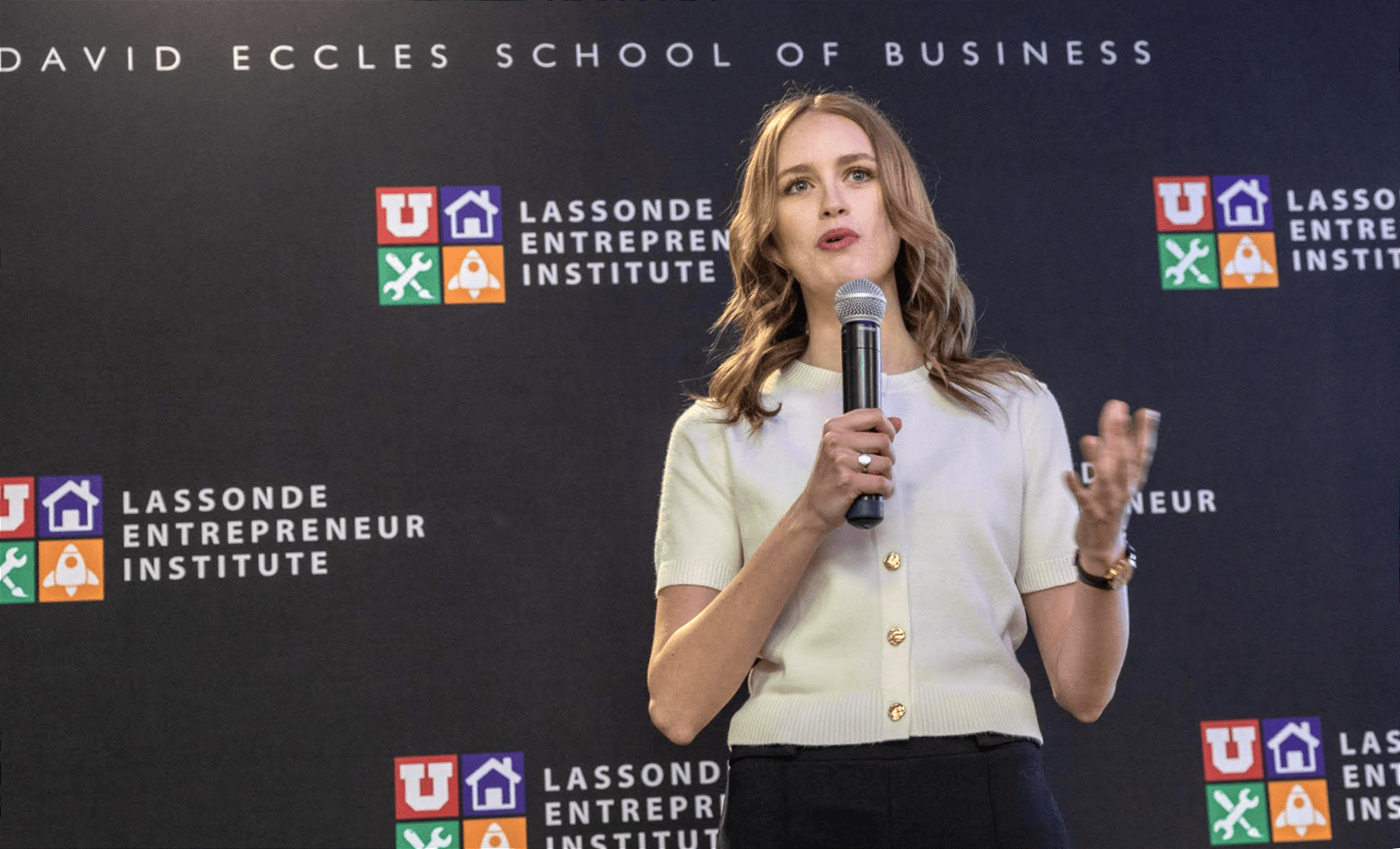
Paige Knudsen, speaking at the Tim Draper Utah Entrepreneur Challenge at the University of Utah's Lassonde Entrepreneur Institute, March 2026
"I pitched him this idea. I'd prototyped ReVroom and explained , this is the market. Nobody knows about it. I have all this experience in it and I think we need to build this," Knudsen says. "Within 10 minutes, he was in."
For Woolstenhulme, who had just come off a bad experience with a previous team, the decision was as much about the person as the idea. "When Paige and I first started talking in her living room, I had one of the strongest gut feelings ever — pins and needles included — that I could trust her as a co-founder," he says. "I believed in Paige first, then the idea. When you have a strong trust that no matter what, your team is gonna make it work, then the idea is almost secondary. But still really important."
He had a name for what they were taking on. Before the program even started, he recommended Knudsen read The Cold Start Problem, a 2021 book about marketplace economics by Andrew Chen. She bought hard copies for both of them. Inside his copy, she wrote a note about tackling this "mutant baby" together. "It has really evolved from those baby steps into something really beautiful," Woolstenhulme says. "And the best part is we are just getting started."
The Market Nobody Was Watching
To understand what ReVroom is building, it helps to understand just how fragmented and opaque the rebuilt title market has always been.
When a car is damaged, an insurance company may declare it a total loss and salvage it. The vehicle goes to an auction house, such as Copart or IAAI, where resellers buy it, repair it, submit documentation to the DMV, pass a safety inspection, and receive a rebuilt title. At that point, the car is legal to register and drive. It's also, typically, available at 30 to 50 percent below market value.
The problem is that the information trail is scattered across insurance companies, auction houses, Carfax reports, and DMV records — and no one has ever aggregated it into a single, buyer-friendly view. Sellers on Facebook Marketplace often can't answer basic questions about their own vehicles. Listing platforms built for clean-title dealers treat rebuilt inventory as an afterthought, and buyers who encounter a rebuilt listing in the middle of their search almost always bounce.
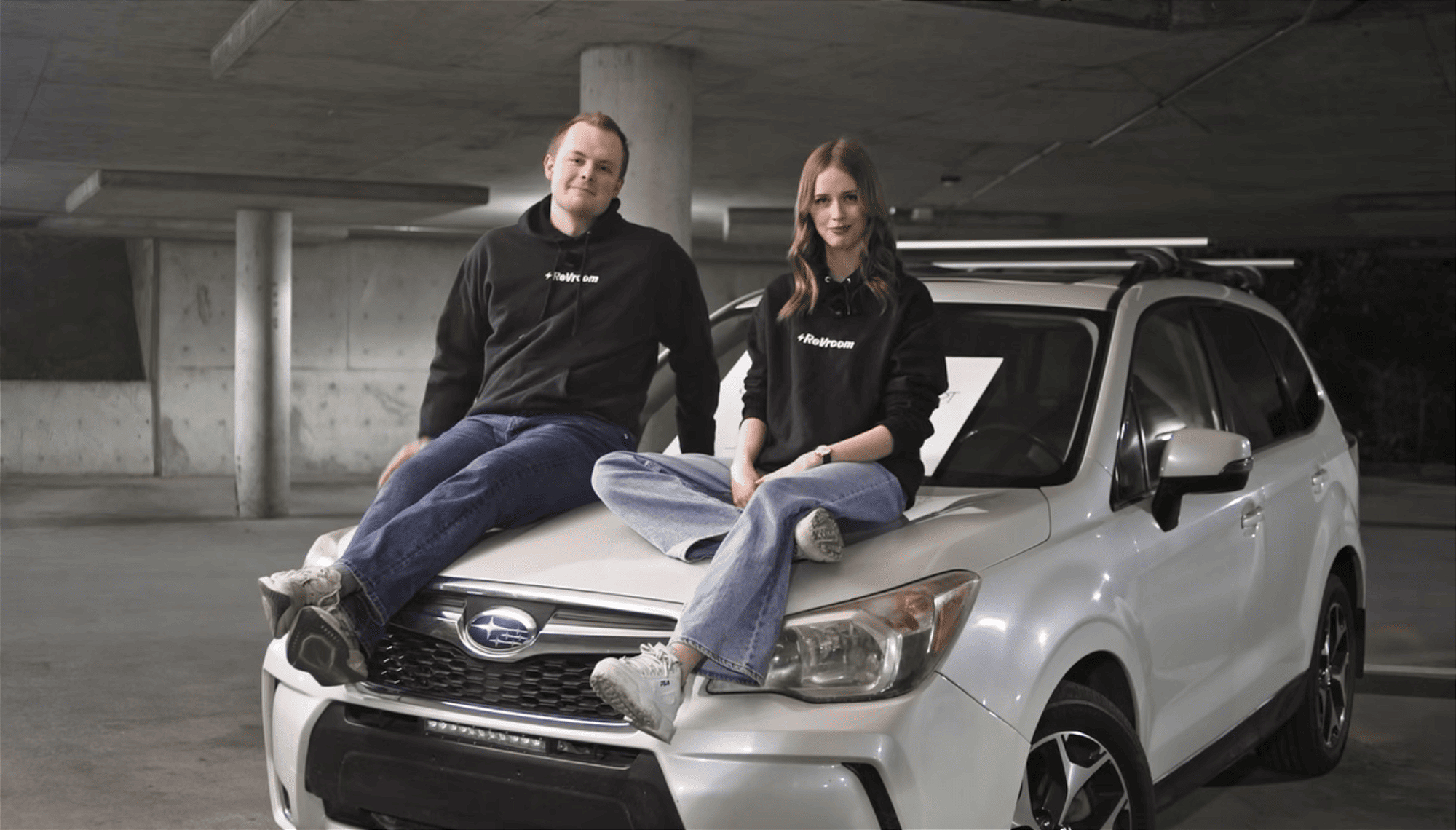
ReVroom co-founders Cameron Woolstenhulme and Paige Knudsen are betting that transparency, data, and a little attitude can reshape the way Americans buy cars. Photo: ReVroom
"The big marketplaces, they're not built for them," Knudsen says of rebuilt sellers. "Buyers have that experience like you and I do, where they go on there, see a great deal, then realize it's a rebuilt title, and they stick their nose up to it and move on."
ReVroom was built specifically to solve both sides of that problem. On the buyer side, every listing includes what Knudsen calls the "ReVroom Analysis," which is a graphic overlay on the vehicle image that highlights exactly where damage occurred, a severity rating, the type of incident, the auction and repair dates, and miles driven since repair. Buyers can filter not just by make, model, and mileage, but by damage type and severity — something no other automotive marketplace offers.
"If they're only interested in vehicles that have had hail damage of a minor severity, they can put that in there," she says. "They want a Toyota Corolla, hail damage, minor, they can look that up and see what's available near them."
That analysis engine was one of the hardest things Woolstenhulme has built. "One of my personal biggest hurdles was figuring out how to make the AI damage analysis cheaper," he says. "In the beginning, it cost us over a dollar per listing to run. Through a series of small steps and aha moments, I've whittled it down to less than one cent." The optimization required him to go deep on how large language models work, approaching the problem from every angle simultaneously. He's still not satisfied. "I still want to get it even cheaper."
Beyond cost, Woolstenhulme sees the AI work as generating something more durable than a feature; it's producing proprietary data. "We have some fun AI magic on the backend powering the useful features for customers that, just by nature of how it's used, generates huge amounts of proprietary training data for all things cars that's exclusive for us to make the site better," he says.
On the seller side, ReVroom gives professional rebuilt dealers a platform designed around their product rather than against it. Most dealers in this space spend significant portions of their marketing budgets listing on platforms where their inventory is actively penalized by buyer psychology. "For us, we go to the seller and say, hey, we put these pre-repair photos on there," Knudsen explains. "At first we thought maybe these dealers want to get away with something and don't want to show people this transparency. However, they generally do, because they take pride in the vehicles they've sourced."
A Launch That Got Out of Hand
ReVroom went live, sort of, on a Tuesday night in December 2024. The site had articles, some scraped listings, and not much else. But Knudsen decided to post about it on LinkedIn anyway.
"I did a post really late at night, just wanting to launch it and get it out there. I thought we could make it good later," she says. "And we shouldn't have done that. Because within thirty minutes, that post was going absolutely crazy."
By the end of the week, her post had cracked 150,000 impressions. She had maybe 100 LinkedIn connections at the time. Her phone wouldn't stop. Her test listing — the top-trim Subaru Forester she'd spent eighteen months hunting down — had dozens of people trying to buy it.
"I'm in my classes the next day, silencing phone calls, turning my phone off because the notifications are killing my battery," she laughs. "I'm in the Joseph Smith Building calling Cameron saying, Cameron, the post is at ninety thousand. There are two hundred comments on it." She pauses. "I was on the verge of tears. Just so grateful that people cared. After all that grinding, the very second we push it out, thinking, ‘just do it, nobody cares, it's fine.’ To realize that people actually did was amazing."
While Knudsen was fielding calls between classes, Woolstenhulme had a quieter morning, by design. "I had a peaceful night but woke up to a lot of activity on the site, to which I smiled and enjoyed the show," he says. That calm was deliberate: knowing ReVroom had explosive growth potential from the beginning, he had built the platform to be horizontally scalable, meaning the site's resources automatically expand to handle any volume of traffic. "So I just messaged excitedly back and forth with Paige while we cheered and cried and planned our next steps."
The marketplace itself didn't go fully operational until April 2025. Today, the platform lists between 2,500 and 3,000 vehicles at any given time, almost all from professional sellers, mostly 2019 and newer, often high-trim. ReVroom currently monetizes through dealer subscription services and backend seller tools, with a small private-party listing fee in development. Revenue from buyers finding value has been easy to document anecdotally: a Marine mechanic from Colorado recently drove to Salt Lake City, bought a Toyota Sienna for his growing family at roughly 60 percent below market, and told Knudsen he'd buy every car he owns for the rest of his life from ReVroom.
Sandbox, and the Art of Not Pretending
Knudsen is enthusiastic about what BYU's Sandbox program gave her, and candid about where its limits showed.
"A lot of the time in business classes, they're awesome, but sometimes it felt like we were playing pretend. We would make a business plan, but we never ran with it. We never saw if it actually worked. We just kind of said that we thought it would," she says. "Sandbox came around and I applied for that thinking it would be the exact opposite."
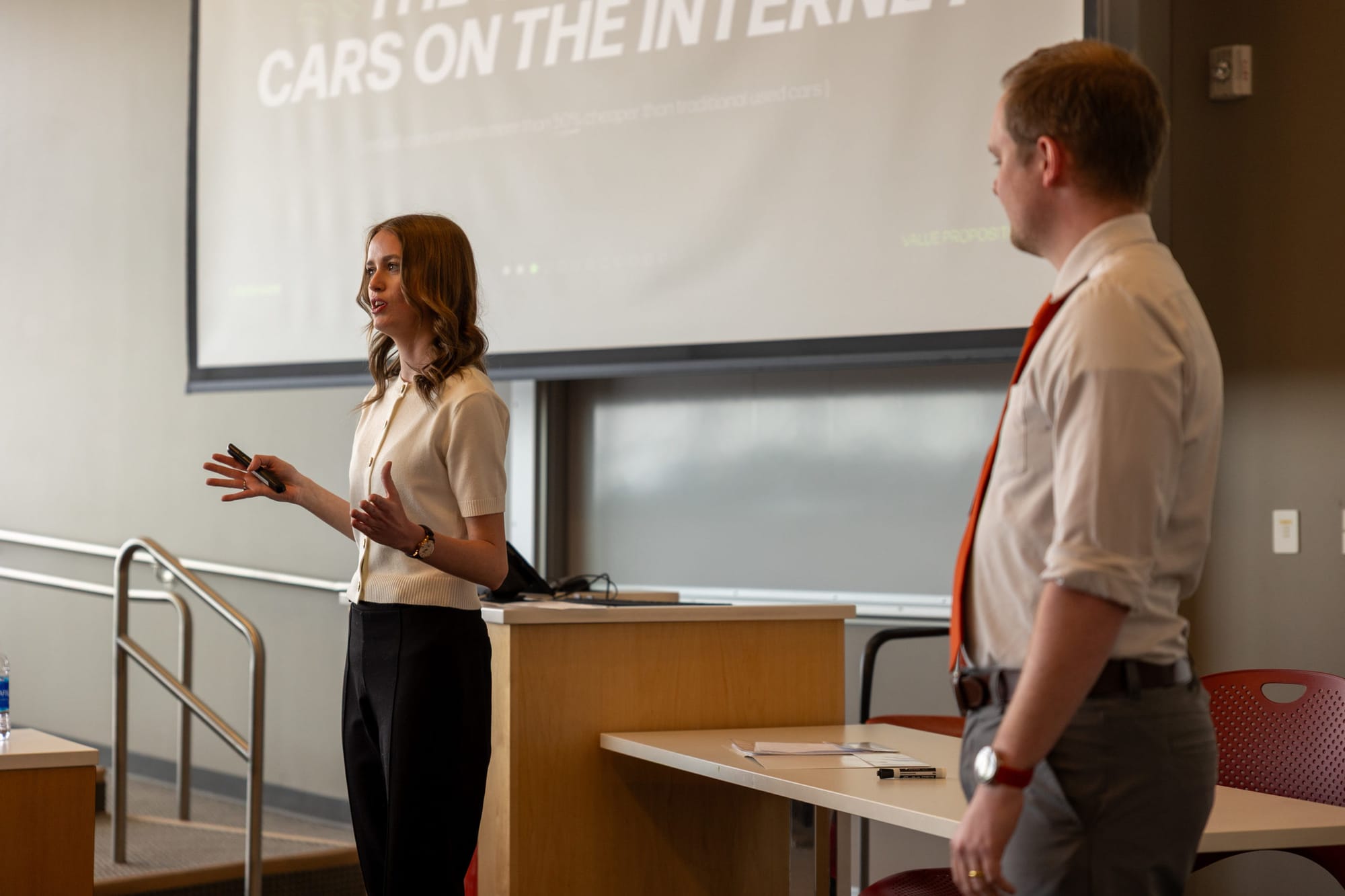
Knudsen and Woolstenhulme presenting ReVroom at BYU Sandbox — the program that gave them the time, structure, and accountability to stop pretending and start building.
The program gave Knudsen and Woolstenhulme time, structure, and community. But building a marketplace, which effectively means building two businesses simultaneously, one for buyers and one for sellers, didn't always fit neatly into a framework designed for SaaS companies. "They kind of at times didn't know what to do with us," she says. "We had to find other resources outside of Sandbox, other founders who had done similar things."
What Sandbox gave them that couldn't be replicated was the pressure of a real deadline, real peers, and the accountability of showing up. "The one thing that really made my experience at BYU great was Sandbox. Because we weren't pretending anymore. We were really doing it."
Woolstenhulme points to two things that he believes are genuinely hard to replicate. The first is ReVroom's accumulated reputation and SEO. It is the result of months of content work and data investment that can't be bought overnight. The second is the data pipeline itself. "The way we get data for customers is one that isn't easily replicated, because no one understands the huge, separated sources that it trickles from," he says.
But perhaps the clearest sign that the product is working came from an unexpected phone call. Unsure whether buyers were actually finding value, Knudsen on a whim called a recent lead who had requested information on a listing. "That user turned out to be driving over eight hours to get the car and absolutely loved the deal they had found on ReVroom," Woolstenhulme recalls. "It was just an amazing aha moment where we knew we were successful in helping real people get the best deals possible on their next ride."
The Stigma Problem Is the Product
Perhaps the most interesting thing about ReVroom is that the stigma it's fighting isn't entirely irrational, and Knudsen knows it.
"There's a lot of misinformation. And unfortunately, when you go to the people who know the most, they're usually trying to sell you something," she says. "We're trying to give buyers that transparency. To give them the resources so that even if a seller tells them one thing, they have the independent picture."
She thinks of the vehicles the way she once thought about shelter animals, after years of wanting to be a veterinarian and working at an animal shelter before pivoting to business. "It's like pound puppies. These cars have been rejected, they're on death row, they're on their way to be euthanized. And some great couple comes in and gets this budget car and gives it a new life. And that new life is better than the one they had before."
That emotional framing isn't just poetic. It's strategic. ReVroom's branding deliberately bucks the utilitarian, corporate aesthetic of traditional automotive platforms. The name itself — a portmanteau of "re" and "vroom" — is built for optimism. The imagery on the site shows cars in motion, in nature, on adventures. The copy doesn't talk about discount vehicles. It talks about going further.
"ReVroom is like vroom again, which is a little bit silly," Knudsen admits. "But we wanted it to be totally positive. No connections to cheap cars or lemons. More like recycle, rebel, ReVroom." She smiles. "Our motto is 'go further.' These cars are literally going further than they would have if they got scrapped. Your dollars are literally going further, too."
What's Next
ReVroom is currently in the middle of a pre-seed fundraising round, with several checks secured including some institutional support. The capital will go toward expanding the development team, building infrastructure to support inventory beyond Utah, and deepening the data partnerships that power the platform's transparency features.
The geographic roadmap after Utah: Colorado, Texas, California, and Florida.
The outside world is already taking notice. In March 2026, Knudsen and Woolstenhulme competed against twenty of Utah's top collegiate startups at the Tim Draper Utah Entrepreneur Challenge, hosted by the University of Utah's Lassonde Entrepreneur Institute and covered by this publication. They took second place and a $10,000 prize, a strong signal that the rebuilt title market is a serious business, not just a niche curiosity.
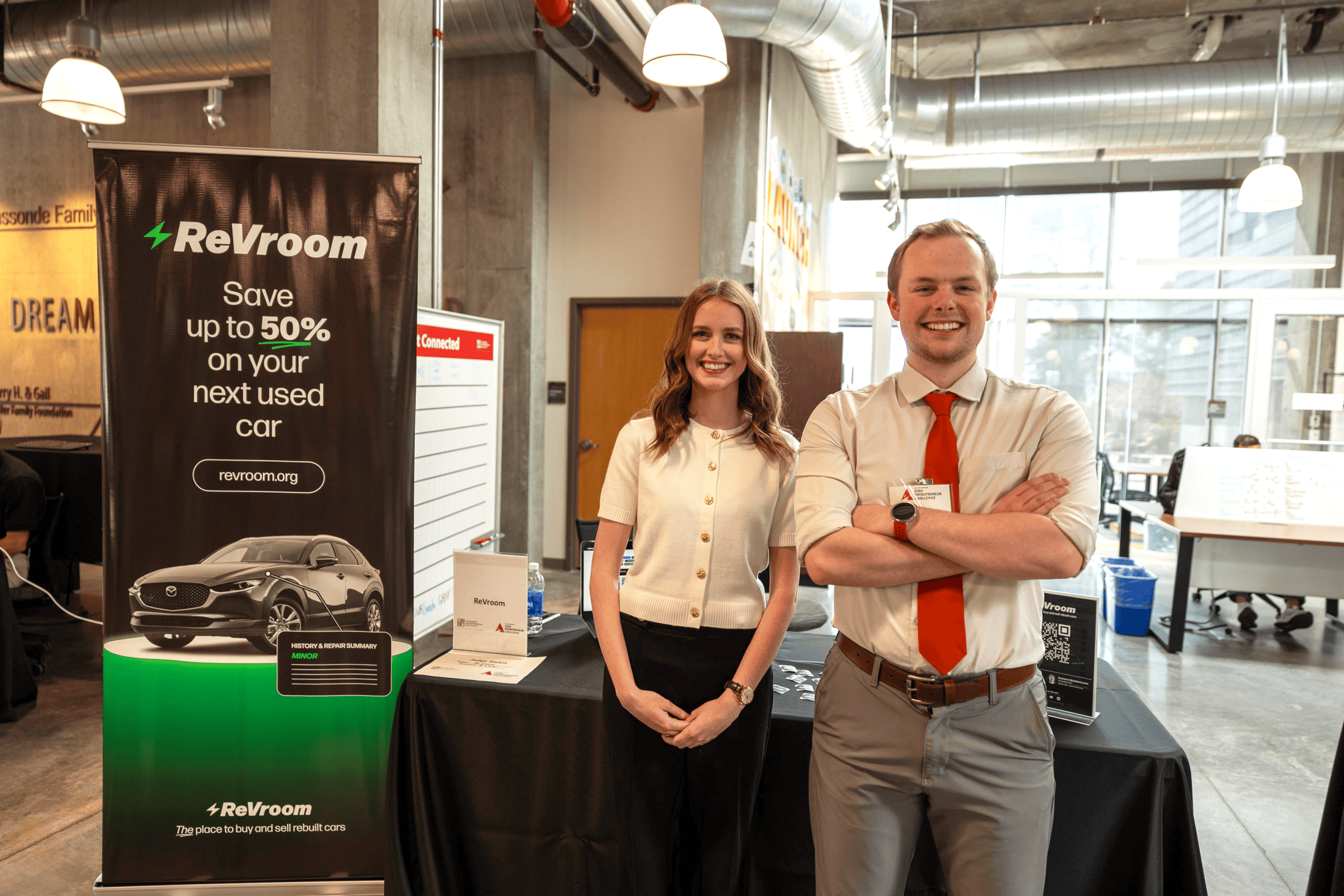
ReVroom Co-founders: Paige Knudsen (CEO) and Cameron Woolstenhulme (CTO)
Woolstenhulme's vision for what comes next is unambiguous. "I firmly believe that in the next couple of years you'll see that we become the place to buy and sell the best deals on cars anywhere in the United States," he says. "Our hope is that when someone thinks about getting amazing savings on their next car, they think, let me check ReVroom." For him, the mission has always been personal. "It's built by people who are always looking for those deals themselves. We're building the tools we've always wanted to see."
For Knudsen, the mission is clear even when the road is uncertain. "Vehicle prices are going up and up. They're rising faster than inflation," she says. "If we could help people have access to really affordable options, protect those more financially vulnerable individuals, and also serve a market that has really no support, that's exactly what we do."
She graduated from BYU on a Friday. The week before, she was closing investor meetings and onboarding new dealers. The week after, she was still working. The discomfort, she has decided, is the point.
"I think you just don't stop doing stuff," she says. "And if you're trying to be diligent and doing the right things, then eventually you're good. Cameron and I are both very stubborn about things we care about and know are important." She pauses, then laughs. "I'm always just motivated to do the greatest good of which I'm capable. This has been a good outlet for that."
ReVroom is currently live at reVroom.org and serves the Utah market. The company is actively fundraising its pre-seed round. Knudsen and Woolstenhulme are graduates of BYU's Sandbox entrepreneurship program.
Share this article
The link has been copied!
Your link has expired. Please request a new one.
Your link has expired. Please request a new one.
Your link has expired. Please request a new one.
Great! You've successfully signed up.
Great! You've successfully signed up.
Welcome back! You've successfully signed in.
Success! You now have access to additional content.