One of Utah's Most Remote Schools Finally Gets Fast Internet. For the Navajo Nation, the Harder Work Is Still Ahead
A 10-year, 200-mile fiber project finally connects Navajo Mountain High School — one of Utah's last unconnected public schools — to high-speed broadband, marking a milestone for the Navajo Nation.
A 10-year, 200-mile fiber project reached Navajo Mountain High School this week — but the community's 27 students go home to a reservation where most households still have no connection at all.
Navajo Mountain, Utah — June 4, 2026
For a decade, the principal of Navajo Mountain High School watched students make do. The school sits on a remote mesa in San Juan County, south of Lake Powell and near the Arizona border. In fact, it is reachable only by a long desert road that crosses into Arizona before looping back into Utah. Until this week, its internet connection ran through a microwave relay that is limited, unreliable, and long since maxed out.
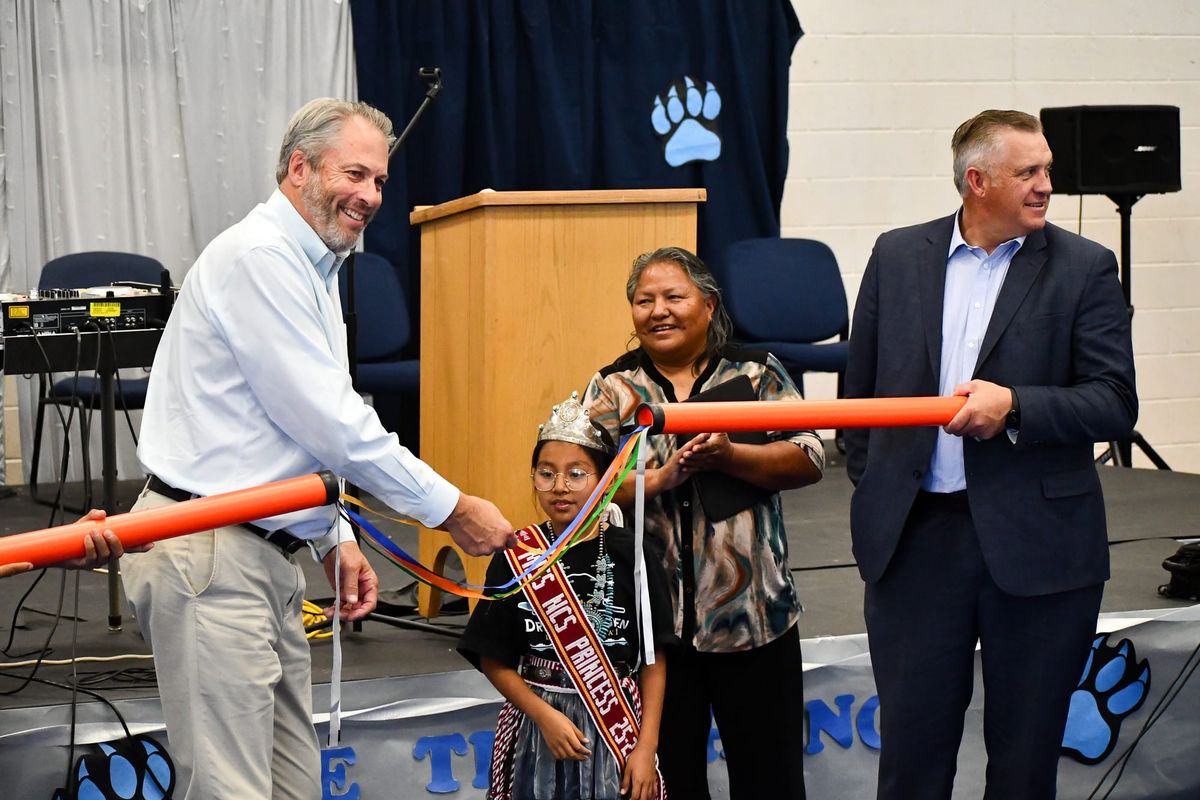
On June 2, 2026, state, tribal, and education leaders gathered at the school to mark a milestone: the completion of a 200-mile fiber network connecting one of the last public schools in Utah to high-speed broadband. The project, a decade in the making and initiated by the Utah Education and Telehealth Network, was built by Emery Telcom and crosses three jurisdictions — Utah, Arizona, and Navajo Nation land — before reaching the 27-student school perched above the canyon country of the Colorado Plateau.
A divide measured in decades
The Navajo Nation spans 27,000 square miles across Arizona, New Mexico, and Utah, a land base larger than West Virginia. As recently as 2014, fewer than 4% of its residents had access to even basic wireline broadband. Even after years of investment, a 2021 Census Bureau analysis found the Navajo Reservation's household broadband subscription rate stood at just 33%. In comparison, Arizona's rate is 88% statewide and New Mexico's stands at 80%. In 65 of the Nation's 109 political chapters, satellite remains the only internet option.
When service is available, it's expensive. Internet on the Navajo Nation runs $21 to $44 more per month than the national average, a premium that collides with a reservation where median household income is roughly $32,000 and unemployment has historically exceeded 40%.
COVID made the cost of that gap impossible to ignore. When Navajo Nation schools shuttered in spring 2020, the reservation became one of America's early COVID hotspots. At its peak in May 2020, the Navajo Nation recorded 2,304 COVID cases per 100,000 people, surpassing New York state's rate of 1,806 per 100,000, making it the highest infection rate in the country at the time.
Students who had relied on school connections for internet access suddenly had nothing. Approximately 60% of students in Navajo Nation schools were without internet access during the pandemic, according to one educator's estimate from schools in the district. Students drove miles from home to park near a building with a Wi-Fi signal, sitting in trucks or on tailgates to attend class.
The funding puzzle
The project did not have a single backer. Brock Johansen, CEO of Emery Telcom, said it required assembling a patchwork of public and private funding before construction could begin.
For Phase 1, running fiber from Blanding south through White Mesa, Bluff, and Montezuma Creek, the primary mechanism was the FCC's E-Rate program, which funds school and library broadband through a tax on telephone and internet customers. The Utah Navajo Trust Fund, Utah Navajo Health System, and UDOT contributed a combined $1 million in matching funds to complete that phase.
The final leg to Navajo Mountain proved harder. With a price tag of roughly $10 million and a route requiring construction through northern Arizona, the project needed a different lever. San Juan County Commissioner Bruce Adams secured a $1 million Utah Legislature appropriation, a compartively modest sum for infrastructure, but one that unlocked a 9-to-1 federal match from the FCC, bringing roughly $9 million in federal E-Rate funds to the table.
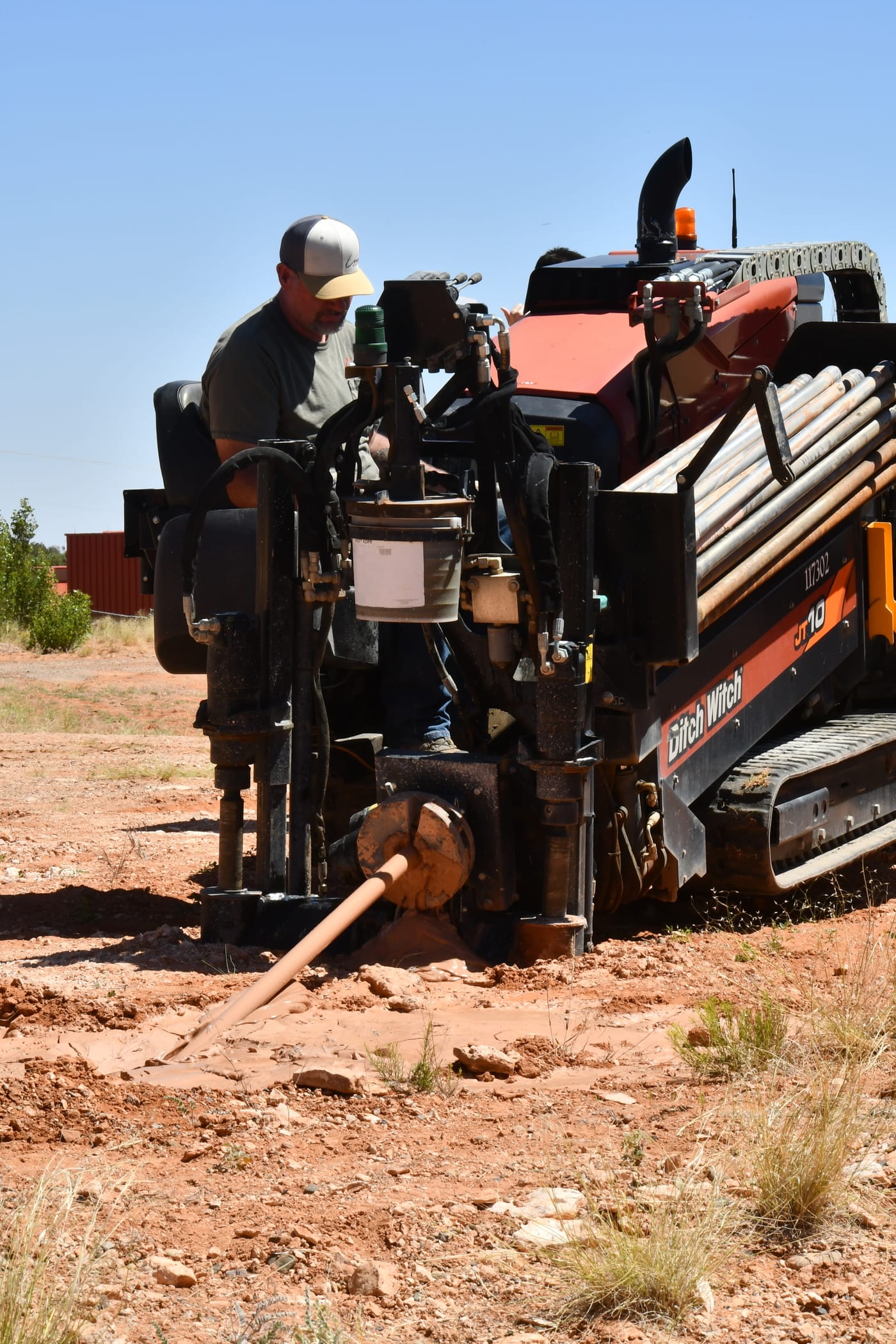
Emery Telcom demonstrates fiber bore at the Navajo Mountain celebration event. Photo Courtesy: Utah Education and Telehealth Network
The gap between school and home
What was celebrated this week connects a school. It does not yet connect homes.
That distinction matters enormously on a reservation where, for many students, the school has long been the only place to reliably get online. The fiber terminating at Navajo Mountain High School can serve as backbone infrastructure for future household connections. Other providers can potentially pay to access the line and extend service to residences.
"Once the fiber is down there, it will open the market to numerous providers," Johansen said when the project was first announced. That prediction now has a chance to be tested.
The path to household connectivity runs through an effort of a different scale entirely. In February 2026, the Navajo Nation announced it had secured approximately $285 million in federal BEAD funding across three states. It is the largest broadband infrastructure investment ever awarded to a tribal nation. BEAD is a $42.45 billion federal grant program funded by the Infrastructure Investment and Jobs Act, administered by NTIA, aimed at connecting every American to high-speed internet through infrastructure partnerships.
The money, drawn from Arizona ($140 million), New Mexico ($111 million), and Utah ($26 million), supports a $373 million broadband plan the Nation will own and control, targeting more than 31,000 unserved and underserved households. Construction is expected to begin as early as late 2026, with completion projected by 2030.
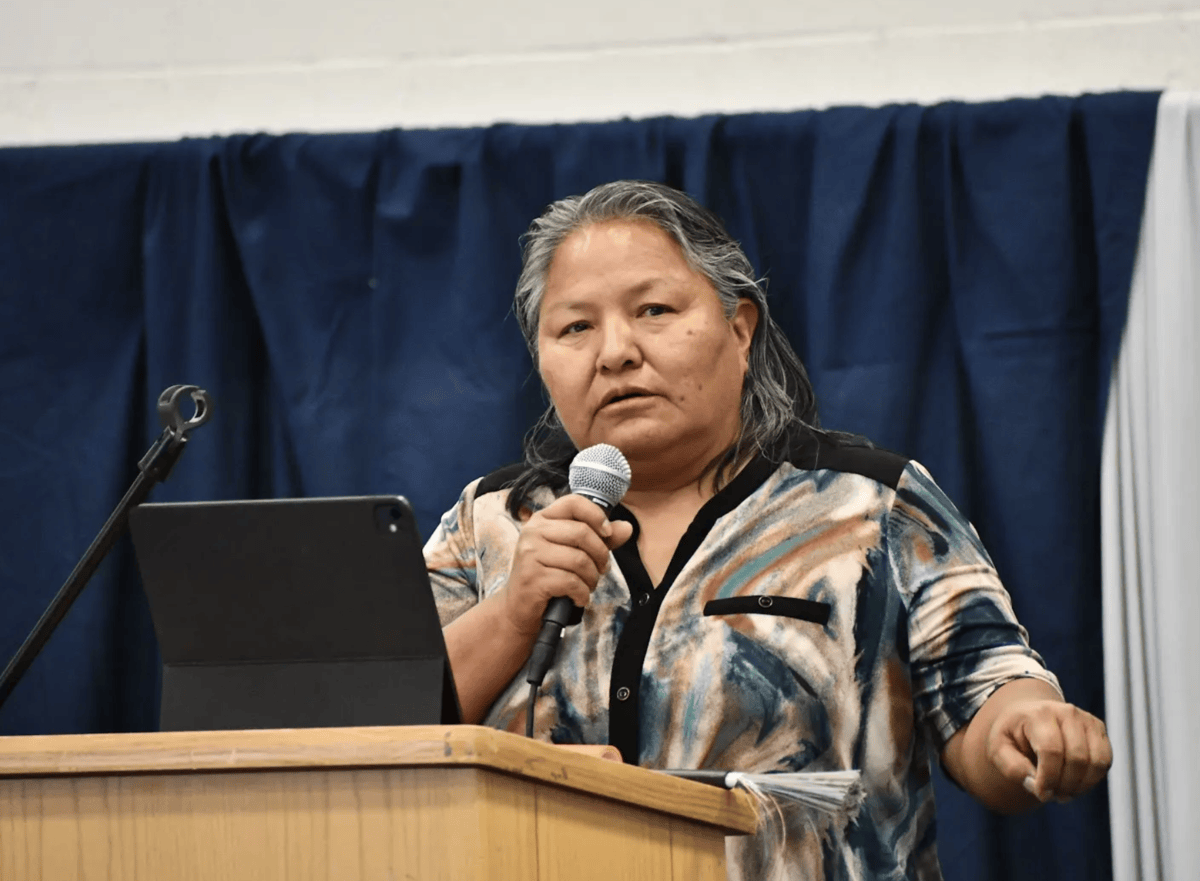
Sonia Nez, who spoke at the Navajo Mountain ceremony, and who serves as Executive Director of the Navajo Nation Broadband Office, is running that effort simultaneously. "This new infrastructure is what makes everything else possible," she said at the event.
Sonia Nez, Executive Director of the Navajo Nation Broadband Office, speaks at the fiber completion ceremony at Navajo Mountain High School. "This new infrastructure is what makes everything else possible," she told the audience — a line that carries double meaning: the school connection she was celebrating is the same backbone the Navajo Nation is counting on to justify last-mile household broadband across the Utah portion of the reservation.
“It means a student here at Navajo Mountain High School can research a college application at the same speed as a student in Salt Lake City, Utah,” said Nez. She added, “it means a teacher can bring video lessons, virtual labs, and online resources into the classroom without watching a screen freeze or video buffer. It means a kid who wants to be an engineer, a doctor, a coder, or a teacher can actually pursue that online right here in the great community of Navajo Mountain.”
Navajo Nation President Buu Nygren, who also attended the June 2nd ceremony, pointed to impacts beyond the classroom. Local students have already been participating in robotics and technology programs, opportunities that reliable connectivity now makes more viable from home. Broadband, Nygren noted, also strengthens public safety and emergency response in a community so remote that the nearest hospital requires a drive across state lines.
A healthcare clinic serving the Navajo Mountain area will also benefit from the fiber connection, expanding access to telehealth services that have long been out of reach. Nygren credited the sustained commitment of educators, healthcare providers, tribal officials, and private partners for seeing the project through what he called "numerous challenges," speaking to a decade-long effort that outlasted funding cycles, permitting delays, and a pandemic.
Infrastructure as sovereignty
The BEAD funding carries a structural distinction that prior rounds of federal broadband investment did not: the Navajo Nation will own the infrastructure it builds. That framing, broadband as a tribal asset, not a service delivered by outside providers, has been a deliberate priority for NNBO.
"NNBO is laying the groundwork for a robust telecommunications strategy," Nez's office stated in recent materials, describing plans that include new 5G mobile towers and expanded fiber coverage across Arizona, New Mexico, and Utah. The Navajo Nation has already allocated $77.8 million to begin construction of 78 new towers and over 1,500 miles of fiber optic lines, with BEAD funds targeting the last-mile connections to individual homes.
Whether the students at Navajo Mountain High School, all 27 of them, will be among the first to benefit from that buildout is a question the fiber under their school now makes answerable.