From Scrunch to Searchable: How Utah Became a Launchpad for the AI Search Economy
Searchable, a UK-based AI visibility startup, has opened a Salt Lake City office staffed by two former Scrunch AI employees whose previous company was just acquired by Sitecore for a reported $225 million.
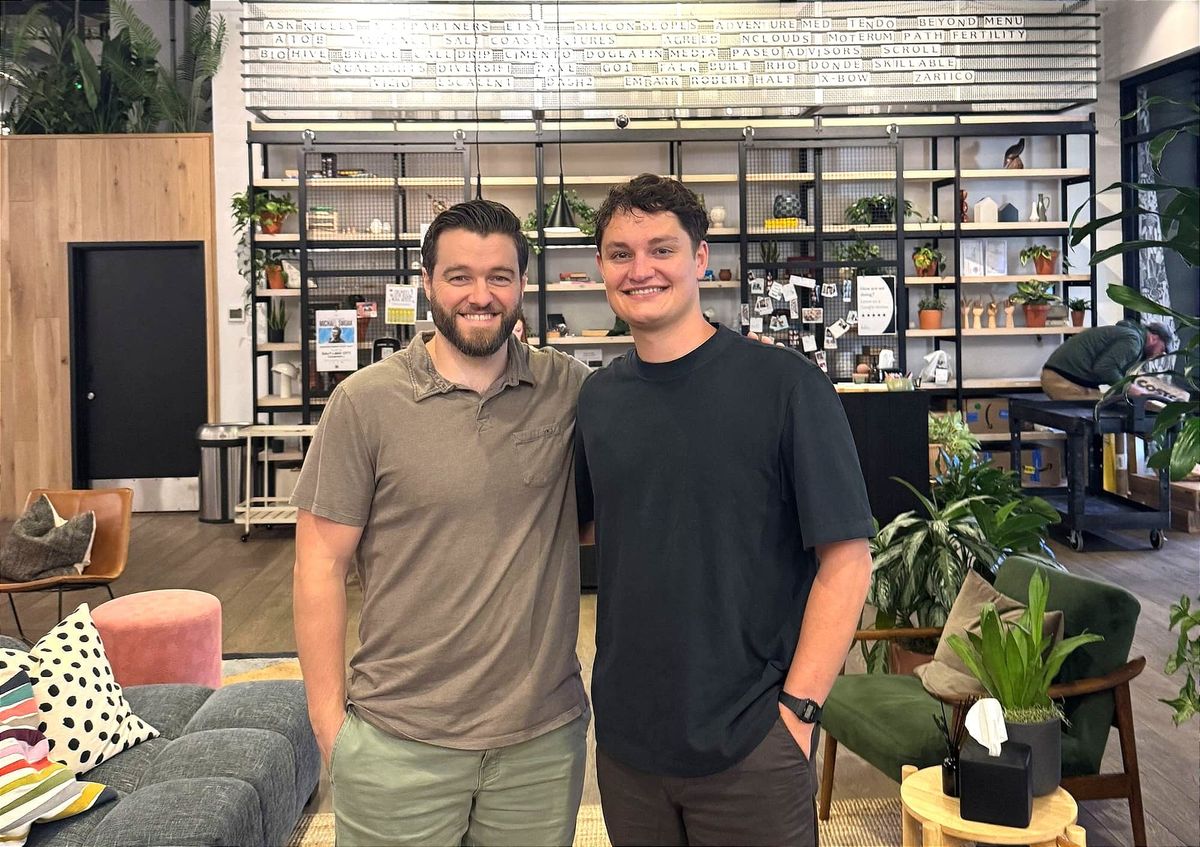
Searchable's Utah Team: Tony Posselli (Head of Sales) and Preston Boling (Founding GTM), Gateway Kiln, downtown Salt Lake City. Photo: Searchable
Searchable's Utah Team: Tony Posselli (Head of Sales) and Preston Boling (Founding GTM), Gateway Kiln, downtown Salt Lake City. Photo: Searchable
Salt Lake City, Utah — August 28, 2026
Fourteen months ago, Preston Boling joined Scrunch AI as one of the company's earliest employees, entering a technology category that barely had a name.
Two months ago, Sitecore acquired Scrunch in a deal reported at $225 million.
Three weeks ago, Boling joined Searchable, a London-based AI search company that had just opened an office at Salt Lake City's Gateway Kiln — roughly two miles from where Scrunch had established its Utah presence.
Boling isn't making the move alone. Tony Posselli, who led sales for Scrunch's competing AI-search business, has joined Searchable as head of U.S. sales. Boling is Searchable's other U.S. employee, helping lead the company's go-to-market operation.
The two hires give Searchable something that would be difficult to manufacture quickly: people who have spent more than a year selling, explaining and learning how a new kind of search works.
"There's not a set playbook around how to grow this industry, because the industry never existed or even had a name 18 months ago," Boling told TechBuzz.
That is changing quickly.
Searchable launched in December 2025 and raised $14 million in May at an $85 million valuation. The company says it has grown to thousands of customers and is using its new capital to expand in the U.S. and continue developing a platform designed to help companies understand — and ultimately improve — how they appear when consumers ask AI systems for answers. Its Salt Lake City office is Searchable's first U.S. location.
Search is changing, and so is optimization
For decades, digital marketing has revolved around a relatively simple question: How do I get my company to appear near the top of a Google search? Searchable is betting that a growing share of that question will soon sound different.
Instead of typing keywords into Google and choosing from a page of links, consumers increasingly ask ChatGPT, Gemini, Perplexity and other AI systems questions such as, "What's the best running shoe?" or "Where should I buy soccer cleats for my child?"
The answer isn't a list of blue links. It is a recommendation.
For a brand, that creates a new problem: How do you know whether an AI model is recommending you, how often it is recommending you, what information it is using to make that recommendation and why it prefers a competitor?
That is what Searchable calls AI visibility.
"Ultimately, when someone is using ChatGPT, they might ask, 'What's the best transmission repair shop in Salt Lake?' or 'My kid needs some soccer cleats, where should I buy them?'" Boling said. "What we start to do is track what brands show up in those actual responses."
The company monitors those answers across 10 AI engines, looking at both mentions and citations and attempting to identify the sources influencing the models' answers.
Searchable says its data set now encompasses close to 1 billion AI citations and more than 400 million brand mentions. The company said in May that it had onboarded nearly 1,000 customers; Boling said the customer count has since grown into the thousands.
Those figures are company-reported, but they illustrate the scale of the new market the company is pursuing.
AEO, GEO, or just search?
The emerging discipline has already accumulated competing names.
Some companies call it AEO, or Answer Engine Optimization. Others use GEO, or Generative Engine Optimization. The terminology itself reflects how young the industry is. Boling has been working in the field for roughly 16 months. When he entered it, he said, there were only a handful of companies pursuing the idea. Now he estimates there are roughly 120 companies worldwide working somewhere in the AI-search space.
The basic distinction from traditional SEO is important. Search engine optimization is largely concerned with human search behavior: What are people searching for? Which keywords have volume? How can a website rank higher in Google's results? AI-search optimization is more concerned with the behavior of the models themselves.
"SEO is more focused on the human behavior and AEO is more focused on the large language model behavior in AI search," Boling said. That does not mean SEO suddenly becomes irrelevant. In fact, Searchable's strategy is partly built around the overlap. Websites still need to be technically accessible. Structured data, site architecture, page speed and crawler access can affect whether AI systems can discover and interpret a company's information.
Searchable also looks at whether websites allow AI crawlers to access their content. But the company then takes another step: It tries to understand what the models actually do with that information.
Looking inside the answer
Consider a seemingly straightforward prompt: "What's the best running shoe?" An AI system may not treat that as one simple query. As Boling explained it, the model can effectively fan the question out into multiple considerations — perhaps the best running shoes for men, women or children, or products that fit different use cases — while consulting numerous sources. The eventual answer might cite only several sources. Searchable attempts to track both layers. It records the sources influencing the answer as well as the sources the model ultimately cites. It separately tracks whether a brand is mentioned without receiving a direct citation.
That distinction matters because a company can be present in an AI-generated answer without being one of the sources the model explicitly credits. Searchable then maps those results against a company's existing content strategy. If a brand wants to be more visible for searches involving running shoes, for example, the platform can examine whether the information influencing AI responses is coming from the company's website, competitors, Reddit, social media, user-generated content or third-party publications.
The result is intended to be more than a dashboard. It is supposed to tell a marketing team what to do next. "Then we start to map out exactly what your content strategy needs to be so that you can start to show up more frequently," Boling said.
The company can then monitor whether those changes increase a brand's visibility, mentions, citations and share of voice against competitors. That feedback loop is central to Searchable's pitch. It is not promising that paying the company will magically cause ChatGPT to recommend a brand. Instead, it is attempting to make the increasingly opaque behavior of AI search measurable enough for marketers to act on.
The problem with measuring AI search
There is one enormous difference between traditional search and AI search: Nobody knows exactly how many people are asking a particular question. Google provides an enormous ecosystem of keyword and search-volume data. AI companies generally do not provide equivalent data showing how many users ask ChatGPT for the best running shoes, the best accounting software or the best Peruvian restaurant in Salt Lake City.
That makes the basic marketing question, "How many people are searching for this?," much harder to answer. Searchable's response is to focus less on trying to estimate human search volume and more on measuring the behavior of the AI systems themselves. The company runs prompts at scale from a logged-out state, according to Boling, attempting to eliminate personalization that could otherwise influence results.
If a user has spent months talking to ChatGPT about a particular company, industry or product category, that history could influence the answers the user receives. Searchable's methodology is designed to capture a more standardized view of how the model responds without that personal history. The company then aggregates those results across its customer base and tracks changes over time. The objective is essentially to turn AI search from something marketers can observe anecdotally into something they can measure.
From data to an agent
Searchable's next layer is where the company moves beyond analytics. The platform includes an AI agent designed to interpret the data and turn it into recommendations and workflows. That agent has memory, Boling said, allowing it to retain information about a company's brand, initiatives and content strategy. Users can establish brand facts and identify whether information being returned by AI systems is accurate. The system can then use that knowledge when helping marketers develop content or analyze competitive gaps. Boling said the agent is its most-used feature.
That makes sense for a category that can otherwise produce an overwhelming amount of data. A marketing executive may not want to spend a day studying thousands of prompts and citations. Instead, the executive can ask the platform a question about performance and have it synthesize the information and generate a report for leadership or clients.
Searchable can also connect with tools such as Google Analytics 4 and Google Search Console, allowing marketing teams to connect AI-search activity with conventional web analytics. Boling sees the technology less as a replacement for marketing employees than as a force multiplier. "There’s kind of been a narrative around AI taking a bunch of jobs," he said. "But ultimately I think a lot of these companies ... are actually needing more humans because now that they can do two to three X what their company could do a year ago."
That philosophy is reflected in Searchable's description of itself as an "agentic marketing" platform: AI is not simply reporting what happened, but helping a marketing team determine what to do next.
Why Salt Lake City?
Searchable considered several U.S. markets before choosing Salt Lake City, including Austin, New York and San Francisco. Boling said the decision was influenced partly by the fact that he and Posselli were already in Utah (Boling in Saratoga Springs and Posselli in Ogden) and believed they could build a larger U.S. operation here.
The company also sees Utah's broader technology ecosystem as an advantage. A year ago CBRE ranked Salt Lake City No. 16 among North America's top tech-talent markets in its 2025 Scoring Tech Talent report. The 2025 report cited a 13.3% increase in the region's tech-talent workforce from 2021 to 2024 and a strong pipeline of technology graduates from Utah universities. Searchable's arrival also follows a notable Utah success story in the same emerging category.
Scrunch, which had established a Utah presence in 2023, was acquired by Sitecore in June 2026 for a reported $225 million.
For Searchable, the Scrunch connection is more than geographical. Posselli and Boling bring direct experience from one of the industry's earliest companies, while Searchable brings a different product philosophy and a much larger infusion of fresh venture capital.
Searchable raised its $14 million round at an $85 million valuation in May 2026 from Headline, a San Francisco-based global venture capital firm that backs founders building category-defining companies, investing from Seed and Series A through later-stage growth through dedicated funds around the world.
Boling said the funding round followed rapid growth, including $2 million in revenue during its first 4½ months and nearly 1,000 customers.
Searchable's founders are Chris Donnelly, Sam Hogan and Arya Nagabhyru. Donnelly, the company's CEO, previously built and scaled an enterprise SEO agency, an experience that Boling said is reflected in Searchable's effort to combine traditional SEO with AI-search optimization.
Chris Donnelly, Searchable's Co-Founder and CEO with Ogden-based Tony Poselli (US Head of Sales). Photo: Searchable
Building the U.S. operation
For now, Boling and Posselli are effectively the company's U.S. beachhead. "We're number one and number two in the U.S.," Boling said.
That will not remain the case for long.
Searchable is actively recruiting in Utah, with plans to build its U.S. operation over the coming months. The company is looking for people with experience in AI search and SEO, but also in sales, customer success, retention and account growth.
That hiring strategy reflects the company's ambitions. Searchable is not positioning Salt Lake City as a satellite sales office. Boling said the goal is to build a substantial team and grow the Utah operation into a significant part of the company.
The timing is notable. The AI-search industry itself is still being defined. Searchable is only eight months old. Its largest Utah competitor has just been acquired. New companies are appearing rapidly. And marketers are still trying to figure out what it means to optimize for an audience that is increasingly mediated by machines.
Searchable is betting that the companies that learn to measure that new audience will have an advantage. Its next product may push that idea even further. The company plans to introduce a product called "Prompt Universe" in September, designed to help companies identify the full universe of prompts relevant to their brands and determine which ones they should actually monitor. That could address one of the fundamental problems of AI-search optimization: If there is no reliable search-volume number telling a company which questions matter most, how does it decide what to measure?
Stay tuned. TechBuzz will follow up with an answer.
For Boling, the broader opportunity is straightforward. "Every business I talk to about AI wants the same thing," he said. "They want to see what AI says about them before their customers do." That may be the simplest description yet of the new marketing discipline Searchable is trying to build around.