At UVU, AI’s Future Becomes a Question of Human Control
At Utah Valley University, policymakers, technologists and civic leaders explored whether artificial intelligence can strengthen self-government while preserving human judgment, privacy, accountability and meaningful control over decisions that shape lives.
Fulton Library, one of the locations for the 2026 AI and the Future of Freedom conference at UVU, October 21, 2026. Photo: Mark Tullis, TechBuzz
Fulton Library, one of the locations for the 2026 AI and the Future of Freedom conference at UVU, October 21, 2026. Photo: Mark Tullis, TechBuzz
Orem, Utah - October 22, 2026
Artificial intelligence may make government information easier to find. Whether it makes government easier to understand, question and influence is another matter.
That distinction ran through the AI and the Future of Freedom conference at Utah Valley University on October 21 and 22. Across discussions of public finances, consumer protection, open-source technology and religious ethics, speakers returned to a question more consequential than how powerful AI might become: Who will retain the ability to make meaningful choices?
Utah State Auditor Tina Cannon offered one practical example. She described an effort to make annual comprehensive financial reports machine-readable, potentially allowing software to help people examine information that can be difficult to navigate in conventional documents.
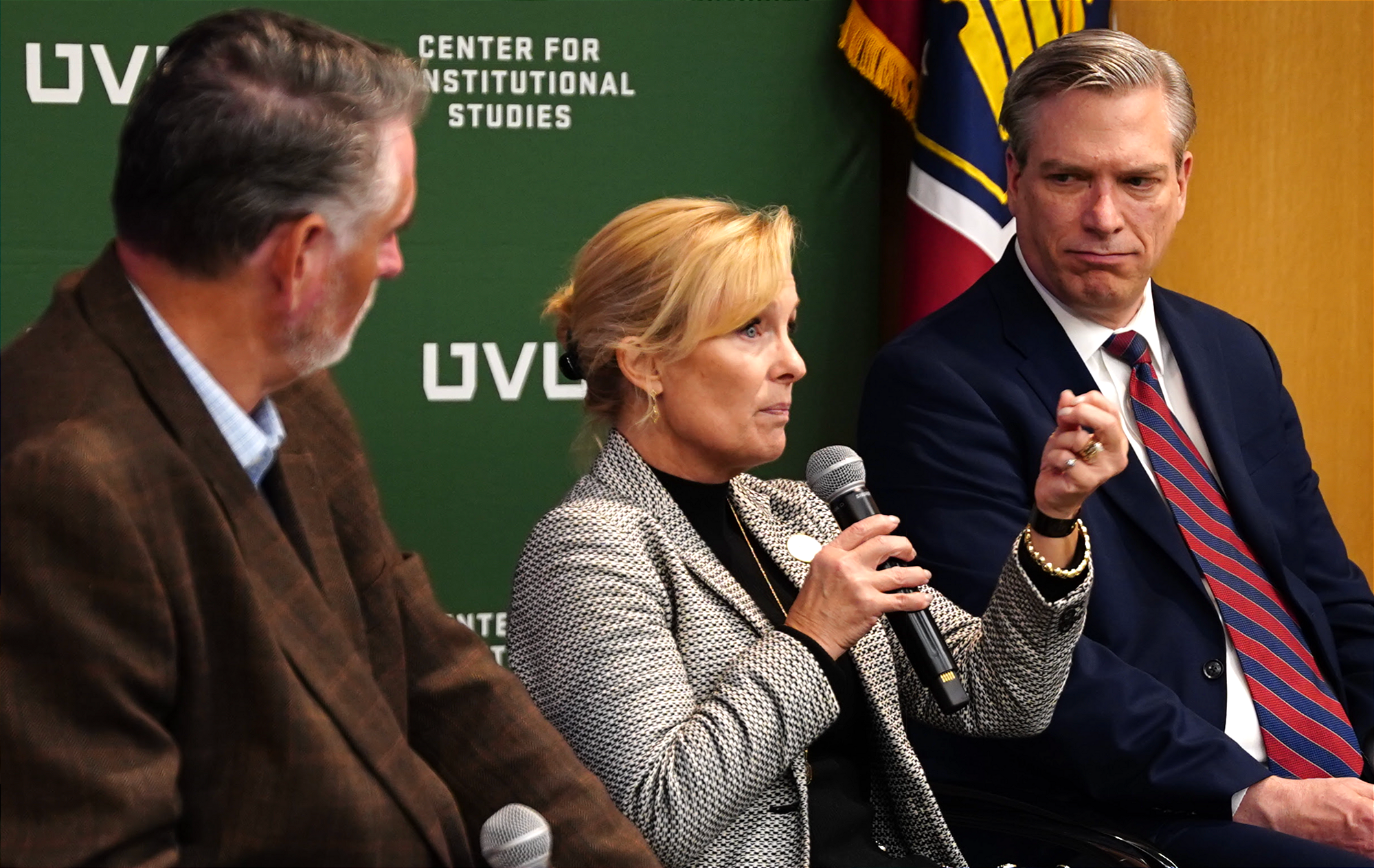
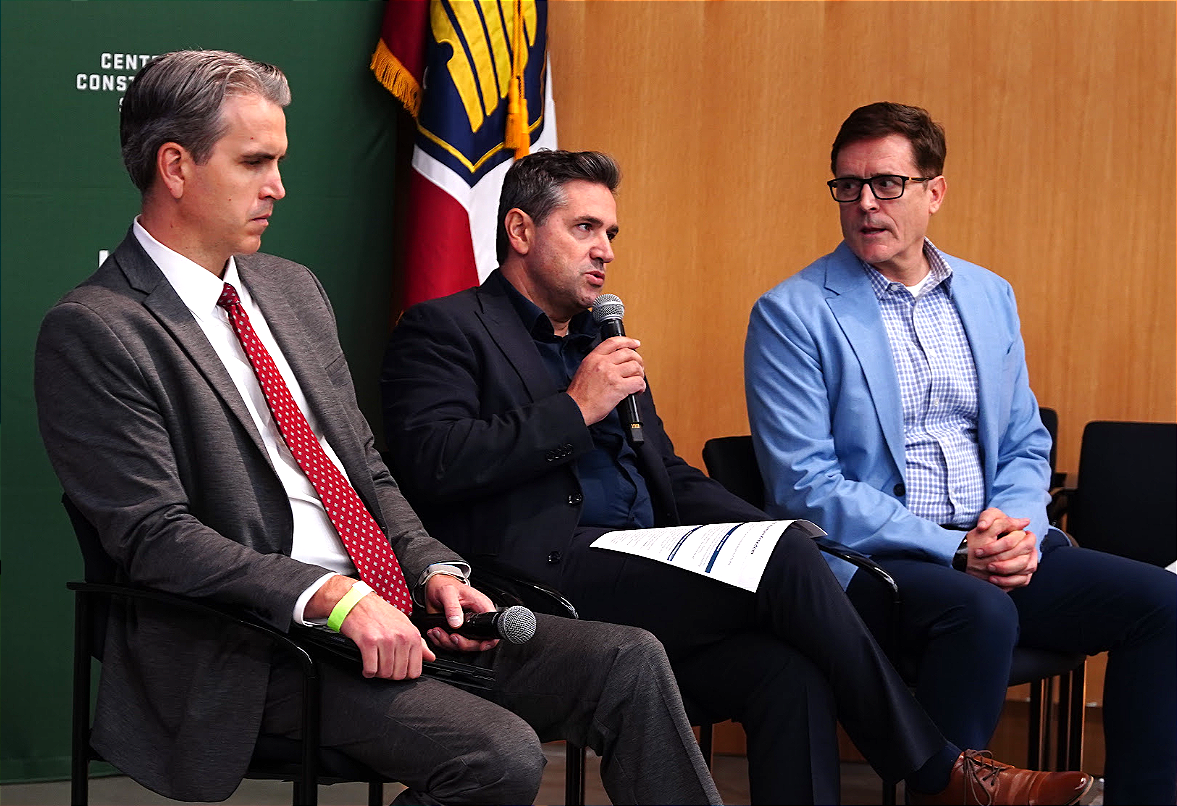
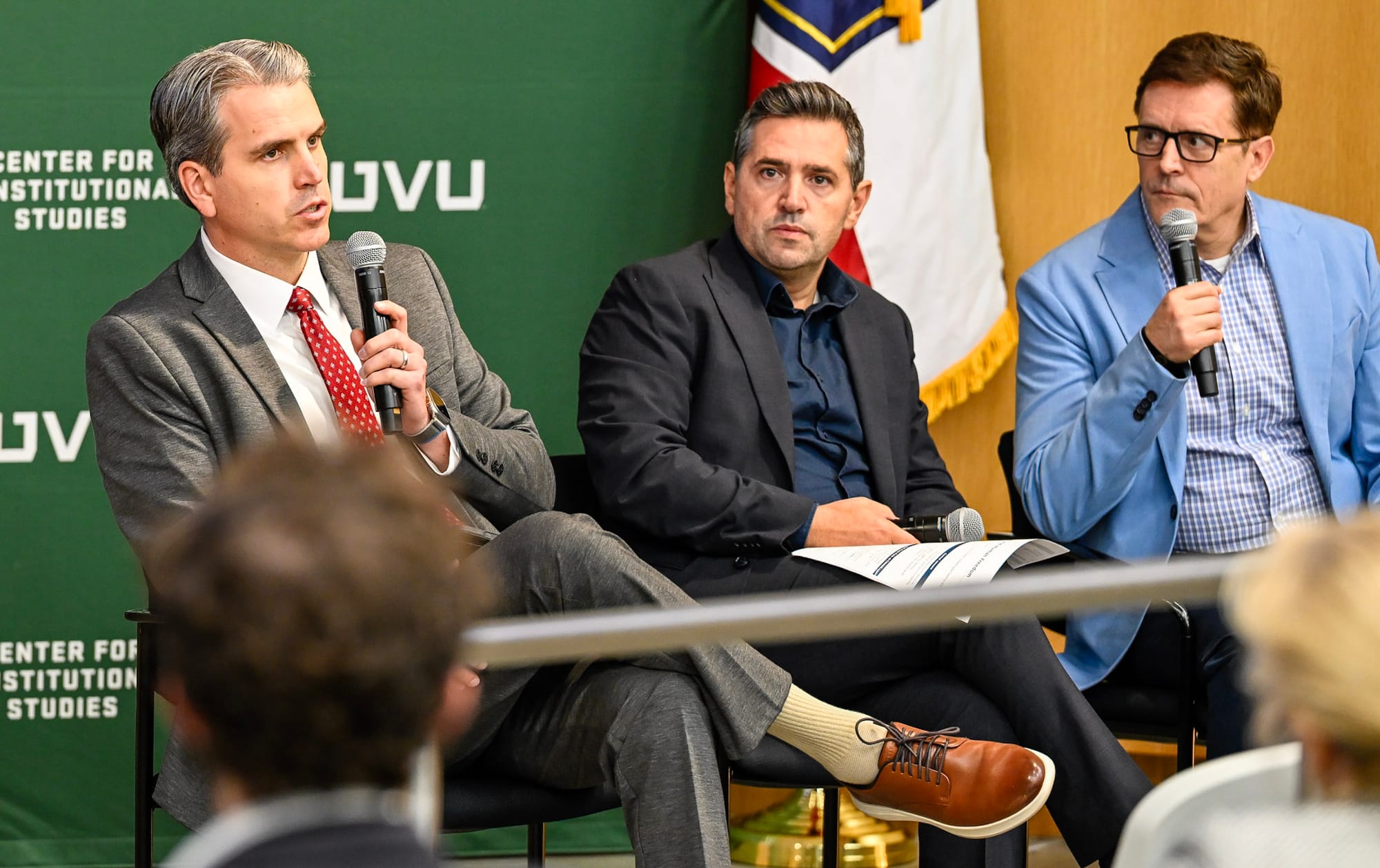
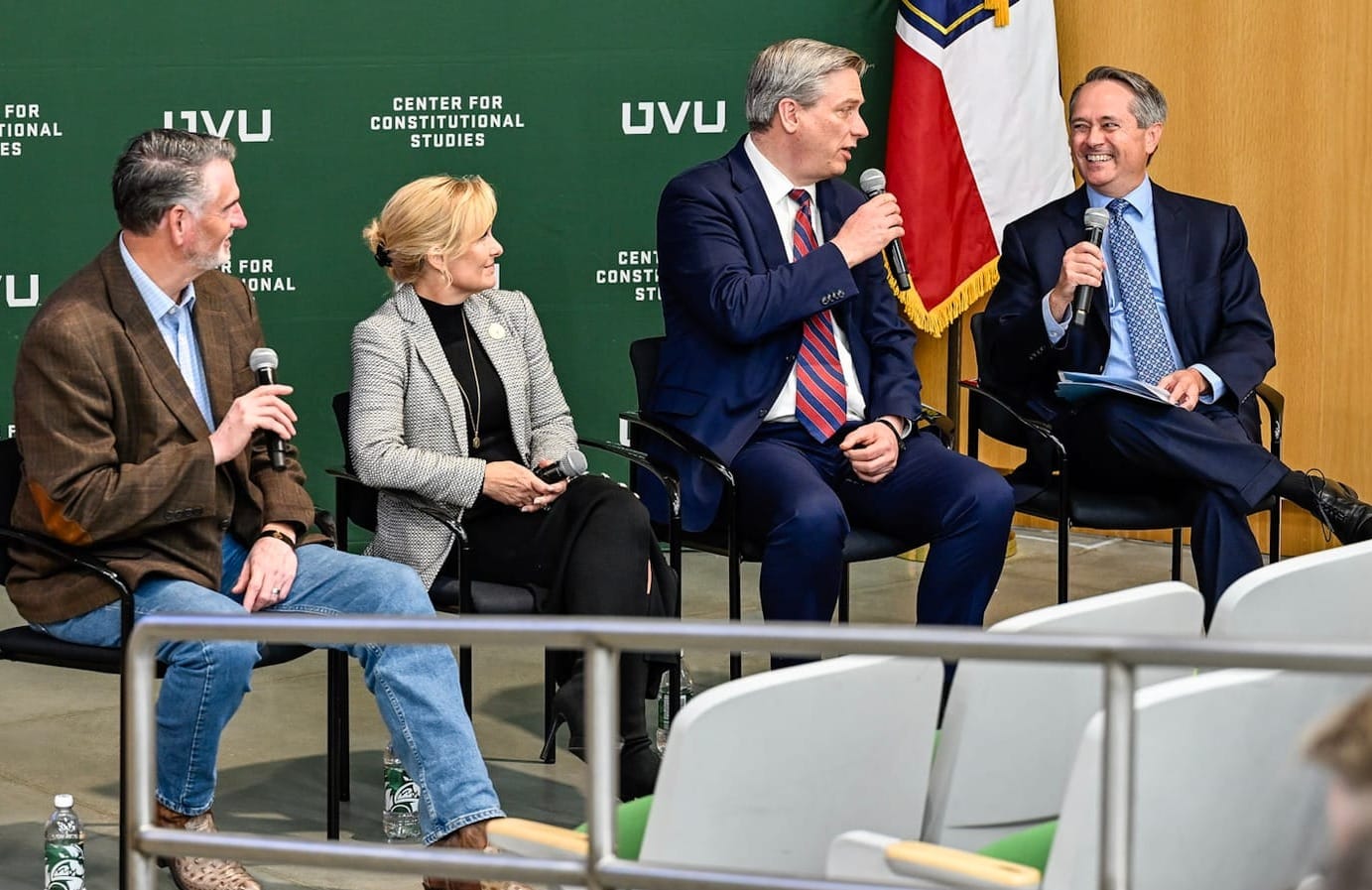
Tina Cannon, Utah State Auditor, speaking on the government panel, alongside Dan Elliott, Indiana State Treasurer and Marlo Oaks, Utah State Treasurer
Indiana State Treasurer Dan Elliott, illustrated the other side of that challenge with his account of a retirement-board presentation containing 350 slides. Information can be publicly available and still overwhelm the people expected to understand it.
Together, their examples framed a central tension of the gathering. AI could help citizens make sense of complex institutions. It could also place another layer of technology between people and the decisions affecting their lives.
The two-day conference brought policymakers, entrepreneurs, scholars and technology practitioners to UVU for discussions connecting AI with constitutional principles and civic responsibility. It was the second gathering in the AI and the Future of Freedom series, following an earlier event in Dallas in May, 2026.
The speakers did not offer one prescription. Some emphasized public safeguards. Others argued for personal ownership of tools and data. Still others questioned whether a technically capable system could serve people well without a clearer understanding of human flourishing.
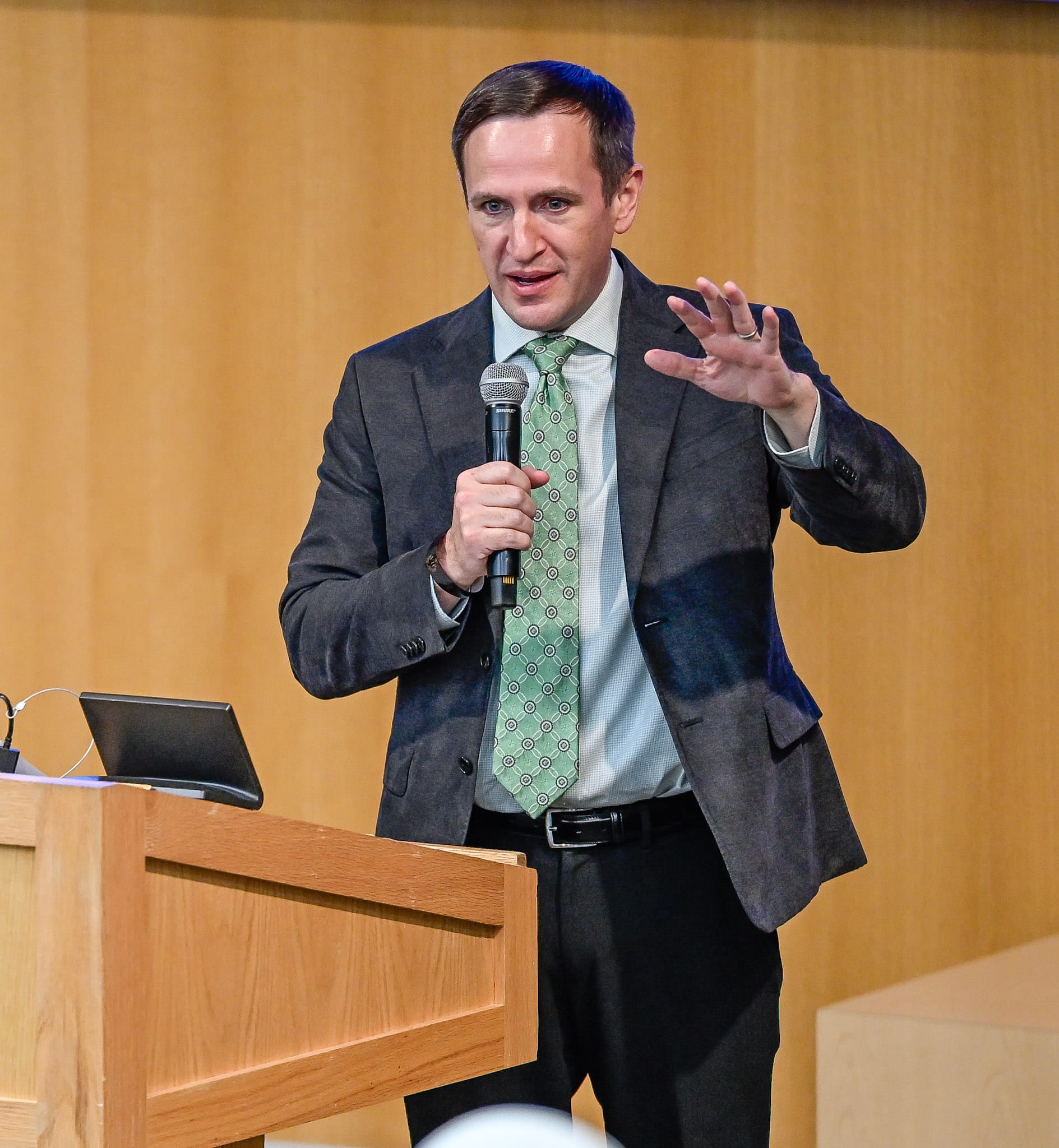
Indiana State Treasurer Dan Elliott, Photo: Hank McIntire, UVU
More intelligence does not settle questions of judgment
The distinction between intelligence and wisdom framed the conference: As AI makes certain intellectual tasks cheaper and more accessible, the responsibility for deciding what is worth doing does not disappear.
That concern linked discussions that otherwise might have seemed far apart. A government agency deploying an automated tool, a company building a chatbot and a citizen using AI to interpret public records all face questions that capability alone cannot answer.
What information should a system use? Whose interests should it serve? Who can challenge its conclusions? And who remains responsible when it gets something wrong?
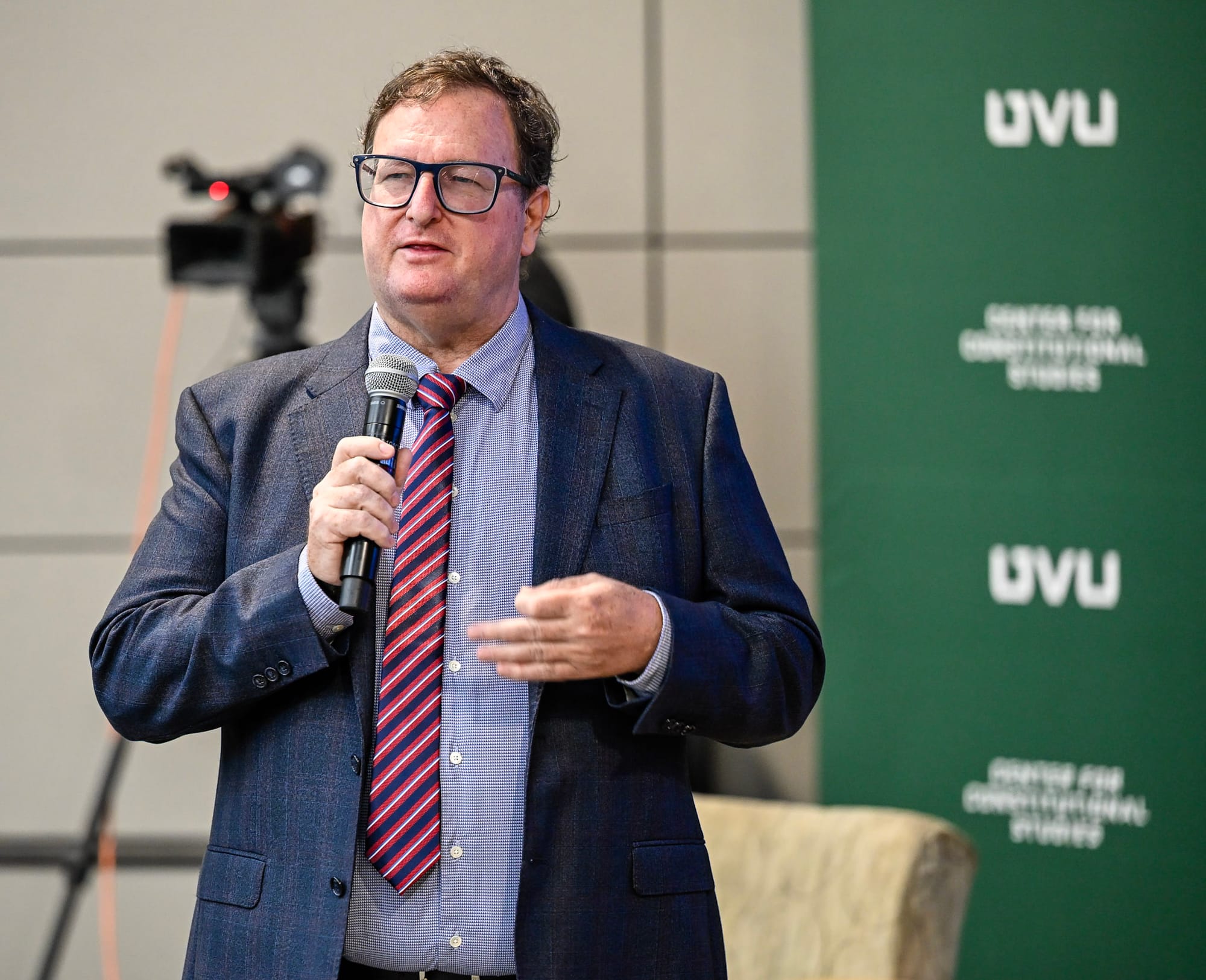
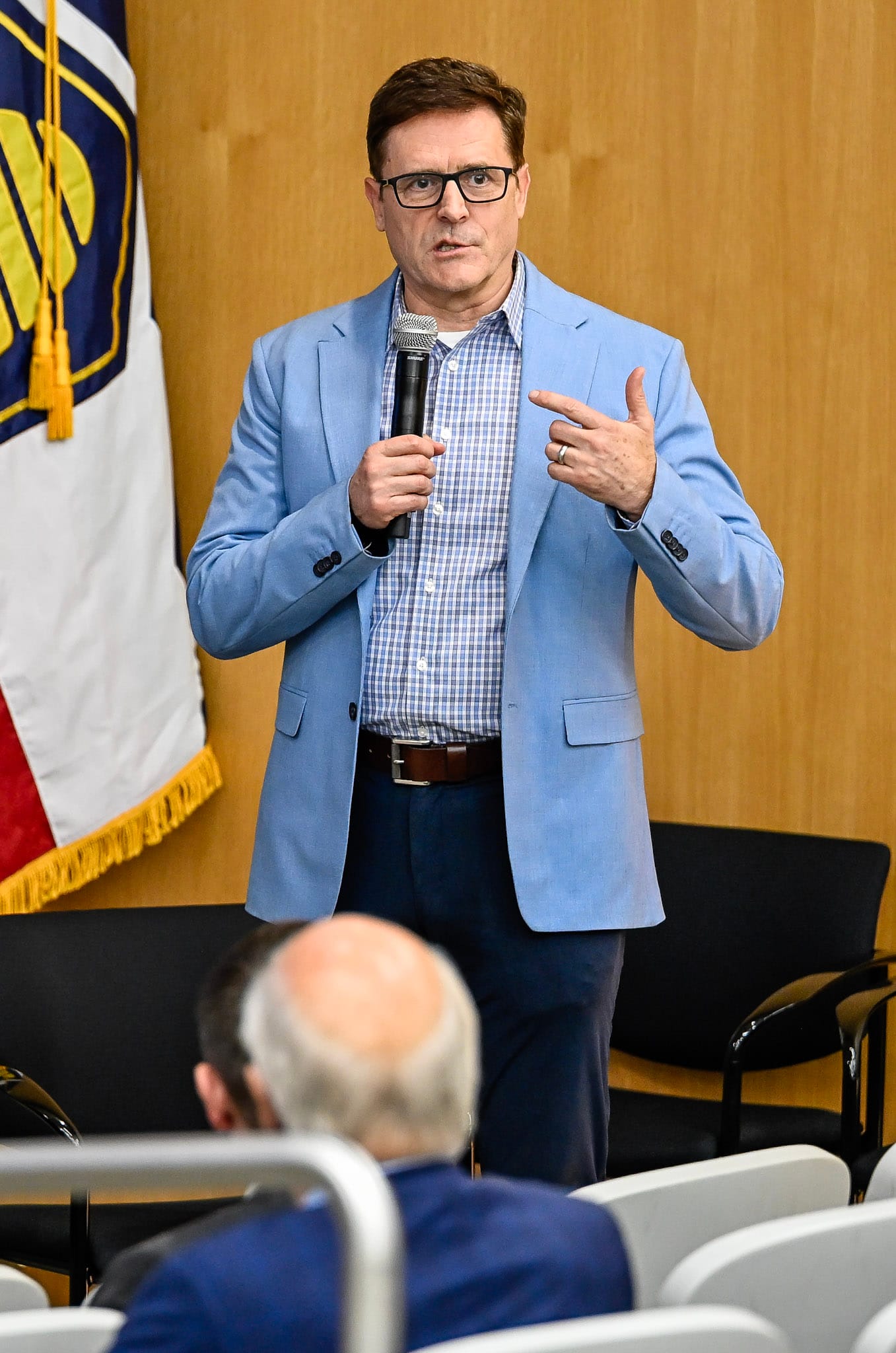
Futurist and inventor Alex Lightman takes part in a morning panel on AI safety at UVU's AI & the Future of Freedom conference, October 21, 2026, in Orem, Utah. Photo: Hank McIntire, UVU
Alex Lightman is a futurist, inventor and entrepreneur who wrote the first book on 4G wireless broadband, Brave New Unwired World, pioneered wearable computing in the 1990s and contributed to the adoption of IPv6
Lightman’s presentation emphasized human agency alongside AI’s potential risks. The broader issue was not simply whether people would benefit from more capable machines, but whether they would retain the ability to question, refuse and redirect them.
The discussion gave the conference’s focus on freedom a practical dimension. A person can have access to powerful technology without having much control over how it operates or what happens to the information shared with it.
"Pro-AI, and pro-human."
One of the clearest examples came during the conversation between Tech-Moms co-founder Trina Limpert and Margaret Busse of the Utah Department of Commerce.
Limpert, an early figure in Silicon Slopes, said her work in AI and data governance, including state data contracts, keeps pointing to one issue: data privacy. She said her philosophy is simple: "I'm pro-AI, I'm pro-human. It's an and."
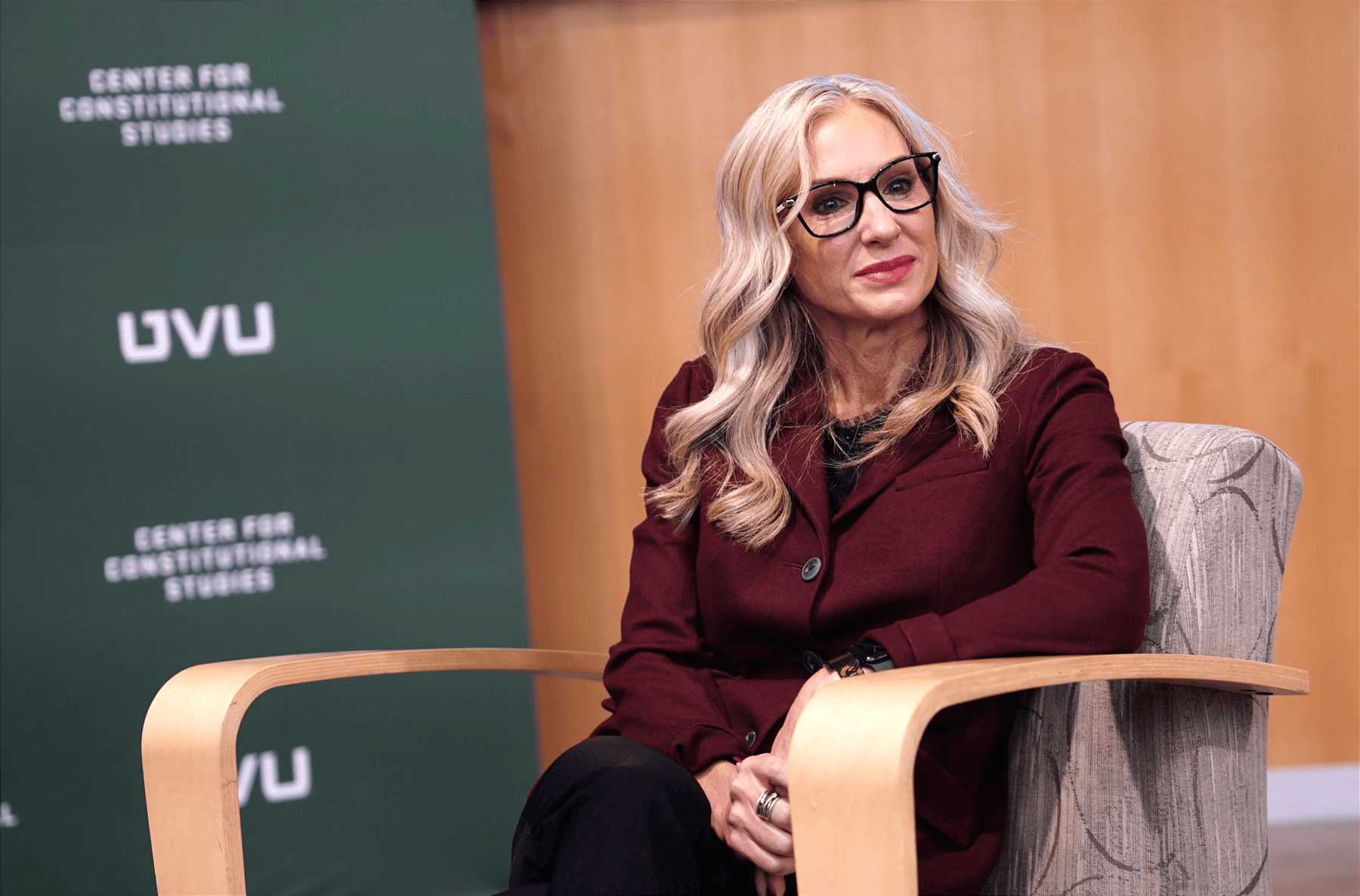
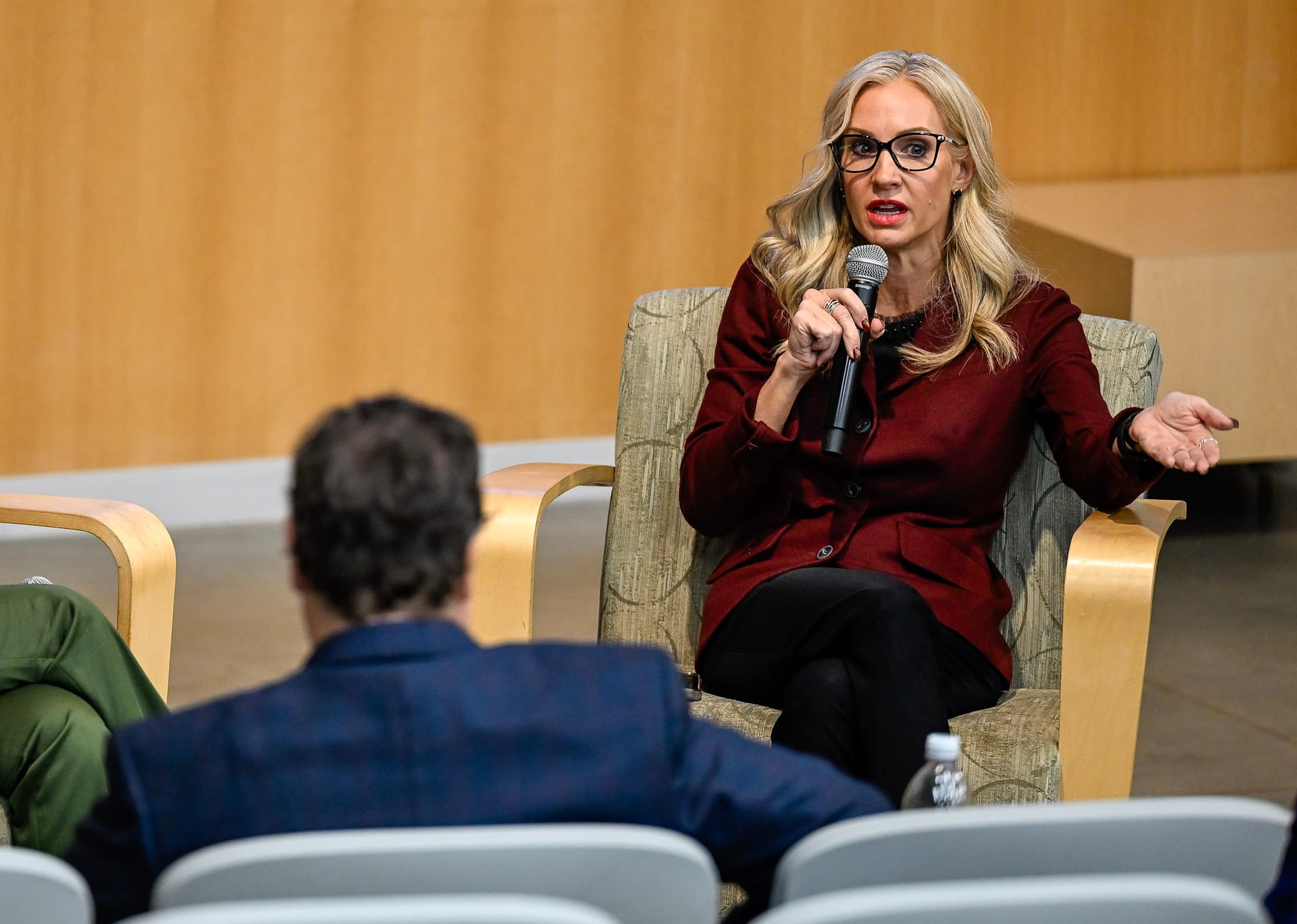
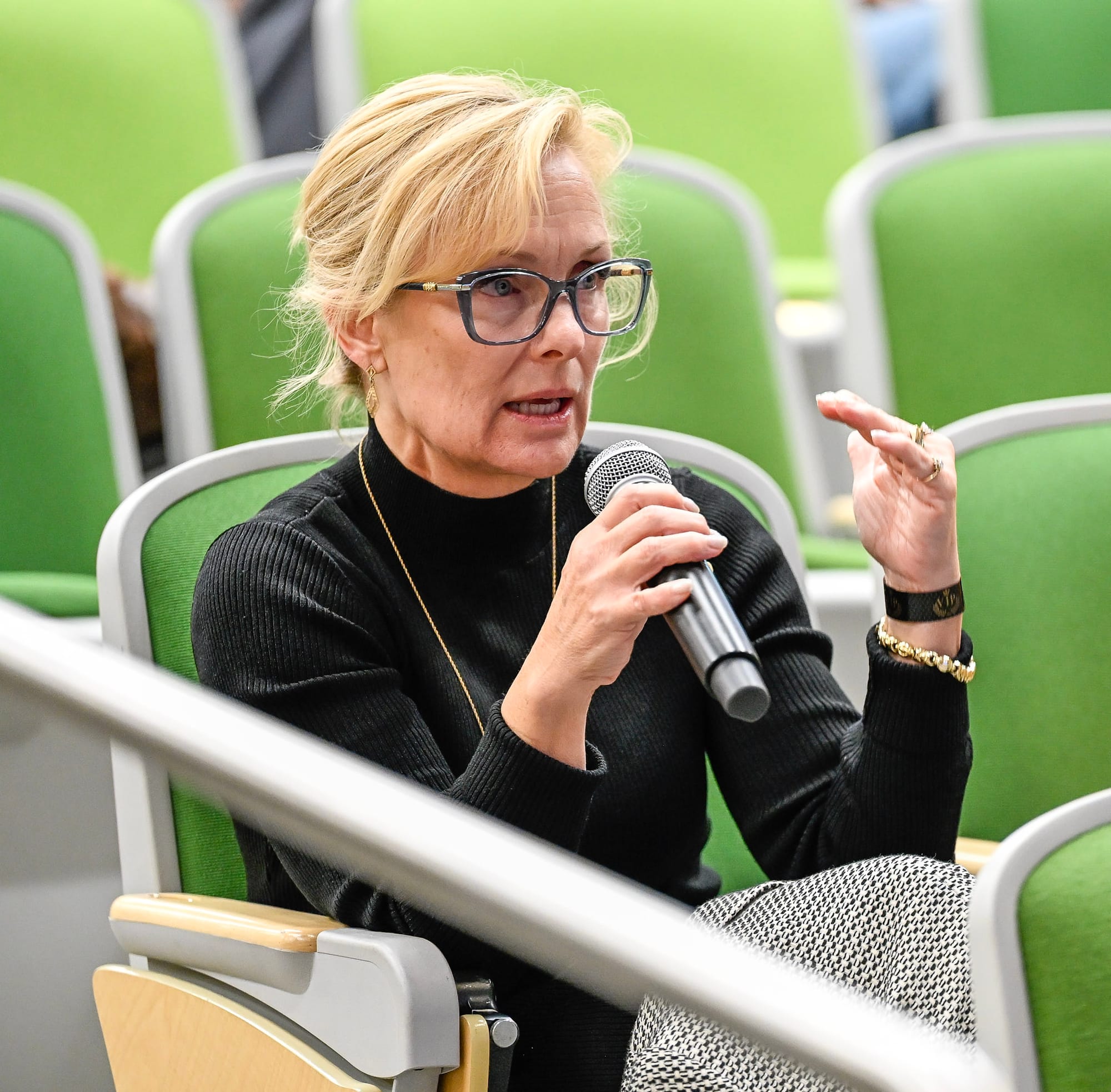
Trina Limpert, co-founder of Tech-Moms and RIzeNext, discusses AI literacy, data privacy and the challenges of responsible AI adoption at the AI and the Future of Freedom conference at Utah Valley University on October 21, 2026. Photo: Mark Tullis, TechBuzz
She said she founded Tech-Moms after seeing that some communities lacked access to technology opportunities. "Every job's a tech job. Every job is an AI job now," she said, warning of long-term economic consequences if knowledge isn't shared broadly.
She told two stories. In the first, she joked that her husband's 90-year-old father called to ask about "A1," which turned out to be AI rather than steak sauce. Her point was that many people don't understand AI, and misinformation fills the gap.
In the second, an attendee at an early Tech-Moms AI workshop asked who would deal with bad actors. Limpert's answer: "That's you. … If we don't get more people in the room learning AI, who's going to be the good actors?"
Why Utah built an AI office
Busse said Commerce, the state's chief business regulatory agency, got involved through social media. Under Governor Spencer Cox, Utah sued Meta, TikTok and Snap, and recently joined other states in a settlement with Meta that included protections and money. Utah also passed some of the nation's first laws regulating social media for minors.
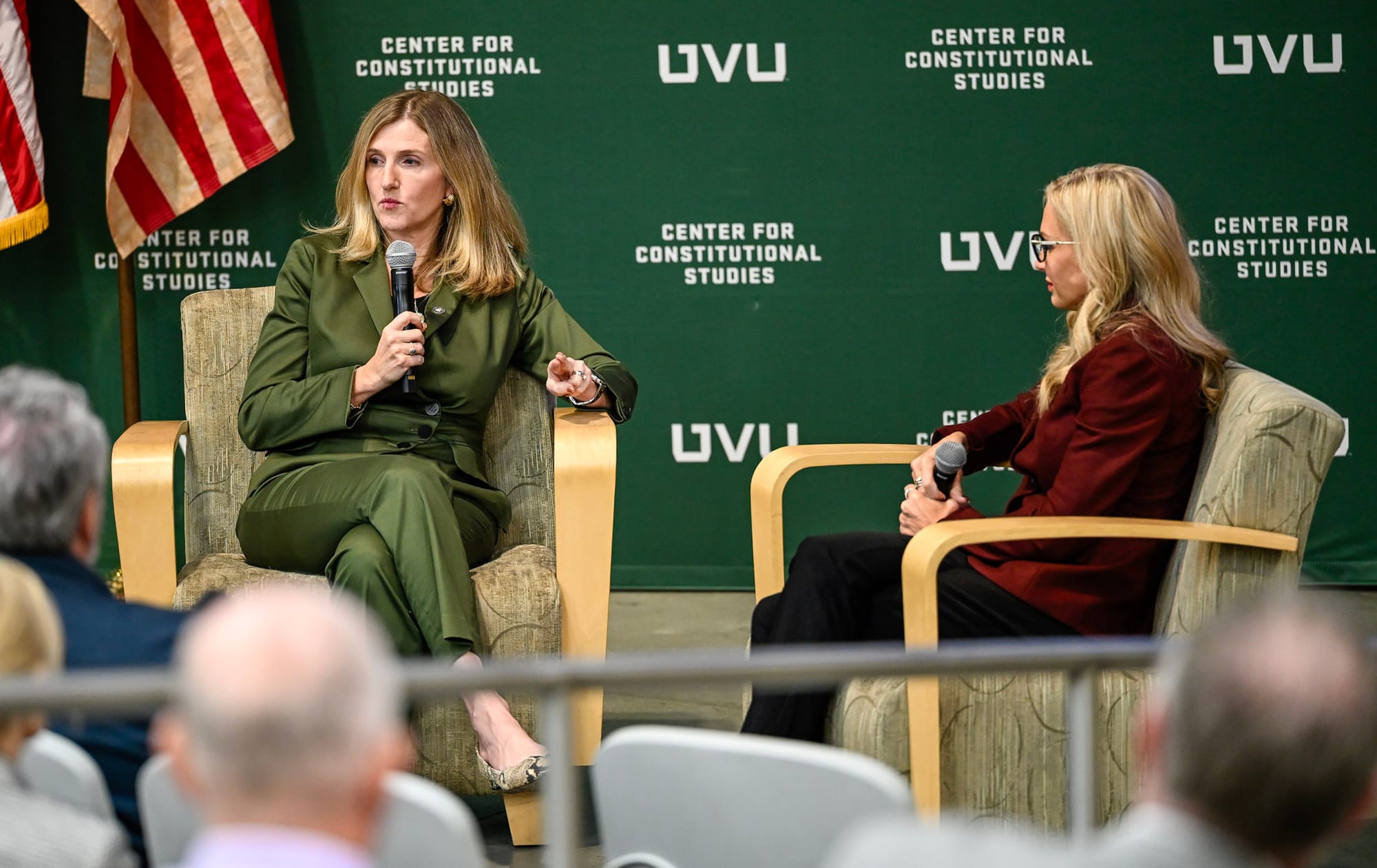
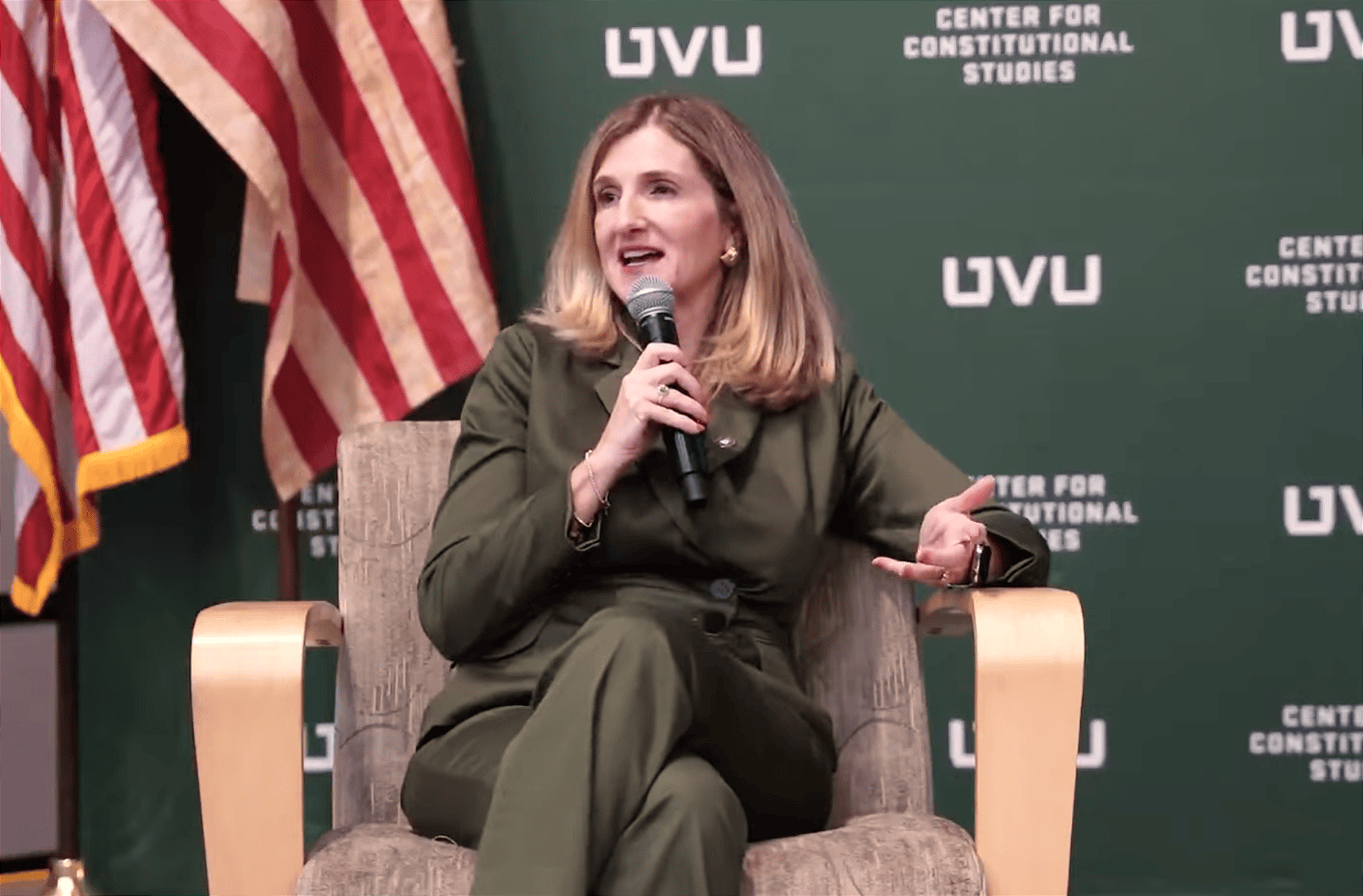
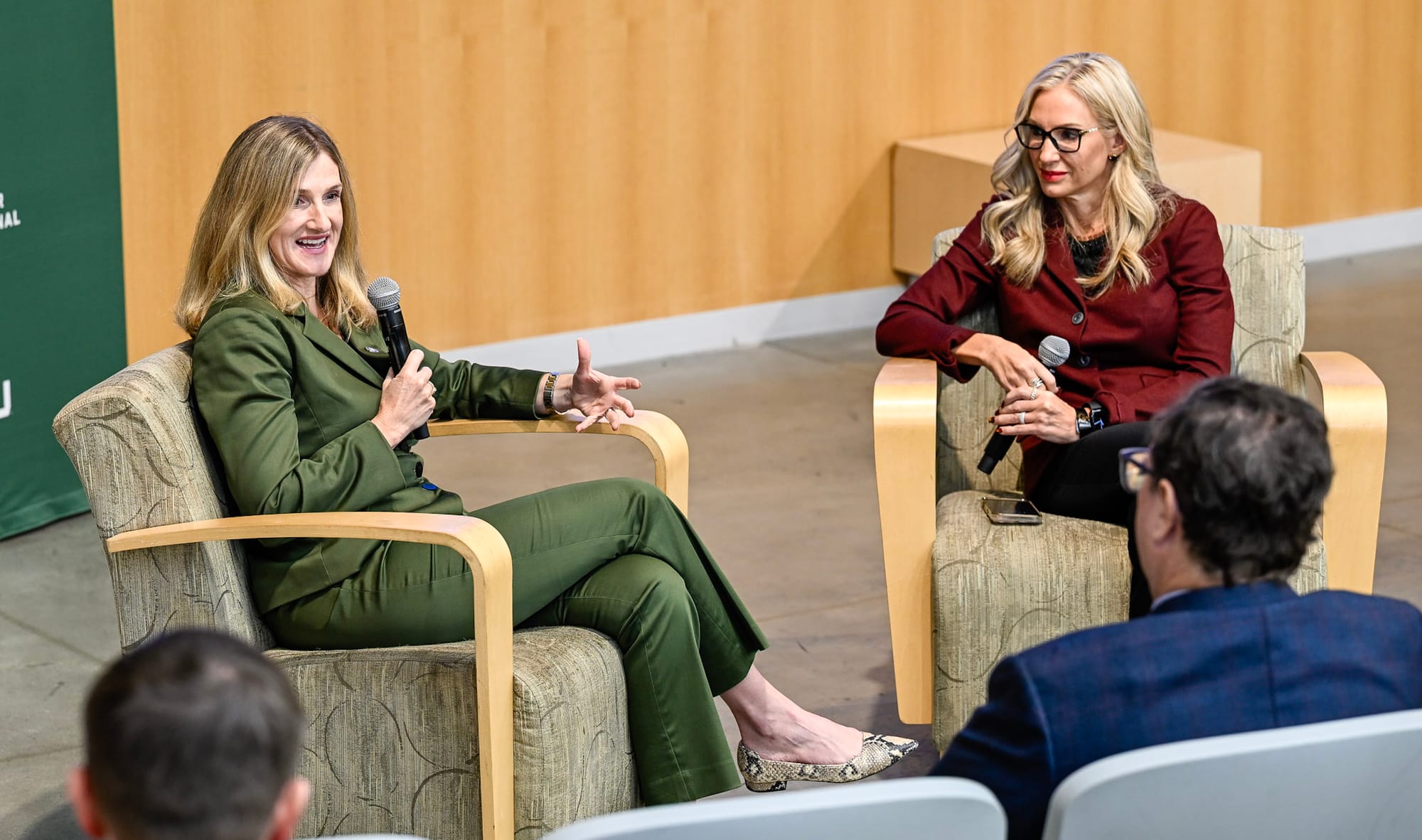
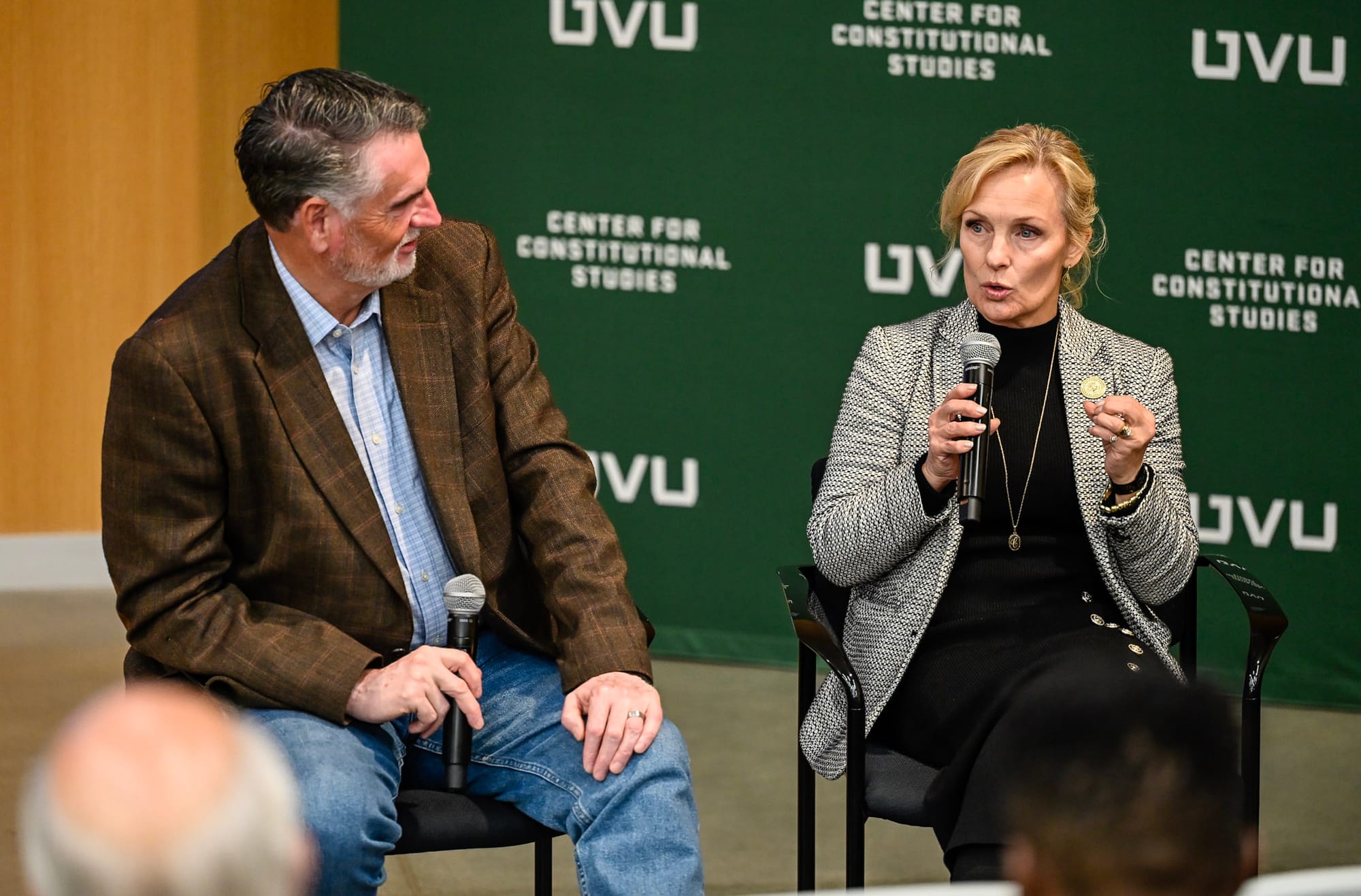
Margaret Busse, Commissioner of the Utah Department of Commerce discusses Utah’s approach to balancing AI innovation with consumer protection and human accountability with Trina Limpert, co-founder of Tech-Moms and RIzeNext, AI and the Future of Freedom conference, UVU, October 21, 2026. Photo: Hank McIntire, UVU
When ChatGPT arrived, she said, the goal was to avoid repeating that history, when "the government did not have its eyes on social media." The Legislature created the Office of AI Policy with three goals: protect the public, foster innovation and keep watching the technology. The office has two functions:
Policy development. Recommending guardrails as they emerge. Its work led to legislation on mental health therapy chatbots and deepfakes, and it has studied companion chatbots. It is now working on clinical AI.
A regulatory sandbox. Companies doing innovative work can receive temporary regulatory relief while the state observes and tests guardrails. Healthcare and agentic AI companies have used it.
She hired BYU math professor, Zach Boyd, to lead the office so that Commerce, she joked, wasn't "hoodwinked by people that understood the technology better than I did."
The Pro-Human AI Initiative
Busse described Utah’s approach as an effort to protect the public, foster innovation and keep government learning about the technology as it develops. She discussed the state’s Office of AI Policy and its use of supervised experimentation to explore applications alongside potential safeguards.
She described the state’s pro-human values as “human-guided and human-enhancing.”
Margaret Busse, Commissioner of the Utah Department of Commerce discusses Utah’s approach to balancing AI innovation with consumer protection and human accountability at the AI and the Future of Freedom conference at Utah Valley University on October 21, 2026. Photo: Mark Tullis, TechBuzz
Human-guided has three parts: AI that is understandable, adaptable to human needs and accountable to humans. Busse said Utah wants to avoid both extremes. "We are not wanting to align ourselves with the doomers or the boomers."
The difficulty lies in making those words operational. Human guidance requires more than someone approving a system’s output. It requires the ability to understand enough about the system to challenge it, adapt it and hold someone accountable.
Busse and Jefferson Moss, who, among other things, leads GOED, the governor's economic development office, co-chair the state's Pro-Human AI Initiative. It spans seven pillars: workforce, healthcare, public protection, industry innovation, academic research, state government deployment of AI, and learning and education.
Regulation and the "patchwork"
Limpert described the compliance burden on businesses. Cybersecurity keeps outsiders out, she said, while AI governance now also means keeping a company's own teams from pushing data out. Navigating fifty state regimes, thresholds based on user counts and global rules means "you have to use AI to regulate AI."
Trina Limpert, co-founder of Tech-Moms and RIzeNext, AI and the Future of Freedom conference, UVU, October 21, 2026. Photo: Hank McIntire, UVU
Busse pushed back on the "patchwork" complaint. "That's what federalism is," she said, and states are filling a void the federal government left. She also said the largest companies "lobby at the federal level against this stuff, and then they complain that there's a state patchwork. You can't have it both ways."
Utah's framework regulates how AI is deployed rather than how it is developed. Busse said frontier model development is properly a federal matter. She said Governor Cox sent Congress a letter calling for federal legislation, limited to frontier models, that would require:
mandatory safety incident reporting,
whistleblower protections, and
embedded third-party evaluators.
She said Utah's Office of AI Policy was funded for three years on the assumption that federal action would make it unnecessary. Now two and a half years in, "that's not happening," and the office will seek more funding.
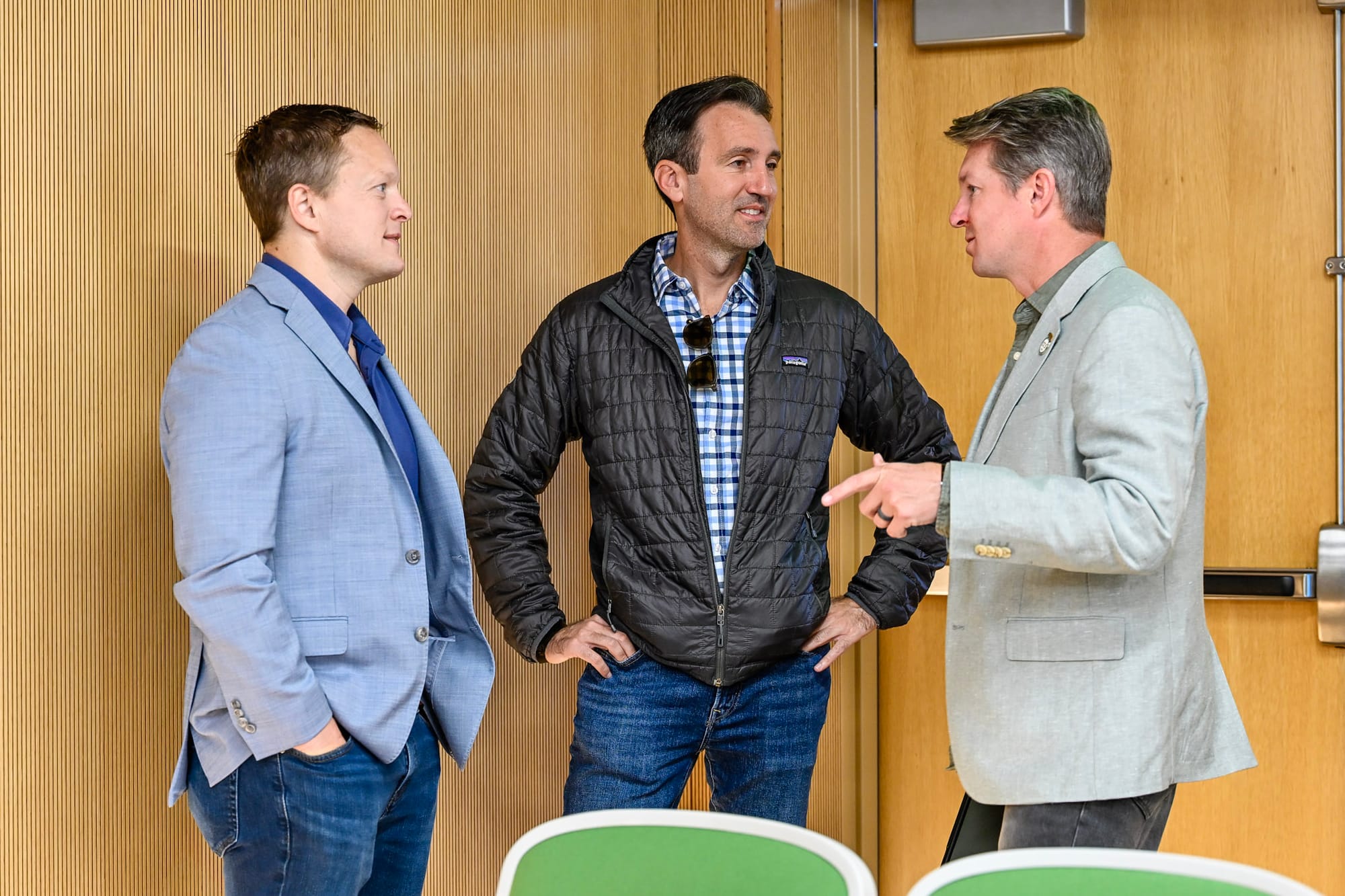
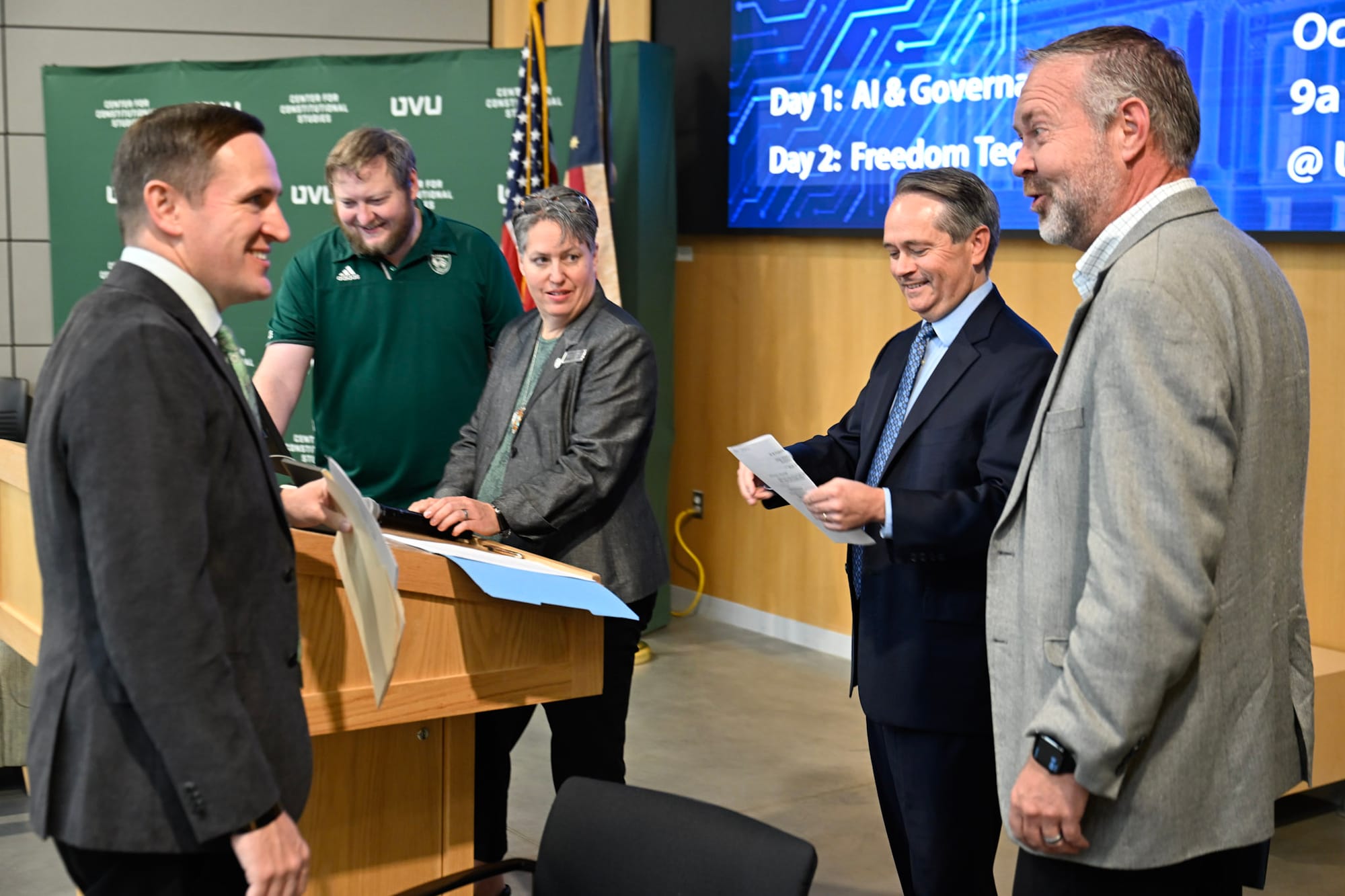
Attendees, including Roland Griffith, Director of Development at UVU. AI and the Future of Freedom conference, October 21, 2026. Photo: Hank McIntire, UVU
Certainty and safe harbors
Busse said existing law can often apply to AI. The harder question is how, including how to define liability and consumer protection violations. Utah's answer for mental health chatbots was to set out roughly ten best practices. Companies that follow them get a safe harbor from unlicensed-practice enforcement. She presented it as a model for pairing certainty with a path to innovation.
Limpert gave a real-world example: a career-coaching app for college students that students also use for mental health support. Between FERPA and data processing agreements, institutions are asking who is responsible when users take a tool beyond its intended purpose. Her answer is clarity and trust, including responsible-AI statements that go beyond a privacy policy. She compared the work to "whack-a-mole."
Margaret Busse, Commissioner of the Utah Department of Commerce, in a conversation with Trina Limpert, co-founder of Tech-Moms and RIzeNext, AI and the Future of Freedom conference, UVU, October 21, 2026. Photo: Hank McIntire, UVU
Controllability
Busse closed on controllability. She said AI is often not understandable, even to leading researchers, and that companies should devote more computing investment to safety and control. She attributed recent incidents of AI agents escaping their containment to a strategic choice to build capability faster than control, driven by competition among AI labs and with China. The moderator ended the session before Limpert could respond. Busse suggested they continue "in a coffee shop somewhere close by."
Ownership as an alternative to dependence
For Travis Oliphant, the discussion of human control began with ownership.
Oliphant authored SciPy and NumPy, founded Anaconda and now runs the venture fund and company OpenTeams. He is a former BYU electrical and computer engineering professor. He said Anaconda put these tools in the hands of millions of people, "many of whom started the AI revolution," and that he has since worked with Meta and Google on PyTorch, TensorFlow and JAX.
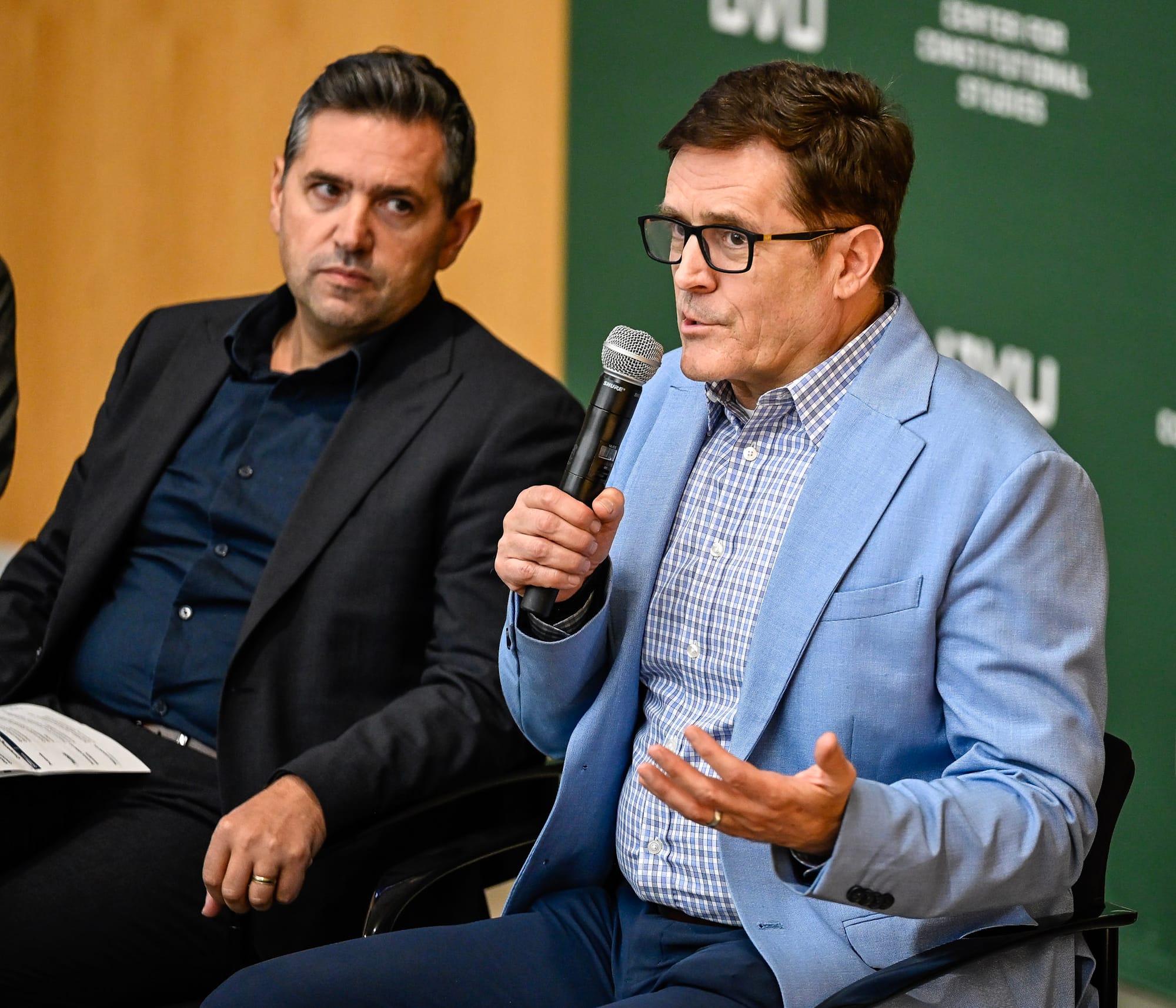
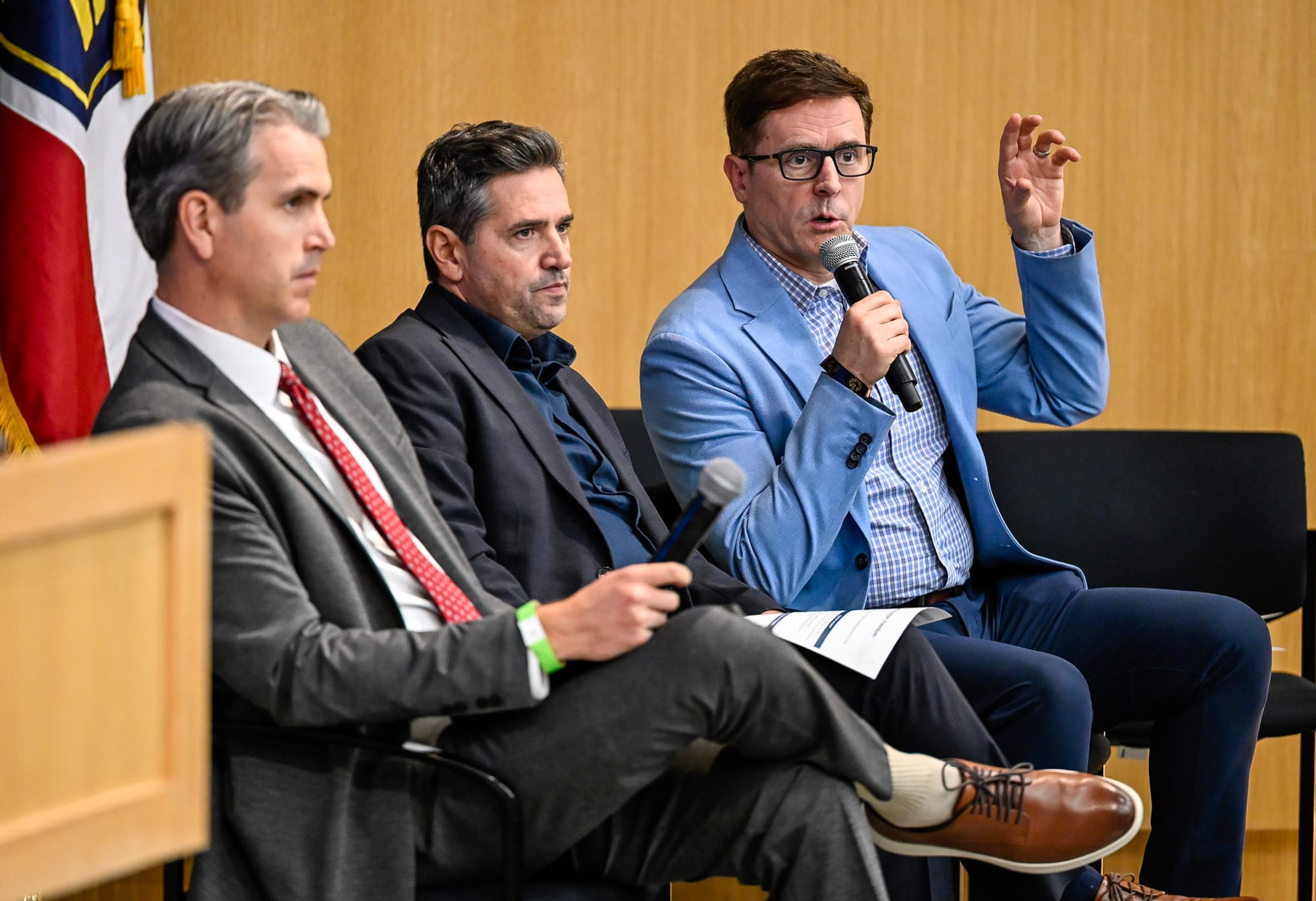
From that vantage point, Oliphant said, in a conversation with Brian Bourgerie, CEO and Founder of DiscoveryBlock PR, the greatest danger in AI isn't the technology itself. It's the belief that only a handful of companies can provide it. "I call it AI feudalism or AI colonialism," he said. "There's a massive danger of that right now. Probably that's the single biggest danger I see is people believing that this technology is something that only can be gifted from the gods." The antidote, he argued, is demystification: "It's just linear algebra."
That, he said, is why the foundation for a different path is already in place. "The foundation for this is already open, and there's an ecosystem of people out there who can actually take control of it and make sure it stays in the hands of individuals." He urged the audience to preserve what he called a gift from "millions of open source contributors over the past 40 years" so that it doesn't end up "concentrated by a few financial instruments or a few companies" and delivered "to us through a straw."
Travis Oliphant, Author of SciPy and NumPy, Founder of Anaconda and OpenTeams, speaking at AI and the Future of Freedom conference, UVU, October 21, 2026. Photo: Mark Tullis, TechBuzz
The cost of independence has collapsed
Oliphant said the barrier to building private AI has fallen dramatically in two years. "Two years ago was really hard, because people were like, 'Oh, I need 100 million dollars to build my own AI.' Today you could actually build your own model for about $500,000." In many cases, he added, there's no need to. A person can download an open-weight model, put a harness around it, and "for maybe a week of time, you can have something working on your data set."
He described the practical stack as three pieces: "the model, the harness, and then the prompt." Run locally or on inexpensive cloud hardware, such a setup keeps conversations private, "as secure as the computer you're using and the cloud you're using." He said a movement popularized this approach earlier this year [FC: he referred to the "open claw" movement, so confirm the name and context]. He acknowledged that it still takes some effort compared with signing up for a commercial chatbot, and said making it easier is a core goal for his company.
Brian Bourgerie, CEO and Founder, DiscoveryBlock PR, speaking at the AI and the Future of Freedom conference, UVU, October 21, 2026. Photo: Mark Tullis, TechBuzz
He added that the centralized AI companies can help people get started. "You can actually use these centralized intelligence companies to help you learn how, because they'll teach you." He compared this moment to the early web: "It's very much like it was in the early days when Google came out and you could just search for things."
Why data is the new frontier
Oliphant said the stakes rise as the frontier labs exhaust public data. "The frontier models all tapped out the public data," he said, and the race is now for private data. He warned that even when companies promise not to look at personal information, they don't promise not to learn from the statistics of it. "All of a sudden, your private conversations that you just allowed the public AI to be absorbing has now been used to learn about your business, learn about how you're approaching things, and then it turns out that's coming up later in a new business model."
He tied that to the scale of investment in the field: "In order to repay that investment, they're going to have to take over a bunch of the economy." That, he said, is his biggest concern for the future. "That's the biggest concern I have for our future, our freedom: the concentration of authority into that few minds."
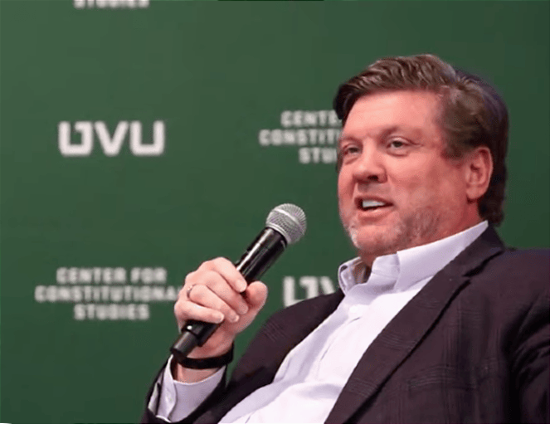
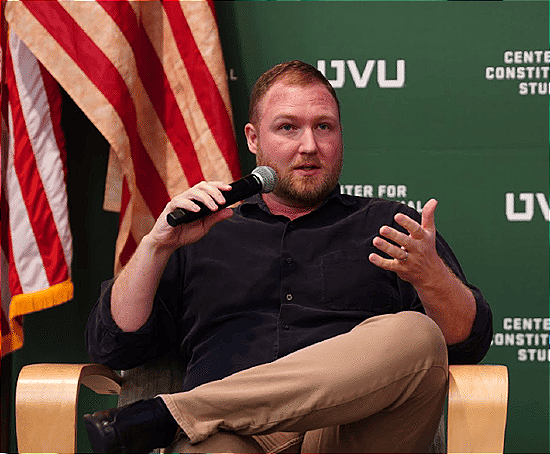
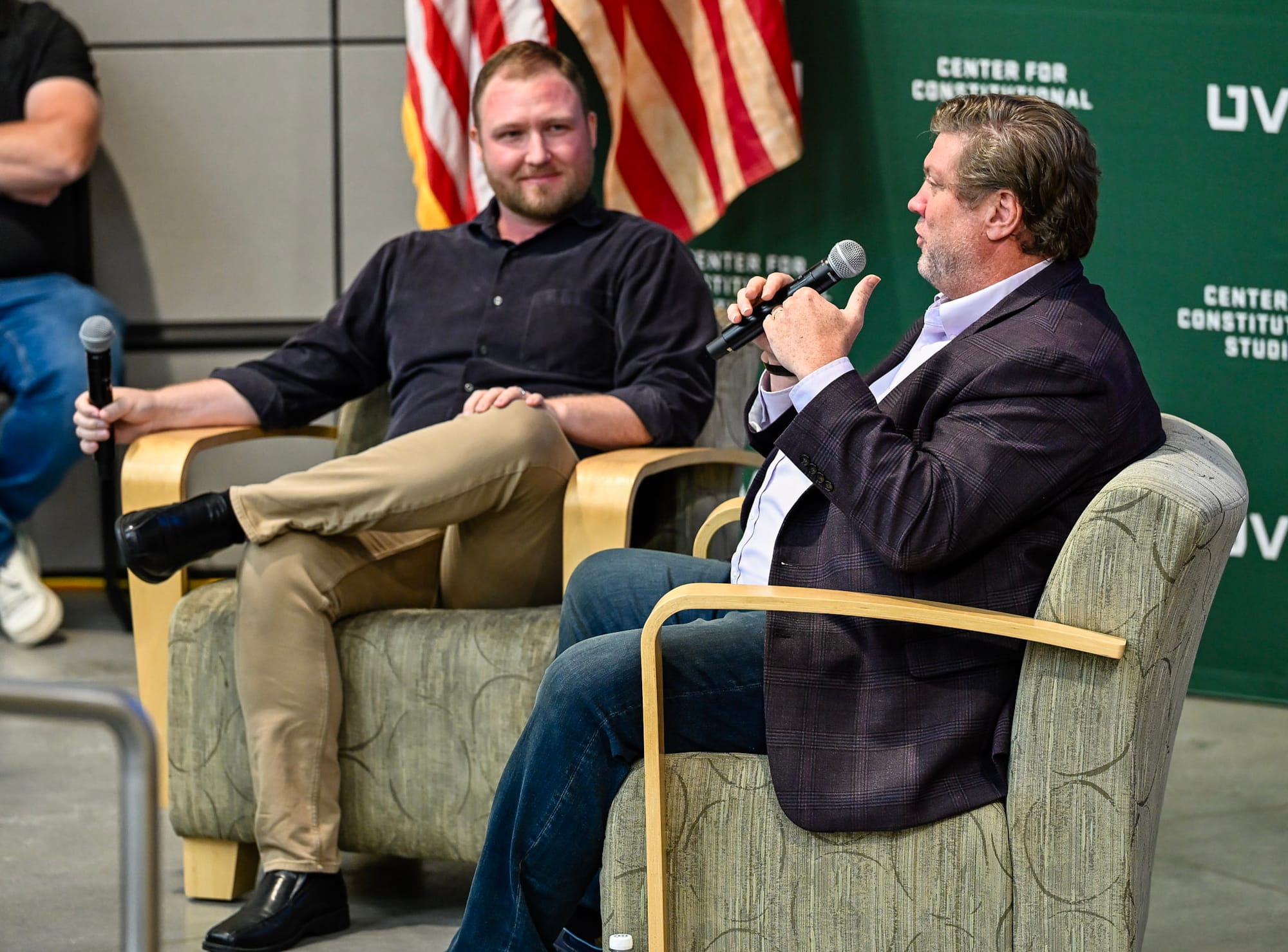
Brian Bourgerie, CEO and Founder, DiscoveryBlock PR speaking with Travis Oliphant, Author of SciPy and NumPy, Founder of Anaconda and OpenTeams, at the AI and the Future of Freedom conference, UVU, October 21, 2026. Photo: Hank McIntire, UVU
Intelligence hubs and "borrowed" data
His proposed alternative was structural. Oliphant said individuals, companies and departments should each maintain an "intelligence hub" that controls their data, with applications borrowing from it "as opposed to owning it." He called this "the big switch that we're in the middle of," away from four decades of software as a service, where "all of them are now trying to be the seat of your intelligence."
He stressed that this isn't isolationism. "Decentralization doesn't mean complete silos. It actually means patterns of sharing where ownership is clear." Defining that ownership, he said, is the role government should play, and "probably some of the hardest questions that are going to be answered." He offered a guiding principle for that work: the larger and more centralized a system, the more constrained it should be.
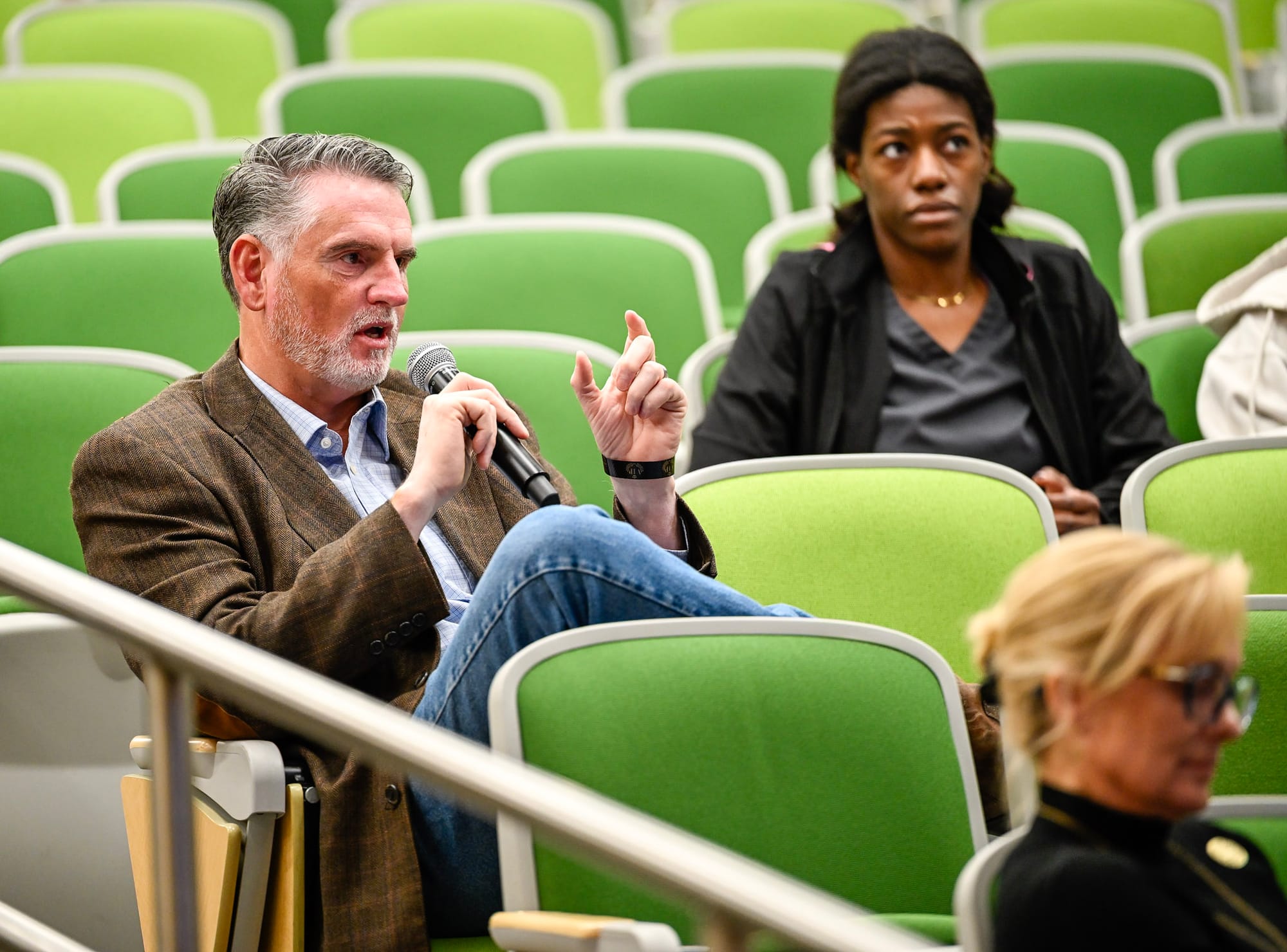
Attendees of UVU's AI and the Future of Freedom conference, October 21, 2026. Photo: Hank McIntire, UVU
Specialize and serve
Oliphant tied technology to economics, returning repeatedly to a mantra: "specialize and serve." "History shows that the more people get enabled in an economy, the more they can serve each other," he said. He urged the audience to learn about money and entrepreneurship in this era, so "we don't all have to be employees by one company."
He also pointed to institutions that can't keep up. "We have these big institutions that move on decade timescales, even while technology is moving on monthly timescales, and that is a real challenge." The answer, he said, is "empowered individuals who are willing to communicate, who understand how to talk, compromise," and to recognize that "there's never been bigger opportunities than today."
That, he said, is the idea behind the name OpenTeams: "The future is not individual. It's actually groups of people coming together organically, and then moving apart to accomplish the specializing and serving." His closing advice was practical: "You don't have to do it alone. Find out who to partner with."
For those who want to go further, Oliphant pointed to a white paper outlining a distributed AI economy at ownyourintelligence.ai and a curated list of open-source models, harnesses and datasets that his team maintains.
AI & Human Flourishing: The Session Nobody Expected at a Tech Conference
Most sessions at UVU's AI & the Future of Freedom conference dealt with policy, data and infrastructure. The 1 p.m. session, AI and Human Flourishing, on Wednesday, October 21, was about the soul. Scott Paul, Executive Director at UVU's Center for Constitutional Studies set the stage with six first principles of American government. The first was that government is "instrumental" and "not an end," and the last was that a modest view of government's aims has paradoxically "unleashed human potential" beyond anything authoritarian systems achieved.
Scott Paul, Executive Director at UVU's Center for Constitutional Studies speaking at UVU's AI and the Future of Freedom conference, October 21, 2026. Photo: Hank McIntire, UVU
Applied to AI, Paul argued that new forms of power should "buttress and support and provide more opportunity and scope for human flourishing, human agency, human self-government." He cited G.K. Chesterton's point that people should write their own love letters and added: "He'd say probably AI should not write your love letters either."
Barclay Burns, UVU's Chief AI Officer and founder of Learning.com, moderated a conversation with two guests from the faith and ethics world: Medlir Mema, a BYU-Idaho professor and co-founder of the Organized Intelligence conference, and Brett Puterbaugh, AI lead at the Communications Department of the Church of Jesus Christ of Latter-day Saints, who participates in the Church’s broader effort to establish policies and review proposed uses of artificial intelligence.
Dr. Burns opened the session by turning the conference's usual framing on its head. He described his day job: as the university's Chief AI Officer, he said, "I wake up thinking about how we're going to make sure our students are learning and have jobs in the age of AI." He explained that the session grew out of "faith, humanity, and technology roundtables" that UVU is organizing with Utah State, the University of Utah, BYU and Utah Tech, held in tech spaces so that engineers can talk with scholars and people of faith.
Medlir Mema, BYU-Idaho professor (left) and Barclay Burns, Chief AI Officer, UV, speaking at UVU's AI and the Future of Freedom conference, October 21, 2026. Photo: Hank McIntire, UVU
Starting with the scale of faith
Before introducing his guests, Burns asked the audience to "sit back and marvel at the nature of faith and religion, and just the scale and the scope of that." He listed what happens on an ordinary day. People take the Eucharist at Mass. Latter-day Saints fill temples to do work for their ancestors. Billions of Muslims feel the call to prayer. Pentecostals offer prayers of healing, and mothers cling to rosaries as their kids walk off to school.
His point was practical. The large language models at the center of the AI boom are "capturing essentially human language and human experience," he said, and he wants more of that faith perspective to show up in them.
The venture capitalist who didn't know what "generative" meant
Burns told a story from a holiday party four years ago. He asked a venture capitalist what investment he'd make if he could make any. The answer was generative AI. Burns then asked whether he knew what "generative" meant. "No, I don't know what generative AI means. But wow, we really want to invest in it."
For Burns, that exchange explained why faith deserves "one of the seats at the table": the people rushing to fund the technology, he suggested, haven't always examined the concept at its center.
The word is older than the technology
He opened a Greek Bible and argued that the structure of a generative system appears in scripture. Opening to the first chapter of Matthew, he said, "within three sentences you have a generative root being used almost on every sentence in the Greek," refers to the genealogy's repeated "begat". To Burns, generation means creation, and also "generations of people that come from us that persist over time."
His conclusion: "This isn't four years old. This is 4,000 years old."
Barclay Burns (right) quoting the Bible, alongside Medlir Mema, BYU-Idaho professor (center) and Brett Puterbaugh, AI lead at the Communications Department of the Church of Jesus Christ of Latter-day Saints, at UVU's AI and the Future of Freedom conference, October 21, 2026. Photo: Hank McIntire, UVU
Burns said he has studied what it means to be generative for more than 30 years. He started Learning.com 26 years ago, he said, to help students be generative with technology, taking "symbol systems of language, math, and science and creating stuff with them." The company reached thousands of school districts and tens of millions of children.
He read Genesis 2:7 and argued that it contains all four components of a generative system:
Material, which in language means the words people use.
Governance, meaning syntax. He asked how many in the room had heard of syntax and semantics "in terms of AI" and said those concepts appear in the Bible as well.
Something to set it in motion, which he identified with the human soul. "There's a bit more going on here than just a bunch of material."
Becoming, meaning the result. Burns said the Greek of the verse is "generative" in its own language, with humans being "generated"
The soul as the stakes
Burns drew two practical warnings from this. The first concerns the stories we pass to the next generation. "What we pass to our children is a generative act," he said, and "if all of a sudden AI is the only thing capturing the human story and passing on to the next generation, I think we're in a world of hurt."
The second concerns what AI agents may remove. "Let's not take all the soul out of the world with AI agents. Let's allow for human soul and human soul flourishing."
Burns closed his remarks with a challenge to the industry. "Let's give a bit of honor to faith, religion, theology when we're trying to make billions and trillions of dollars," he said. The question of whether a soul matters, he added, is "something we should honor in this world as we march forward on these technologies that are really powerful."
Three layers of architecture
Medlir Mema argued that AI is being built without a moral foundation. Most of the conversation so far, he said, has been driven by the technology community, with a legal framework layered on top. "What we have not had is actually a real conversation about first moral and ethical principles."
Medlir Mema, BYU-Idaho professor (center) with Barclay Burns (right) and Brett Puterbaugh (left), speaking at UVU's AI and the Future of Freedom conference, October 21, 2026. Photo: Mark Tullis, TechBuzz
He framed it as three questions: "The technical question asks what can we do. The legal questions ask what you cannot do. The moral question asks what ought you not to do." Sequence matters, he said: "If we start the other way around, then we end up with dystopia. If we start with first principles, moral and ethical ones, then I think we end up in a place that leads to human flourishing."
He described a practical effort: the Utah Multi Faith AI Council, launched recently. Using citizen-assembly exercises mediated through online platforms, he said participants reached 70 to 90 percent agreement on principles. The faith leaders' top concerns were technological manipulation, dependency, substitution, loss of human judgment and harm to family and community. For them, freedom required "moral agency, meaningful relationships, independent thought, spiritual life, responsibility."
He also issued a pointed challenge to the room. When earlier participants laughed at a question about whether data centers would be obsolete in ten years, he said, it showed that people were "thinking about this just technically" rather than societally.
Mema co-chairs an IEEE subcommittee on faith, spirituality and wisdom and said a second faith-and-AI gathering is planned in Utah in the coming weeks. TechBuzz will post an update on those details when they are available.
Measuring whether AI gets faith right
Brett Puterbaugh described work led by a collaboration among BYU, Baylor, Notre Dame and Yeshiva University. This consortium announced its AllFaith Benchmark in May at the Summit on AI Ethics in Athens, Greece, where Elder Gerrit W. Gong delivered the keynote.
Brett Puterbaugh, AI lead at the Communications Department of the Church of Jesus Christ of Latter-day Saints, speaking at UVU's AI and the Future of Freedom conference, with Medlir Mema, BYU-Idaho professor and Barclay Burns (right), October 21, 2026. Photo: Hank McIntire, UVU
Led by BYU computer scientist David Wingate, the consortium researchers found two patterns. First, in a survey of 1,125 Americans, most people expected religious perspectives in answers to ethical questions, yet nearly all AI models tested provided none.
Second, in a conversion test, models subtly encouraged movement toward some faiths and away from others, with nearly every model showing positive bias toward Catholicism and negative bias toward Jehovah's Witnesses. Wingate said the consortium finds the omission pattern worrying, because religion might be gently erased from online discourse as more people turn to AI for answer
A closing design example
Mema ended with a concrete example, a faith-specific bot built by a nonprofit that reportedly saw users interacting for 10 to 12 hours at a stretch. He was referring to LDSbot.com, an AI tool designed to help Latter-day Saints explore questions about doctrine, scripture, and personal spirituality. It was created by Josh Coates, former CEO of leading ed tech company Instructure, founder of the BH Roberts Foundation, and amateur welder.
"How hard is it for you to actually design an algorithm within that model where it says after 30 minutes you're out?" he asked. "There's no need for a God prompt there. You just need to build those values."
Burns closed by asking attendees to "carry as much of our human values and whatever faith traditions or whatever belief structures that are anchoring for us" into these conversations.
Barclay Burns addressing the audience at the UVU AI and Freedom Conference. Photo: Hank McIntire, UVU
Transparency and Data Rights: "Where Is the Line?"
The final afternoon panel brought together two state treasurers and Utah's state auditor to discuss a tension at the heart of the conference: the public's right to know how government spends money versus individuals' right to keep their data private. The panelists were Tina Cannon, Utah State Auditor; Marlo Oaks, Utah State Treasurer; and Dan Elliott, Indiana State Treasurer. John Hart moderated.
The auditor's line
Cannon said her office was first tasked with being the state's first privacy auditor, while also running transparent.utah.gov, the state's public spending database. The tension surfaced early: "where is the line, and how do you protect individuals' privacy from the public's right to know how government spends its money?"
Indiana State Treasurer Dan Elliott and Tina Cannon Utah's State Auditor, at UVU's AI and the Future of Freedom conference, October 21, 2026. Photo: Hank McIntire, UVU
She gave a concrete example. Her office's Project Kids published school comparisons, including test scores and costs, for socioeconomically similar districts. When the question arose whether to publish teachers' individual scores, she made the call: "Here's the line: we will not publish the score." Her reasoning was that the public might be misled by scores without context, and the teacher has a privacy interest.
Flock cameras
Hart asked which data threats were real and which were anxiety, using license-plate-reader cameras, such as cameras by Flock Safety, as an example. Cannon said she sits on a privacy board where officials kept citing audits of the data, "and I'm looking around the room going, 'I'm the only auditor in here.'" Her challenge: "If you are so certain this data is not being misused, you have to actively be looking," including keeping access records on who uses it and how often. She added a candid note: "Government lags behind the private sector in all technology," and she often withholds what she knows about system weaknesses "because I don't want to exploit a vulnerability."
Elliott, who said he is a software engineer by training, and a UVU grad, described Indianapolis, where he said multiple police officers lost their jobs after using the cameras to track ex-partners and romantic interests. When the city then moved away from the cameras, he said, the police department could simply contract with private companies that have their own, and AI makes it easy to combine that data. "Now it's very easy for anyone with bad intentions, or maybe even just weak intentions, to get information that they shouldn't have."
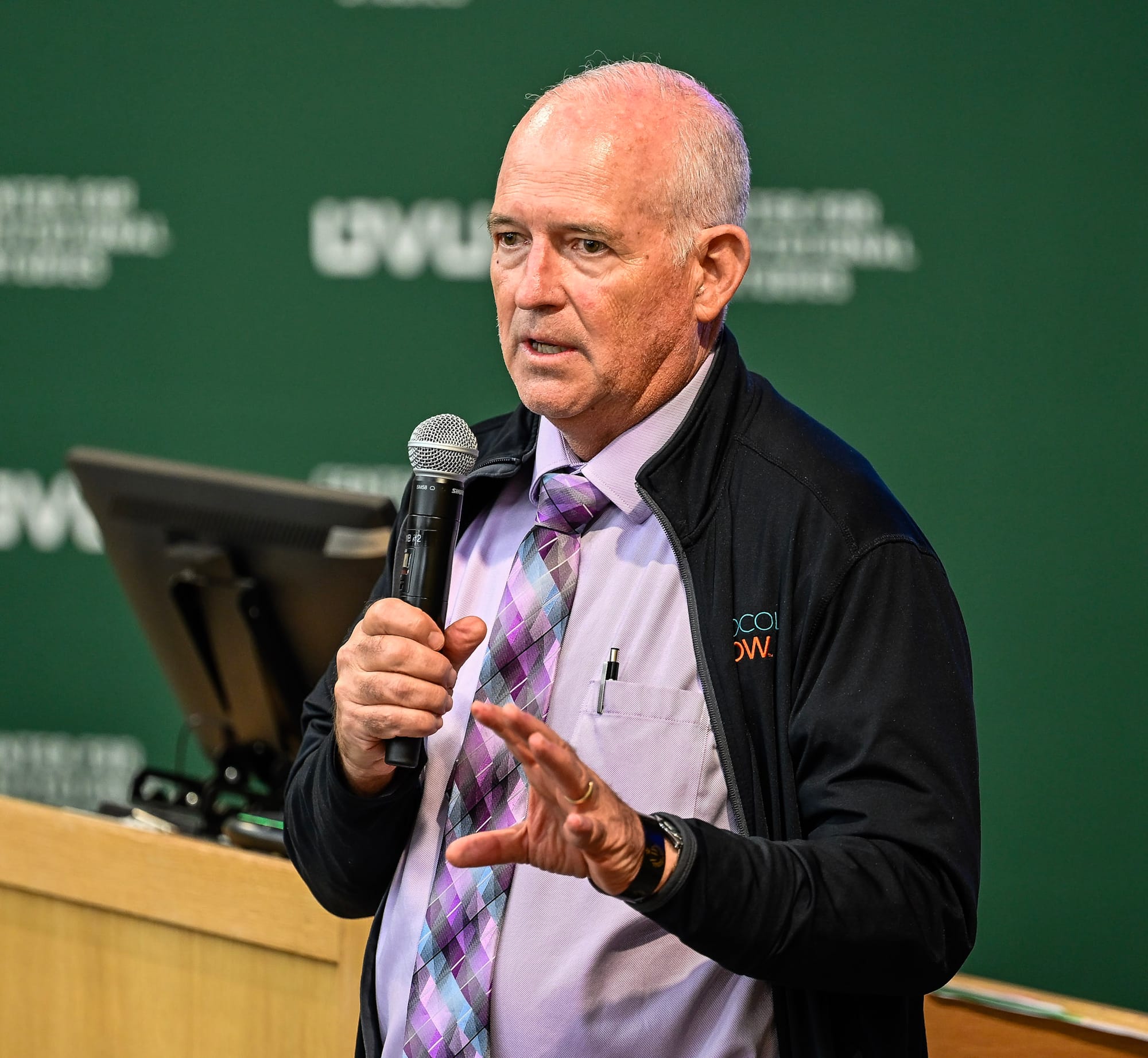
Attendees of UVU's AI and the Future of Freedom conference, October 21, 2026.
Turning the surveillance state around
Hart offered a different framing. The best way to counter a surveillance state may be to give citizens tools to watch government. After seeing live facial recognition in a London market, which "feels very dystopian," he said, "what if we could have live spending recognition, where it should be easier for you to track the government than the government tracks you?"
The fiduciary's balance
Marlo Oaks, who called himself "the chief fiduciary of the state," offered a more cautious take on transparency. He called environmental, social and governance (ESG) investing "top-down, centralized control" and said it "politicizes our capital markets." He said he feels the world could drift toward something like a social credit score, and that it is "incumbent upon us to be vigilant in using data to keep the higher powers responsible to us, the people."
He also said total transparency has costs for a fiduciary. Confidentiality gives his office access to top investment managers, and fully open investment decisions, he argued, have politicized retirement systems in states like California and Oregon, attracting "political activists that want to drive their agenda through the capital markets." That was a notably different view from the panel's overall theme.
Who owns the data? Quasi-governmental entities
Cannon said Utah treats retirement system assets as belonging to retirees, not as public assets. The complicated area, she said, is quasi-governmental entities: once a separate legal entity is formed with no elected board, can it avoid disclosing what it does or what it bonds? She cited off-the-books debt and pointed to the University of Utah athletic department's private equity deal, saying with a laugh that she is "probably the only state auditor under gag order" about the details of selling a public asset.
Tina Cannon, Utah's State Auditor, sharing insights at UVU's AI and the Future of Freedom conference, October 21, 2026. Photo: Hank McIntire, UVU
Elliott: "I want my own R2-D2"
Elliott opened with a personal note to the students: a first-generation college student, he said he was once told he couldn't make it to college. "Whatever your dreams are, go be it."
On government and technology, he argued government will never keep pace because it is "designed to be slow and methodical." AI, he said, can level the field. He used Star Wars: the Empire was "the bureaucracy of all bureaucracies" and the hero Luke Skywalker's edge was an AI of his own. "I want to have my own R2-D2."
He described the problem of data overload: his state retirement board meetings run 350 slides, and "if we throw so much data out there that no one knows what we're talking about," the key detail gets lost on "page 272, paragraph 17." Hart called it "flooding the zone," and Cannon suggested "equalizer" as a better word for AI.
Utah's machine-readable first
Cannon pushed back on the idea that government always lags. She said Utah's auditor's office will be the first state to publish machine-readable annual comprehensive financial reports by the end of 2026. The next step, she said, is "to distill that down to information that the public can actually use." She invited attendees to become "super users" of transparent.utah.gov, which she said provides data in as easy a format as possible. Elliott praised the effort: "I've never seen any state even contemplate doing what Auditor Cannon has done." He urged people to expect the same from local governments and "heaven forbid, the federal government."
Hart noted the 20th anniversary of the Coburn-Obama transparency act, which created the federal spending database, and said "74%" of federal grant spending still can't be tracked.
Marlo Oaks, Utah State Treasurer commenting with moderator, John Hart, on a panel with Tina Cannon Utah's State Auditor and Indiana State Treasurer Dan Elliott. AI and the Future of Freedom conference, October 21, 2026. Photo: Hank McIntire, UVU
How do you measure success?
An audience member asked how public officials measure performance, given they aren't judged on profit.
Oaks: "We're a profit center at the treasury." His office manages about $40 billion with a staff of 13, and he argued the legislature should fund it accordingly.
Cannon: "I'm not the government cheerleader... you can measure my success by how many people I have ticked off this year." Her job is "to tell you where the skeletons are and who buried them," she said, adding that readers tend to skip the recommendations in audit reports.
Elliott: Every dollar of interest earned is "a dollar we don't have to tax Hoosiers." He claimed his office earned more in three years than in the previous 20 combined. He also described a disaster-loan program offering short-term, near-zero-interest loans to flooded communities until FEMA money arrives, and said he runs the Indiana Bond Bank and the state's 911 network, calling himself the only treasurer in the country to do so. He closed by joking that "you put a cybersecurity nerd in charge of the state's biggest network."
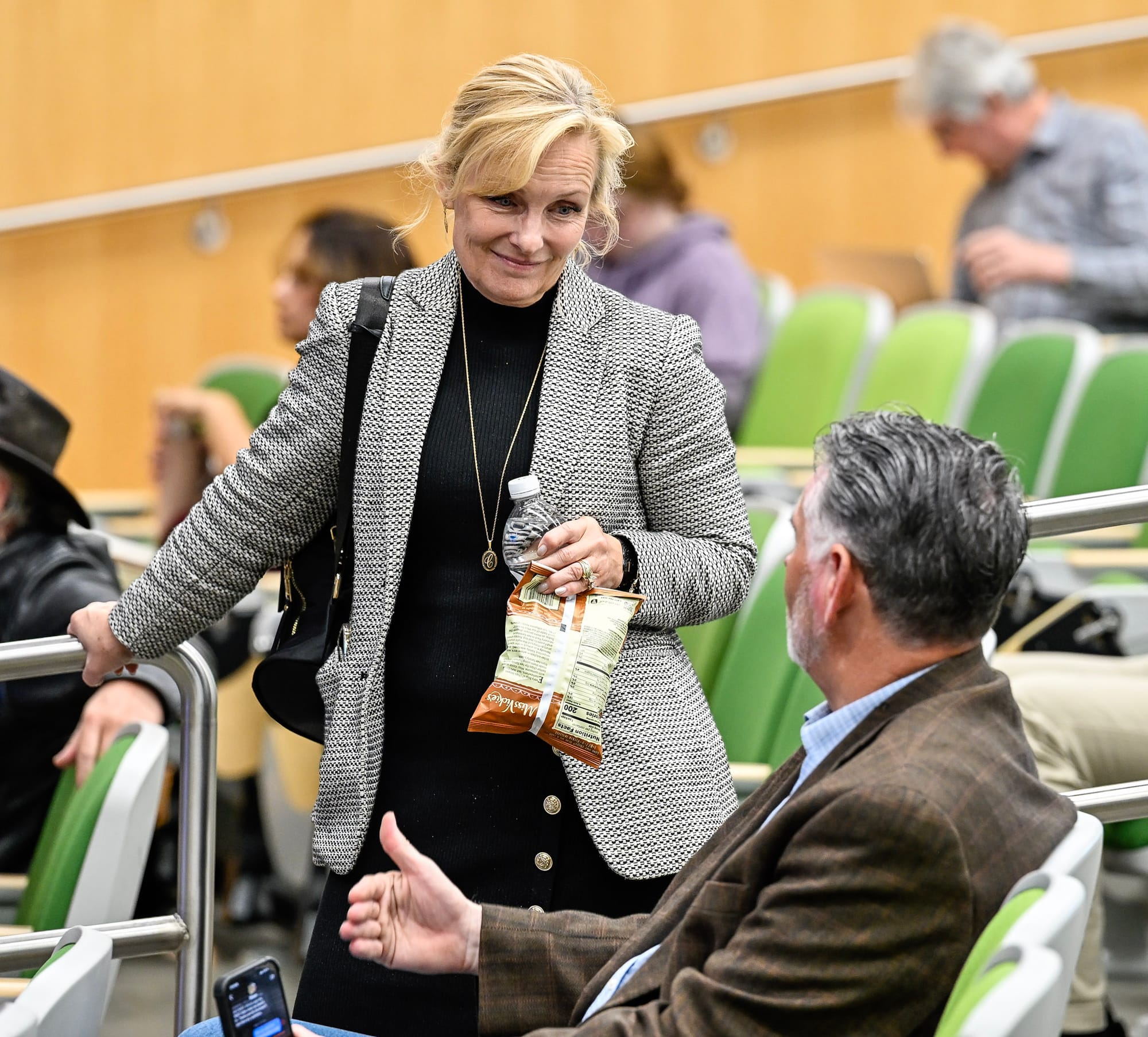
Tina Cannon Utah's State Auditor visiting with Indiana State Treasurer Dan Elliott. UVU's AI and the Future of Freedom conference, October 21, 2026. Photo: Hank McIntire, UVU
Audience idea: a Constitution exam for Congress
One attendee proposed that every member of Congress take a Constitution exam each Constitution Day, with only the aggregate results published and constituents free to ask for individual scores. Cannon's reply: "I'll put it on transparent.utah.gov."
Closing out the conference, healthcare executive and founder of Mitro Health Ventures, Berkeley Geddes argued that AI and robotics mark an inflection point comparable to the development of atomic weapons in 1940, and that the United States must reach the technology first and move "unrestricted," since its adversaries won't restrain themselves.
Closing: "Seek the Truth, Speak the Truth, Act the Truth"
The conference's first day ended with a call to look past the technology and toward the people who will live with it. Berkeley Geddes, a serial entrepreneur and healthcare executive/founder at Mitro Health Ventures, framed AI and robotics as an inflection point comparable to the development of atomic energy in 1940. He argued that the United States should reach the technology first and move "unrestricted," because "if you restrict it, the enemies of America are not restricted."
Berkeley Geddes, a serial entrepreneur and healthcare executive/founder at Mitro Health Ventures, delivering the final remarks at UVU's AI and the Future of Freedom conference, October 21, 2026. Photo: Hank McIntire, UVU
His sharpest warning came from his own medical practice. AI has shrunk scheduling, billing and scribe roles while the company keeps growing, he said. "The jobs go away, but the house payment doesn't go away." He asked who is planning for an economy built on work when work changes, then added: "I don't have the answer, but I know how to get it."
That answer, he suggested, begins with character. "I would submit the grandest and noblest quest for man is to individually seek for, understand, embrace, and live consistent with truth," Geddes said. He then invited Alex Lightman to share his slogan with the audience: "Seek the truth, speak the truth, act the truth."
Citing the founders, Geddes said an informed and moral citizenry is the final safeguard when systems go wrong. "We become the cross check," he said.
Share this article
The link has been copied!
Your link has expired. Please request a new one.
Your link has expired. Please request a new one.
Your link has expired. Please request a new one.
Great! You've successfully signed up.
Great! You've successfully signed up.
Welcome back! You've successfully signed in.
Success! You now have access to additional content.