Vis e Terra: A Utah Energy Startup that is Dissolving the Problem
Vis e Terra has spent four years developing a closed chemical system that converts coal, plastic, and waste rubber into hydrogen and electricity — without burning anything. Now, with a new name, a new manufacturing facility, and a Utah investor behind them, they're ready to be found.
The first thing you notice is the smell — or the absence of it. In a small warehouse in West Valley City, where a compact tangle of plastic tanks, PVC pipe, and glass-filled columns sits inside a containment tray the size of a parking space, there is no smoke, no exhaust, no acrid bite in the air. There is only the low hum of pumps, a faint chemical sharpness, and the quiet spectacle of coal disappearing.
Dr. Luca Patauner, the company's CTO and process inventor, tips a small measure of ground coal into a feed auger. Within seconds, it drops into a bowl of boiling acid and a proprietary catalyst structure. Almost instantly, the coal simply ceases to exist as a solid. The generated gas stream rises a distillation column packed with small glass tubes, condensing all of the gases into liquid except for the hydrogen (HI) and carbon dioxide (CO2) that are the initial products of this plant. In this system, the hydrogen is separated from the fluid, passed through a charcoal filter and finally into a small fuel cell no larger than a hardback book.
A television on a nearby table flickers on.
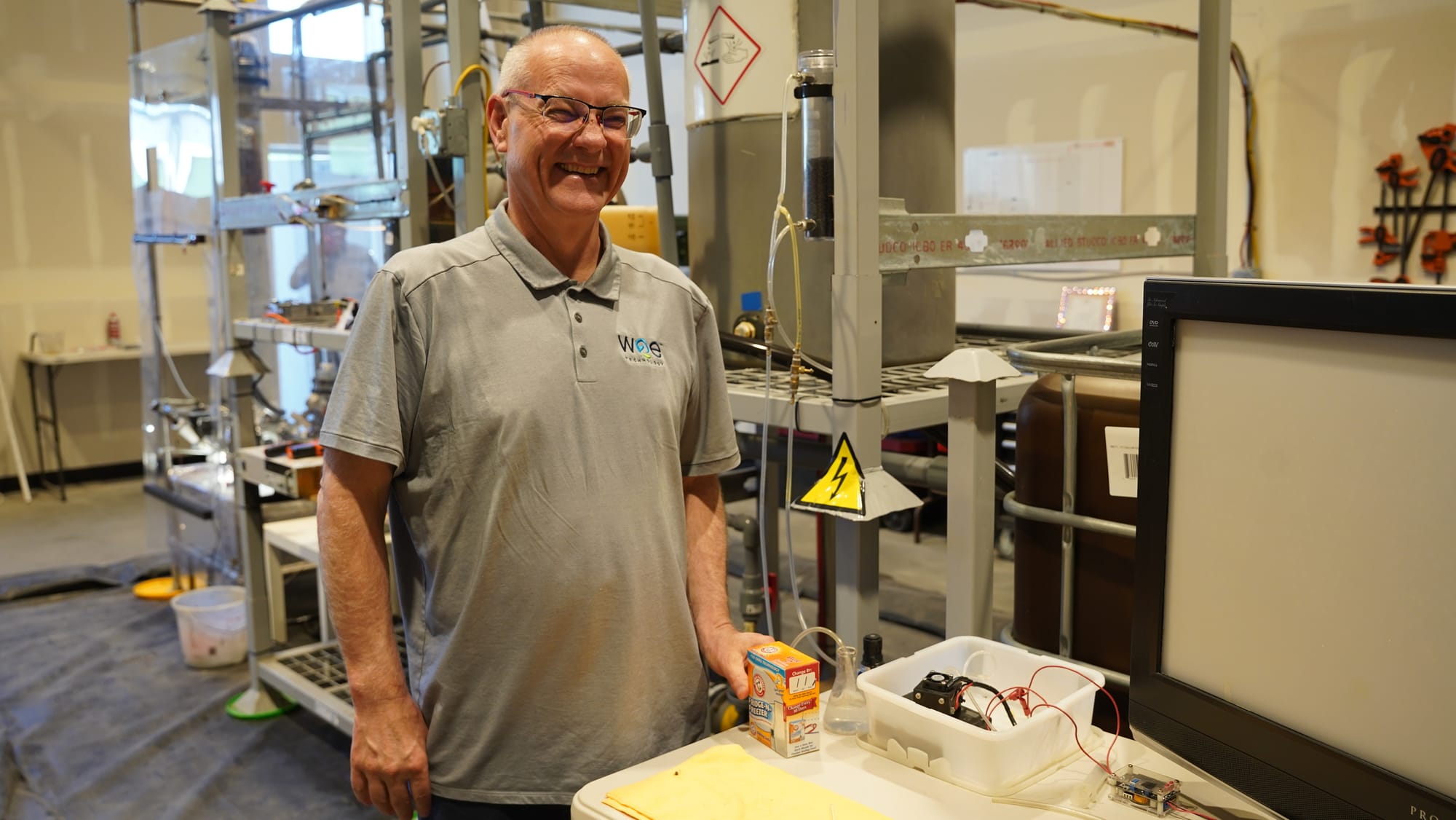
Larry Jones, Purchasing Director, at the demonstration table where Vis e Terra's proof-of-concept chain ends — hydrogen fuel cell at right, television just out of frame. His hand rests on a box of Arm & Hammer baking soda, the system's designated acid-spill neutralizer and, at commercial scale, one of its most marketable byproducts. The full laboratory prototype is visible behind him. West Valley City, Utah.
"That's electricity," says Chairman and CEO James Farrell. "Made from coal. No combustion, no emissions, nothing in the air."
This is the laboratory prototype of Vis e Terra, a South Jordan-based energy technology company that, until about a week before this visit, operated under a different name. The rebrand is so recent that the office still carries the old signage. Business cards are being designed. The website is being updated. But the technology has been in development for four years, and the people behind it believe it is ready — or nearly so — to move from a warehouse in West Valley City to commercial production.
What the System Actually Does
Vis e Terra's process is a non-conventional process that works without combustion, pyrolysis, or gasification. The distinction matters, and the team makes this distinction deliberately.
"Those processes burn or heat the material," says COO Tony Ferracone. "We dissolve it. The moment an organic substrate hits the boiling acid, it breaks down to a gas stream and inert inorganic ash drops out the bottom. We never combust or ignite anything."
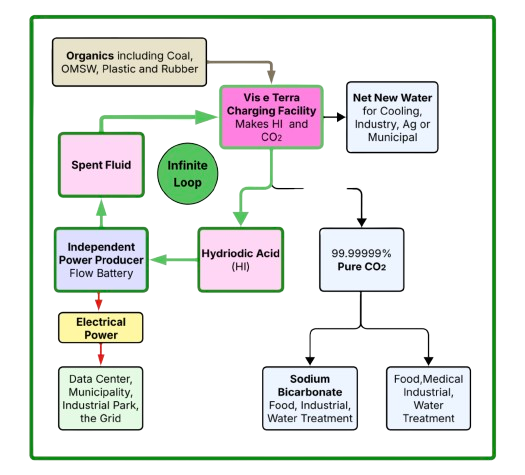
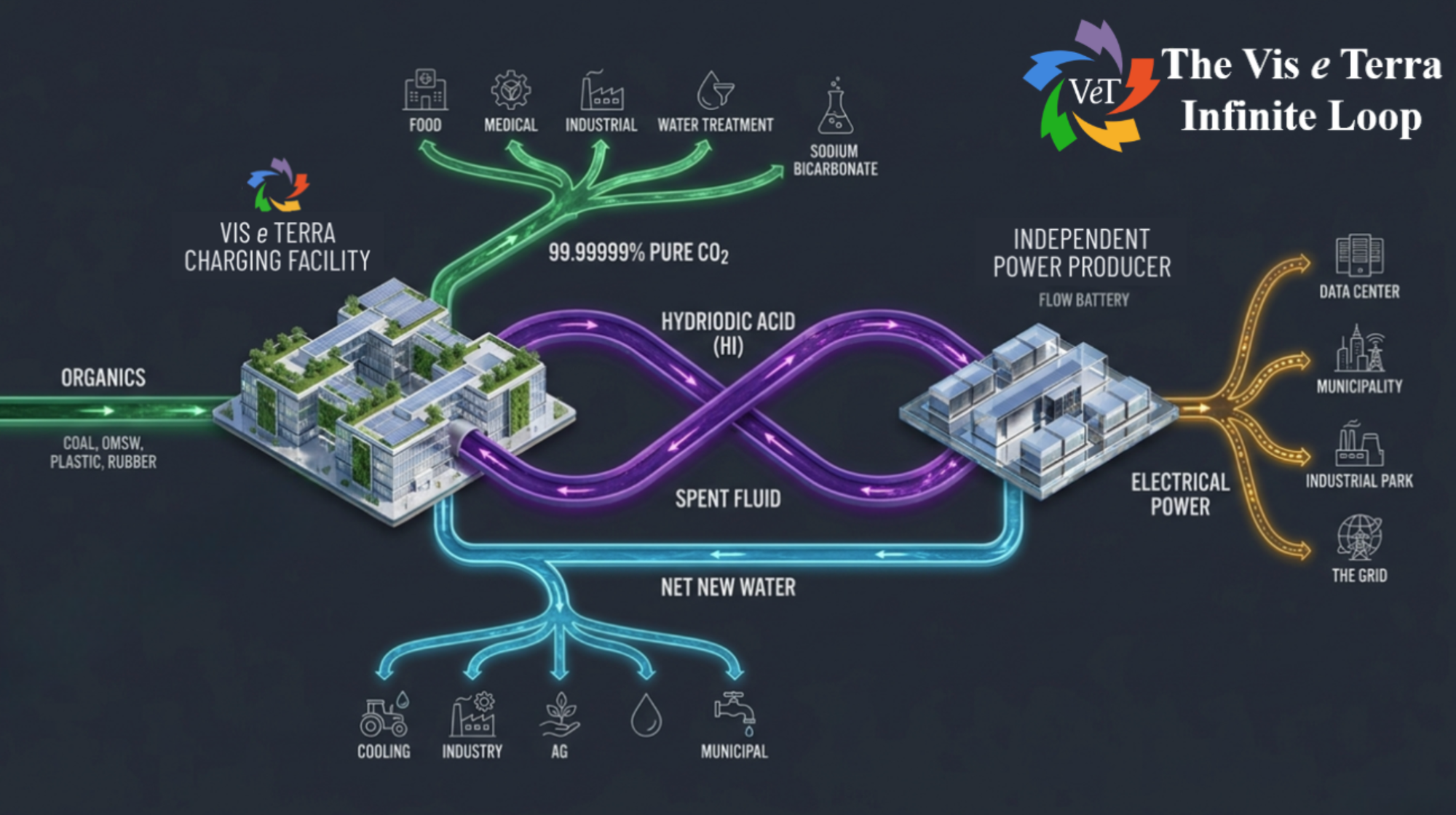
The Vis e Terra process chain, as designed for commercial deployment. Organic feedstocks — coal, plastic, rubber, or organic municipal solid waste (OMSW)— enter the Vis e Terra Charging Facility, where the thermochemical reaction produces two primary outputs: hydroiodic acid (HI), which carries the hydrogen to an Independent Power Producer's flow battery for conversion to electricity; and 99.99999 percent pure CO₂, which can be converted to sodium bicarbonate or sold directly for food, medical, and industrial applications. Net new water — a byproduct of the flow battery reaction — exits the system available for cooling, agriculture, or municipal use. Spent fluid from the flow battery returns to the charging facility in a closed loop, eliminating the need to continuously replenish the working fluid. Electrical power flows to data centers, municipalities, industrial parks, or the grid. Diagram courtesy Vis e Terra.
The chemistry of the process is centered on a catalytic exothermic reaction. It is a Bunsen reaction, named for the same Robert Bunsen of the laboratory burner, and it is accelerated by a proprietary catalyst structure developed by Patauner. The Bunsen reaction itself is well-known in industrial chemistry. What Patauner’s catalyst does is accelerates and compress a process that would otherwise take hours or days into something that happens in seconds.
"That's the core of the innovation," Ferracone says. "Without the catalyst, the reaction works, but it is too slow to be commercially viable. With it, the organic substrate (feedstock) is consumed almost instantly."
Sulfuric acid boils, at Utah's elevation, at about 600 degrees Fahrenheit. That temperature ceiling is important. Dioxins, nitrous oxides, and other noxious compounds associated with combustion require roughly 1,200 degrees or more to form. The system never approaches that threshold. What emerges from the top of the distillation column is pure hydrogen, in the form of hydroiodic acid gas, and pure carbon dioxide. Nothing else. All other gases and compounds are condensed and return to the reactor bowl.
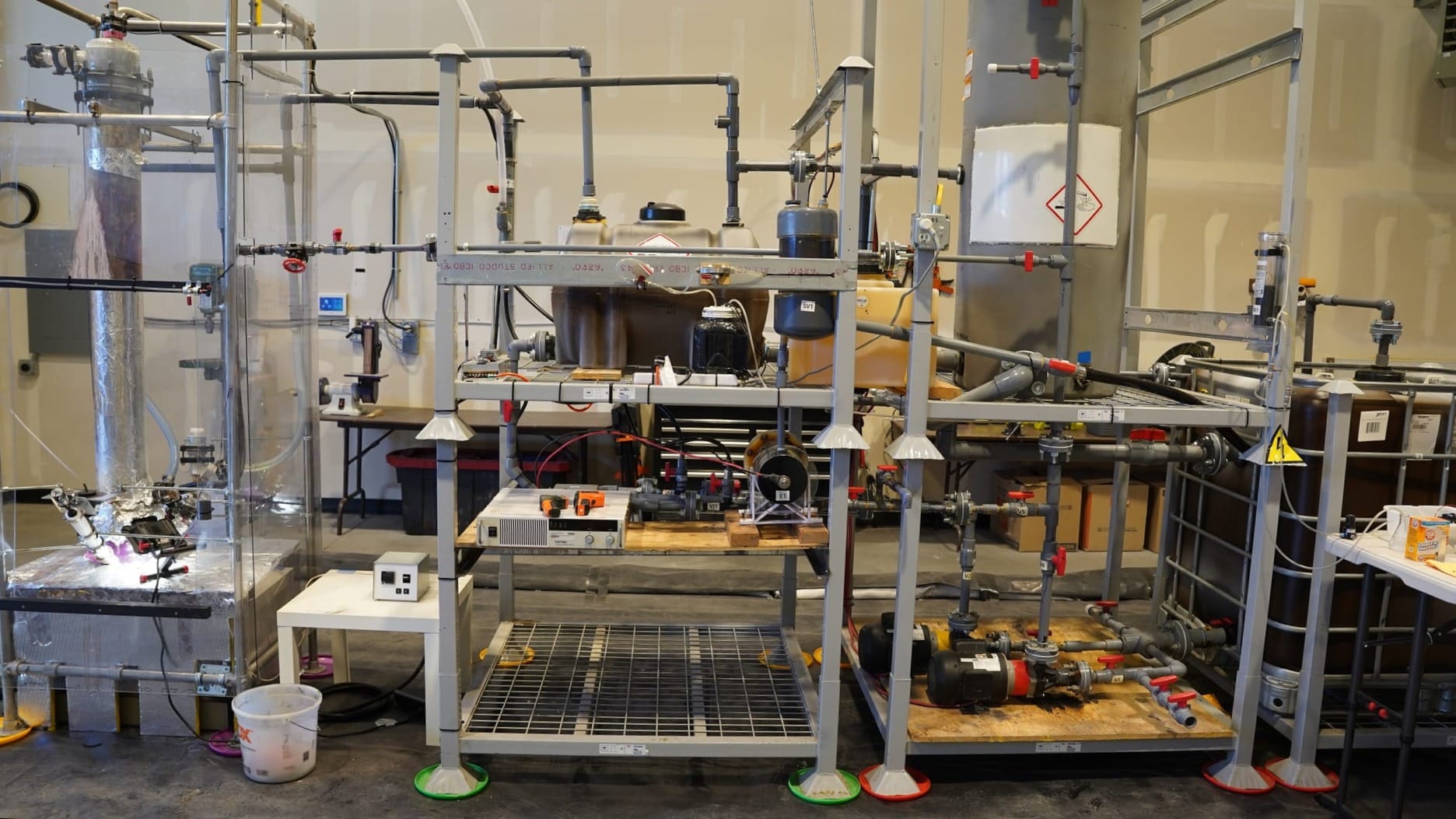
The complete Vis e Terra laboratory prototype, West Valley City, Utah. At far left, enclosed in a clear acrylic containment structure, is the distillation column packed with Raschig rings (short glass tubes) — the iodine staining on the column walls is visible evidence of the reaction cycle. The reactor vessel sits at the base of the column, where boiling acid dissolves the organic feedstock on contact. Center rack: the electrolytic cell, power supply, and fluid management components that separate hydrogen from the hydroiodic acid solution. Right section: the scrubber system, fluid tanks, circulation pumps, and the large HDPE storage vessels that hold the hydroiodic acid working fluid. The entire apparatus fits within a standard warehouse bay.
The system is entirely closed. Anything inorganic in the feedstock, such as trace minerals and silica, drops to the bottom of the reactor vessel and is filtered out. The acid is continuously recycled. In the laboratory unit, hydrogen is separated from the hydroiodic fluid using an electrolytic cell, dried, and fed into the fuel cell. In a commercial configuration designed for power generation, the hydrogen stays in liquid form, stored as hydroiodic acid, and runs through a proprietary flow battery, a device functionally similar to a fuel cell but one that operates on liquid rather than gas.
"Hydrogen gas is extraordinarily difficult to store and move," Farrell explains. "It permeates almost any container. The infrastructure to use it does not yet exist at scale. But hydroiodic acid — one iodine atom, one hydrogen atom — is storable, stable, and basically not flammable. You could pour HI on the floor and try to light it with a match. Nothing would happen; it would put the match out."
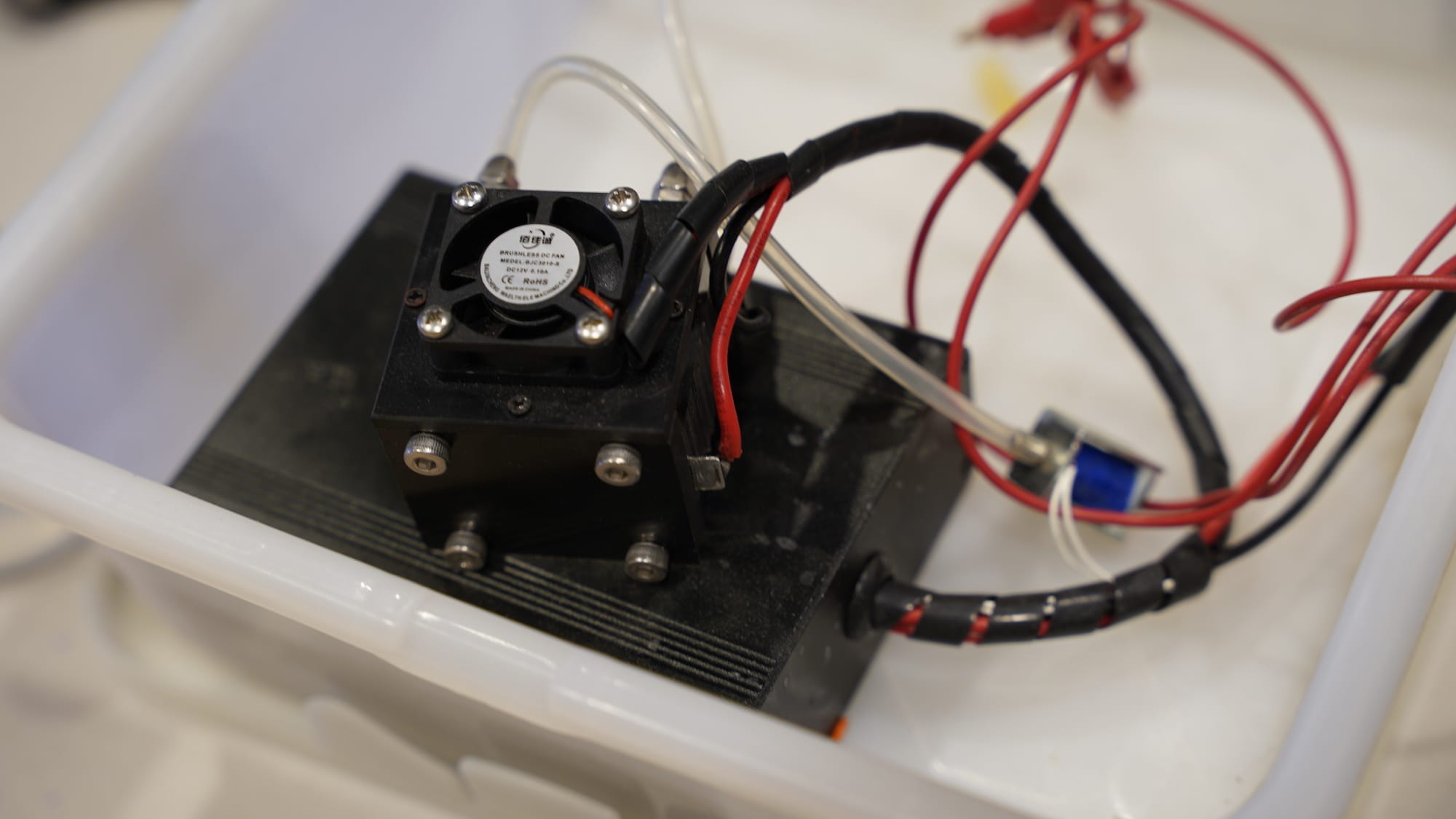
A close-up of the laboratory hydrogen fuel cell, seated in a plastic containment tray. The unit — roughly the size of a hardback book — requires 99.9 percent pure hydrogen to operate; feed it anything less pure and it fails. That intolerance is precisely why the team uses it as a proof-of-purity instrument: when this cell runs, the hydrogen is unambiguously clean. The small cooling fan on top manages the heat generated during the electrochemical conversion of hydrogen to electricity. The red and black leads carry that electricity to the television on the table above. The clear tubing delivers the hydrogen. The entire chain — from finely ground coal dissolving in boiling sulfuric acid to current flowing through these wires — takes place in a single warehouse bay in West Valley City.
The fuel cell in the laboratory demo requires 99.9 percent pure hydrogen to operate. It is, by design, a proof of purity as much as a proof of concept. When Farrell closes the valve and the television goes dark, the point has been made.
The Feedstock Advantage
Coal is the demonstration substrate, but Vis e Terra's system is, according to Farrell and Ferracone, organic fuel agnostic. Any organic material will work. The chemistry does not distinguish between ground coal and shredded plastic, between clean material and dirty.
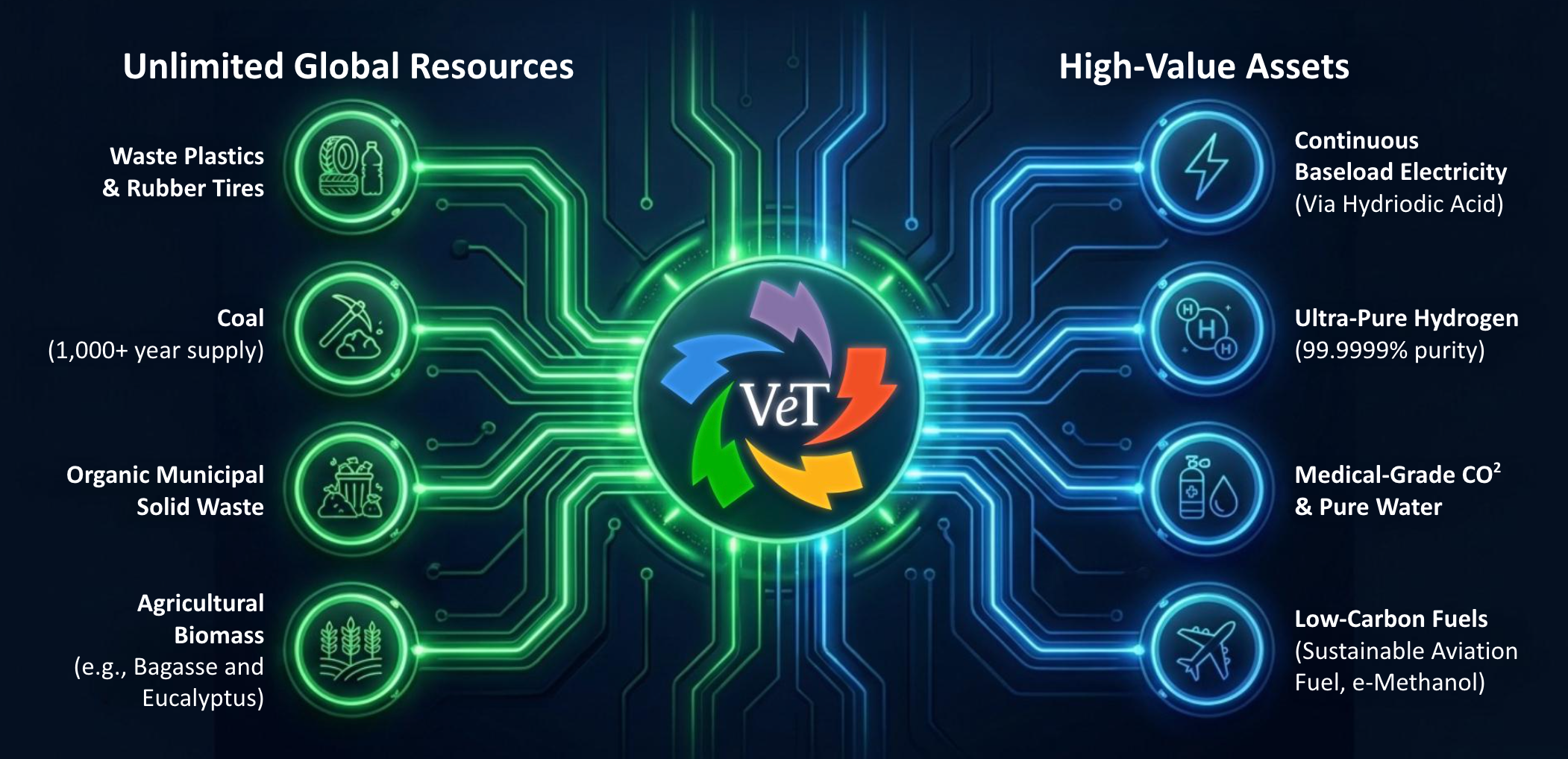
Vis e Terra's system accepts four categories of organic feedstock — waste plastics and rubber tires, coal, organic municipal solid waste, and agricultural biomass — and produces four categories of output: continuous baseload electricity via hydroiodic acid flow battery, ultra-pure hydrogen at 99.9999 percent purity, medical-grade CO₂ and pure water, and low-carbon fuels including sustainable aviation fuel and e-methanol. The company describes global coal reserves alone as representing a 1,000-year feedstock supply at projected consumption rates. Graphic courtesy Vis e Terra.
"The acid doesn't care whether the plastic has mustard on it," Farrell noted. "It doesn't care what color it is, what type it is, whether the label is still on. It eliminates all of it. Anything inorganic drops out and gets filtered. The rest becomes gas."
The feedstocks the company has identified as optimal, based on hydrogen content per unit, are coal, waste plastic, and rubber from scrap tires. All three happen to be among the most persistent and problematic waste streams in the world.
The tire problem, at the scale Farrell described, is not theoretical. The mining industry generates some of the most unmanageable waste rubber on earth: off-the-road haul truck tires that stand up to 13 feet tall, weigh more than three tons apiece, and are composed of natural and synthetic rubber, an elastomer, which is chemically carbon cross-linked making it nearly impossible to be ground fine enough, at any commercial scale, to be reused the waste rubber as new rubber. According to industry research, roughly 1 million tons of OTR tires are discarded globally each year, with mining operations responsible for 15 to 20 percent of that volume. The stockpiles that result are large enough, as Kal Tire's senior vice president of mining noted in published industry commentary, to be visible on Google Earth.
The steel belt inside each tire, copper-coated, high-tensile, sells for around $300 per ton once separated. The rubber itself has essentially no viable market. Tire fires are among the most severe solid waste incidents in the industry: once ignited, the high energy content and internal air pockets of a stockpile of tires makes them extraordinarily difficult to extinguish, and the combustion products — benzene, polycyclic aromatic hydrocarbons, heavy metals — contaminate soil and groundwater for years.
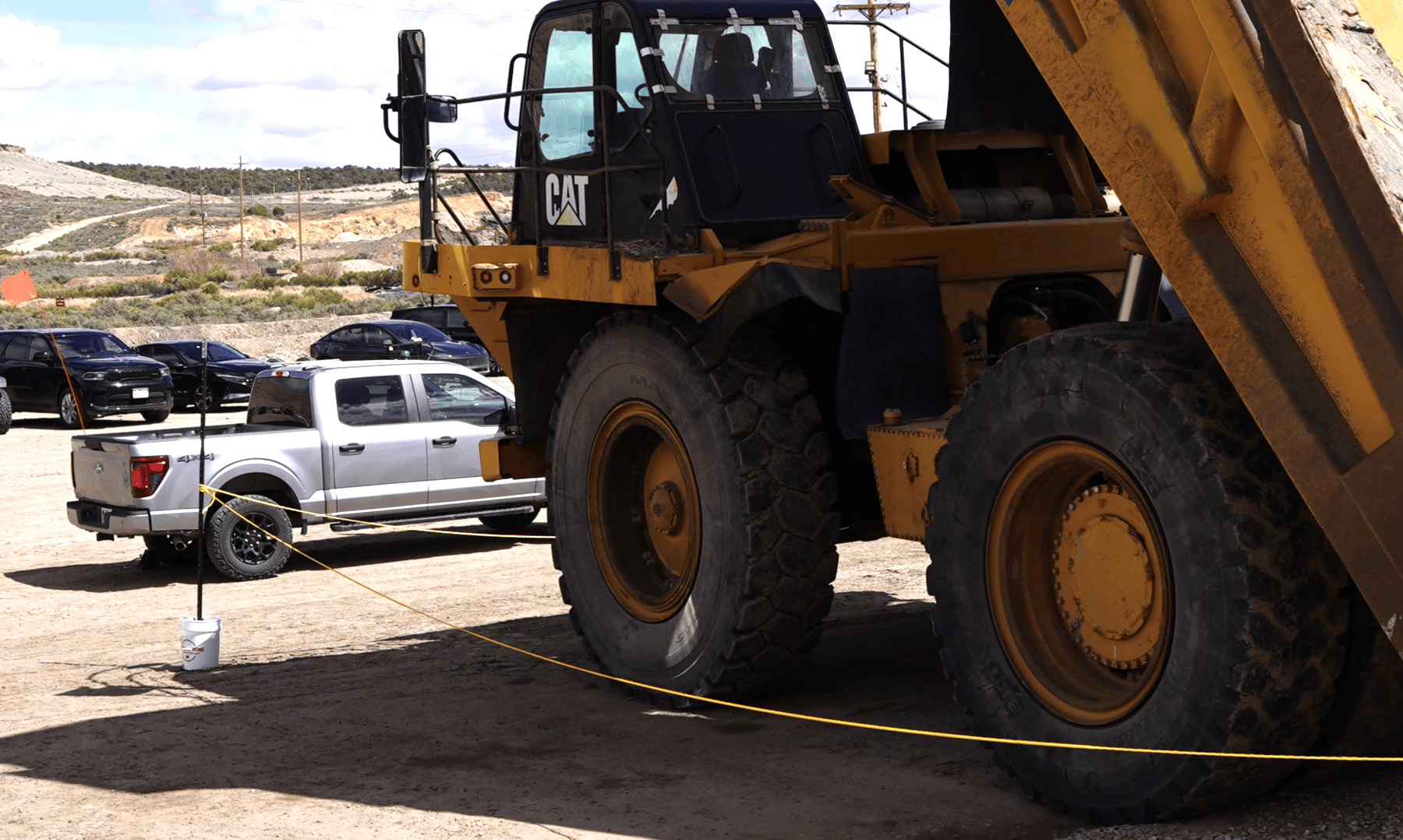
A Caterpillar haul truck at the Copper One launch event, La Sal, Utah, May 2026. The OTR tires on vehicles like this — standard equipment at mining operations across the intermountain west — stand roughly five feet in diameter on a mid-size haul truck and considerably taller on the largest equipment. They are composed of a chemically cross-linked natural and synthetic rubber that cannot be recycled into new rubber at any commercial scale. When they wear out, most have nowhere to go. Rio Tinto's Kennecott operation alone has thousands stockpiled above ground in the Oquirrh Mountains.
Rio Tinto's Kennecott operation in Utah's Oquirrh Mountains is known to maintain large inventories of giant haul-truck tires. "They are visible on satellite imagery," Farrell noted. The EPA pressure to find a disposal solution has so far produced no viable answer.
Waste plastic presents a parallel problem at a different scale. Farrell described the sorting operations run by Republic Services and Waste Management, which separate municipal solid waste streams and pull out plastics. What emerges is a material stream of mixed colors, mixed polymers, mixed cleanliness — the storage containers, the patio furniture, the condiment bottles — for which there is no viable recycling market, they said.
"Mechanical recycling of something like a clear plastic water bottle is a multi-step process that captures maybe five percent of the PET," Farrell said. "Everything else goes to landfill. We take all of it, mixed, dirty, any color, any polymer. The only step between what comes out of a sorting facility and what goes into our system is shredding it to a small size and removing any metal."
The coal picture in the intermountain west is more complicated — and more advantageous for Vis e Terra — than it might appear.
Utah sits atop substantial bituminous coal reserves, concentrated primarily in Carbon, Emery, and Sevier counties in the state's east-central region. According to the Utah Geological Survey, these fields form an inverted U across the Colorado Plateau, with the largest single deposit on the continent lying in the Kaiparowits Plateau in Kane County.
Utah's coalfields, shown in orange, are concentrated in the state's east-central corridor — Carbon, Emery, Sevier, and Kane counties — with the Kaiparowits Plateau in the south representing one of the largest untapped bituminous deposits on the continent. The fields sit along existing rail corridors connecting to the Wasatch Front, making them accessible feedstock for a modular system like Vis e Terra's that can be deployed at or near the point of power demand. Map: Utah Geological Survey.
In 2023, five Utah operators produced seven million short tons of coal valued at $291 million from underground mines. This coal is high in BTU content and, in the main fields, relatively low in sulfur. Carbon and Emery county bituminous coal typically runs 11,500 to 12,900 BTUs per pound, higher than the subbituminous coals produced in Wyoming and Montana. That high energy density makes it, per the Vis e Terra chemistry, an excellent hydrogen source.
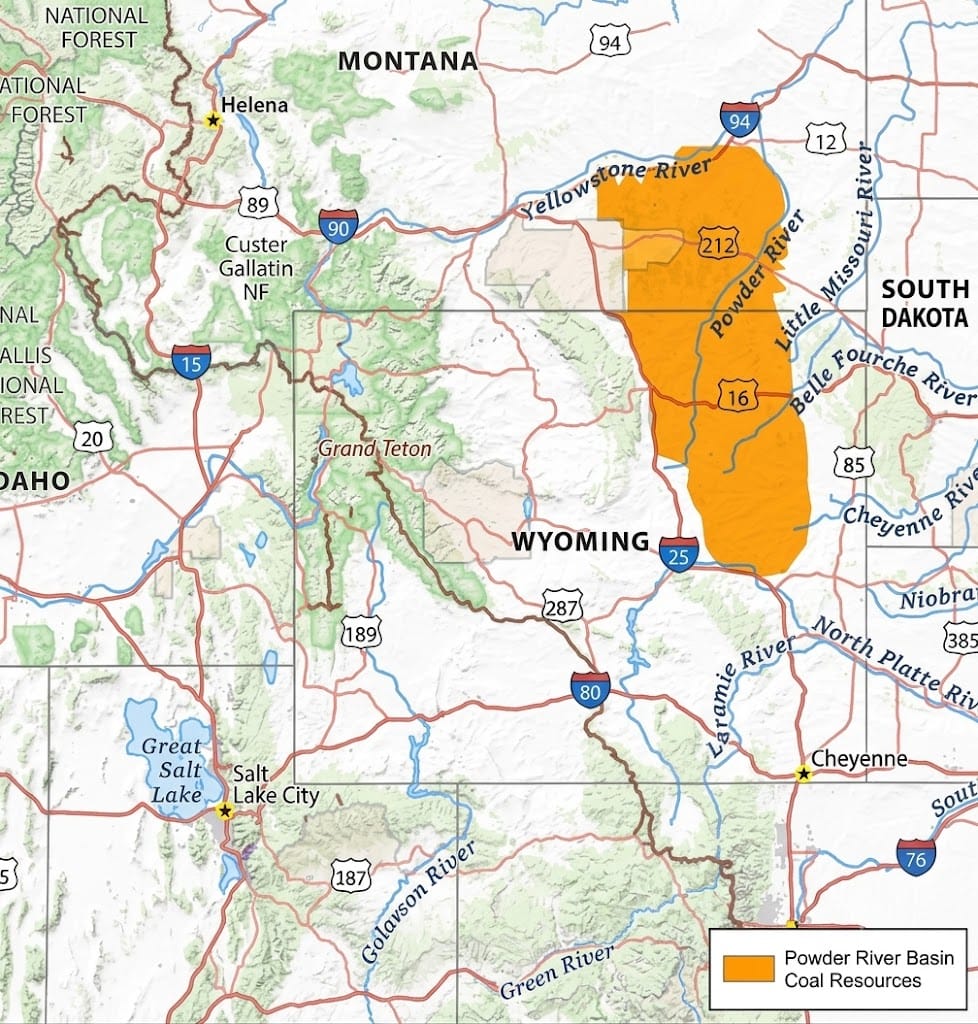
To the north, Wyoming's Powder River Basin is a different story in almost every respect. The USGS estimates in-place coal resources of roughly 1.07 trillion short tons in the basin — the single largest coal deposit in the United States — with about 25 billion tons considered economically recoverable. But PRB coal is subbituminous: lower BTU content, 20 to 30 percent moisture, and sulfur content below 0.5 percent. It burns cleanly, which is why utilities from Texas to Illinois buy it by the trainload. It is, however, the coal Ferracone characterized as less ideal for the Vis e Terra chemistry — too much water, too little carbon density — though the company notes that waste heat from the system can be used to pre-dry it, making Wyoming coal a viable if secondary feedstock option.
Wyoming's Powder River Basin, shown in orange, is the single largest coal deposit in the United States — the USGS estimates roughly 1.15 trillion short tons in place, with approximately 25 billion tons considered economically recoverable. The basin's subbituminous coal burns cleanly and powers utilities across the country, but its high moisture content — up to 30 percent by weight — makes it a less efficient hydrogen source than Utah's denser bituminous fields, visible to the south near Salt Lake City. A 2013 fact sheet puts the estimate at 1.07 trillion short tons. For Vis e Terra's system, the two fields represent different points on the feedstock spectrum: Utah coal offers higher energy density closer to the Wasatch Front; Wyoming coal is available in virtually unlimited quantity with the requirement of some pre-processing. Map adapted from USGS Coal Geology and Assessment of Coal Resources and Reserves in the Powder River Basin.
The more interesting feedstock opportunity may lie in a different direction entirely. The Illinois Basin — spanning Illinois, Indiana, and western Kentucky — contains an estimated 66 billion tons of recoverable bituminous coal, more reserves than West Virginia and Kentucky combined. The problem, well documented since the Clean Air Act of 1970, is sulfur. An estimated 95 percent of Illinois Basin coal carries three to five percent sulfur by weight. When burned, that sulfur becomes sulfur dioxide — a criteria air pollutant with hard regulatory limits. Utilities adjacent to this coal, like Ameren in St. Louis, have for decades bypassed their local supply entirely and shipped in low-sulfur Wyoming coal by rail rather than install the scrubbers that would be required to burn what lies in their backyard.
This is precisely the dynamic Farrell and Ferracone flagged in the lab. High-sulfur coal is stranded not because it lacks energy value but because conventional combustion makes it legally unusable in most jurisdictions. Vis e Terra's process sidesteps that constraint entirely. Sulfuric acid, the system's core reagent, is indifferent to the sulfur content of the feedstock. Actually, more sulfur in the coal simply produces more sulfuric acid in the reactor, which the system uses and recycles. There is no combustion, no stack, no SO2 emission. The regulatory problem that has rendered billions of tons of Illinois Basin coal effectively worthless becomes, in this chemistry, a non-issue.
"We're thrilled to take high-sulfur coal," Ferracone says, "because we're putting it into sulfuric acid. It just makes more sulfuric acid. And high-sulfur coal is cheap, because nobody else wants it."
The geographic spread matters for a modular system that can be deployed wherever the feedstock is. Utah's bituminous coal is close, high-density, and rail-connected to the Wasatch Front — the most straightforward feedstock case the company faces. Wyoming's vast subbituminous reserves are a more complicated proposition: the PRB's moisture content of 20 to 30 percent by weight means a significant portion of each ton of coal delivered is water, not carbon, and that water must be driven off before the feedstock performs efficiently in the reactor. Ferracone acknowledges the tradeoff directly — the company's solution is to use waste heat recovered from the thermochemical process itself to pre-dry incoming Wyoming coal, which adds a processing step but keeps the energy economics intact. Whether that pre-drying step remains economical at commercial scale, against the backdrop of PRB coal's low market price and abundance, is a calculation the company will need to make site by site. The PRB is not off the table — it is simply not the path of least resistance.
The stranded high-sulfur coal of the Illinois Basin, by contrast, presents a different kind of opportunity. Legally unburnable at scale in a growing number of states, it represents a feedstock pool that no combustion-based system can touch — and one that, in many cases, would pay to be taken off the hands of the operators sitting on it. For Vis e Terra, feedstock that arrives at a discount because no one else wants it is not a liability. It is a structural advantage.
The system's carbon dioxide output is, by the same chemical logic that governs the hydrogen, high purity, according Ferracone’s description. Carbon dioxide is a commodity used across multiple industries, including food processing, water treatment, chemical manufacturing, and semiconductor fabrication. It can also be combined with hydrogen in a Fischer-Tropsch process to produce synthetic fuels, including sustainable aviation fuel (SAF) and low-carbon diesel.
"Almost every refinery in the world uses somewhere between 70 and 120 tons of hydrogen every day in the oil distillation process," Farrell says. "They're using gray hydrogen made from mostly from natural gas. It is expensive and it is not green. We can supply green hydrogen at a price they can actually use."
The Green Hydrogen Question
The term "green hydrogen" has a precise regulatory meaning and a contested commercial reality. By the generally accepted definition, green hydrogen is hydrogen produced by using renewable electricity—typically solar or wind power—to split water into hydrogen and oxygen through electrolysis, resulting in little to no direct carbon emissions. Most current hydrogen production, even from facilities that bill themselves as green, fails this test because the facilities draw from the electrical grid, which is substantially powered by fossil fuels.
Vis e Terra's system produces its own electricity using a portion of the hydrogen it generates. It does not draw from the grid.
"We make all of our own energy," Farrell said. "By definition, when we make hydrogen, it's green, regardless of what the feedstock is. Coal goes in. Green hydrogen comes out. That's not a marketing claim; that's the regulatory definition."
The system's energy efficiency is, Ferracone argued, the most significant differentiator. The global process is exothermic, meaning the chemical reaction itself generates heat, which is recovered and used to maintain the reactor temperature. The system does require supplemental heat when cold substrate is introduced. Adding room-temperature coal to 600-degree acid drops the temperature a bit, but that supplemental heat is drawn from the system's own power production and amounts to a small fraction of total output.
"The plants that are trying to make green hydrogen using electrolysis and solar or wind power are so energy-intensive that they can't afford to use their own hydrogen to power themselves," Ferracone stated. "They have to buy or produce power from somewhere else, which is exactly the wrong direction. We use our own."
The company has intentionally not applied for patent protection for the proprietary catalysts or the overall system design. It is a company trade secret. The decision, Farrell and Ferracone say, was deliberate and took years of legal consultation to reach.
"A patent is public information," Farrell said. "The moment we file, the full technical description is available to any company in the world, including those with resources to build a version of it and legal teams to fight us for years if we object. A trade secret stays secret."
He invokes the synthetic diamond industry, which protected a two-part manufacturing process for more than 50 years without a patent. The inventors held each half of the process separately. The principle, if not the precise analogy, holds.
Patauner himself holds multiple patents, including on the novel Vis e Terra reactor, and led the first pilot systemdeployment of the underlying technology in Italy before joining the company. The decision to protect the Utah application as a trade secret rather than a patent is, in that context, a well-considered one.
Utah's Power Gap
The context into which Vis e Terra is launching matters. Utah's grid is under documented stress. The state's Operation Gigawatt initiative has set an explicit goal of adding significant generation capacity, double, or more, driven in part by the explosive growth of data center and manufacturing development. Rocky Mountain Power, the state's dominant utility, has publicly acknowledged on its own Large Service Requests page that there may be scenarios for which self-generation, made possible under Utah Senate Bill 132, is an available option when the utility cannot meet demand without major upgrades.
Utah's SB 132, sponsored by Senator Scott D. Sandall of Tremonton and Representative Colin W. Jack of St. George, and passed in 2025, gives industrial and data center developers the right to contract with independent power producers when Rocky Mountain Power cannot meet their timeline. Vis e Terra is positioning itself squarely as that alternative.
The gap between available capacity and incoming development is not theoretical. "Weber County has a large parcel of underdeveloped land ready for development," Farrell described, citing conversations with Weber County economic development officials. "Companies come in, they see the land, fall in love with it, and call Rocky Mountain Power for 20 megawatts; they're told maybe they can get five megawatts in three years. Nobody builds a plant and waits three years. The deals die."
A commercial Vis e Terra unit is standardized and modular. A rack-mounted 1 MW cell that can be arrayed to match exact load requirements. A 30 MW facility fits on approximately three acres. A 100 MW hyperscale array requires less than ten. The units are designed so that each operates independently; a failure in one does not cascade through the others.
The company cites as a near term opportunity the Intermountain Power Project (IPP) near Delta, one of the largest coal plants in the West. It was originally developed as a roughly 1.8–1.9 GW coal-fired generating complex. It is being redeveloped around an approximately 840 MW hydrogen-capable natural gas combined-cycle plant, leaving the site with substantial existing transmission and electrical infrastructure that was originally sized for a much larger generation footprint.
Vis e Terra views the site's industrial-energy infrastructure as containing valuable assets that could be used for future large-load projects, as it represents a rare, utility-scale grid interconnection site, existing high-voltage transmission access to major Western markets, large industrial acreage already zoned and permitted for energy infrastructure, and a nearby hydrogen-storage and hydrogen-production projects such as ACES Delta
"All the infrastructure to distribute 1.2 gigawatts of power already exists at that plant," Farrell says. "We could use the coal supply chain that's already there. If we started manufacturing in the first quarter of next year, we could have that plant producing power in a matter of months."
Vis e Terra has already identified a potential manufacturing site in West Jordan, large enough, the team says, for at least a decade of production. To that end, a recent investment by a Utah company — which the company is not yet prepared to name publicly — is funding the transition to mass production.
The Byproduct Case
Beyond power and hydrogen, Vis e Terra's process produces outputs that may prove independently significant for Utah.
Pure water is the primary byproduct of the flow battery: when hydroiodic acid fluid passes through the battery membrane in the presence of oxygen, the hydrogen and oxygen combine and the waste product is pure distilled water. The company's own figures show a single 1 MW cell processing plastic producing at least 750 gallons of water daily.
The Vis e Terra Infinite Loop: organic feedstocks — coal, plastic, rubber, or organic municipal solid waste — enter the Vis e Terra Charging Facility on the left, where the thermochemical process produces hydroiodic acid (HI) carrying hydrogen to an Independent Power Producer's flow battery on the right. Spent fluid returns to the charging facility in a closed loop, continuously recharged without replenishment. Three output streams branch from the system: 99.99999 percent pure CO₂ flows upward to food, medical, industrial, and water treatment markets, with sodium bicarbonate as an optional co-product; net new water flows downward to cooling, agricultural, and municipal applications; and electrical power flows rightward to data centers, municipalities, industrial parks, or the grid. Nothing is combusted. Nothing is vented. Graphic courtesy Vis e Terra.
Using the company's published figure of 750 gallons of water per day from a 1 MW system, a hypothetical 1 GW deployment could generate approximately 750,000 gallons of distilled water daily, or roughly 864 acre-feet annually, which amounts to 274 million gallons, or more than 400 Olympic pools' worth of water.
While modest relative to Utah's statewide water consumption, that volume could be material for local industrial users. It represents an unusual secondary benefit in a region where water availability remains a long-term economic constraint.
"It's not a solution to the Great Salt Lake on its own," Farrell acknowledges. "But it's clean, distilled water being added to the system at no cost to anyone."
The carbon monoxide stream, when combined with water and sodium from trona — essentially a combination of sodium carbonate (soda ash), sodium bicarbonate, and water of crystallization that is mined in massive quantities in Wyoming — yields sodium bicarbonate: baking soda. The chemistry is simple and the feedstock is abundant.
Trona forms in ancient evaporated lake beds where alkaline waters became highly concentrated over geological time. The world's largest known deposits are in the Green River Basin of Wyoming, which supplies a large share of global natural soda ash production. Other deposits exist in Turkey, China, Kenya and Botswana.
Utah's water treatment plants, many of which are transitioning from acid-based treatment to bicarbonate-based processes, represent a direct market for sodium bicarbonate. Ferracone says most of them haven't converted yet not for lack of interest but for lack of a reliable, affordable supply.
"We could produce both food-grade CO2 and baking soda as byproducts of power production," he said. "The water treatment market is waiting for exactly that."
The carbon dioxide sequestered in baking soda qualifies, under current regulatory frameworks, as a recognized form of carbon sequestration — a point the company does not lead with, but one that is not incidental to how the system will be evaluated by regulators and prospective partners.
Coming Out of Stealth
Vis e Terra is, by any reasonable measure, still early. The prototype works. The commercial design is complete, pending a few remaining engineering details. Manufacturing has not begun. The team has had conversations with potential customers in Weber County, at refineries, and with data center developers, but no commercial contracts have been announced.
James Farrell, Chairman and CEO of Vis e Terra, the South Jordan energy technology company he co-founded four years ago. Photo courtesy Vis e Terra.
The name is one week old.
"We've kept a low profile because we wanted to solve the technical problems first," Farrell shared with TechBuzz. "We didn't want to be out talking to people and then have to explain why something wasn't ready. Now the design is ready. The manufacturing facility is ready. The investment is in place."
The core team is small but carries significant combined experience. Farrell, with 55 years in manufacturing and industrial consulting, drives strategy and business development. Ferracone, a specialist in large-scale industrial finance and project structuring, handles operations. Patauner spent decades working as chemist and process engineer in multiple countries before joining the company as a principal. Michael C. Walch, a senior partner at Salt Lake City's Kirton McConkie, serves as board member and corporate counsel. And Larry Jones, the company's purchasing director, ran the laboratory demonstration with the practiced ease of someone who has watched coal disappear into acid many times.
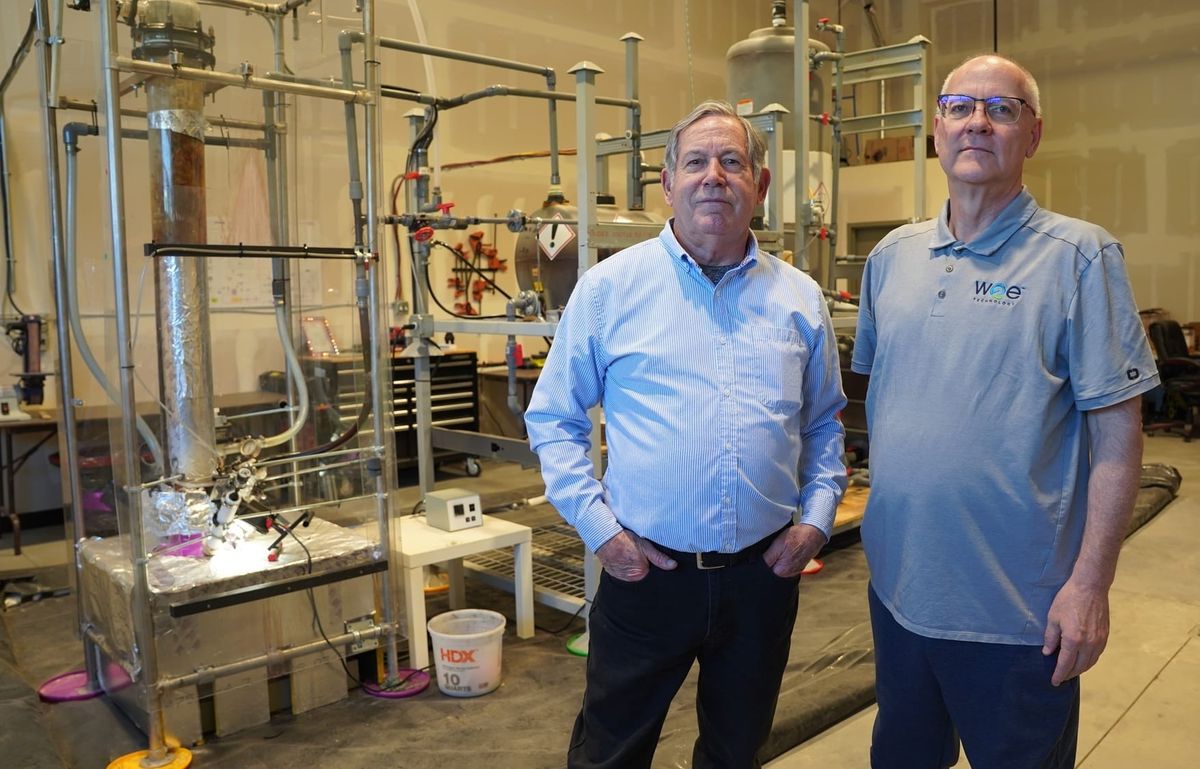
Dr. Luca Patauner, CTO and Chief Engineer of Vis e Terra, at the company's West Valley City laboratory. The Italian industrial chemist, who holds multiple patents and led the first commercial deployment of the underlying technology in Italy, developed the proprietary catalyst that makes the company's thermochemical process commercially viable. Patauner spent decades as a consultant across multiple continents before joining the company as a principal.
The rebrand was driven by a category problem. The prior name used an acronym — waste-to-energy — that has accumulated significant baggage from failed projects and, in some cases, outright fraudulent ventures operating under the same label. Potential partners and investors were dismissing the company before the first conversation was over.
"We don't have to explain away someone else's failure anymore," Ferracone says. "The technology is what it is. It either works or it doesn't. We'd rather people judge it on that."
The new name — Vis e Terra, rendered in the company's own tagline as "Reclaiming Energy from the Earth" — is, to the best of the company's knowledge, otherwise unused in the energy or technology sectors. A restaurant in California holds the phrase. That appears to be all.
The laboratory device in West Valley City will keep running. Coal will dissolve. Gas will rise and separate and cool and become, through a sequence of steps that are individually unremarkable and collectively unusual, electricity. The television will light up.
Whether that sequence can scale to the gigawatts Utah needs. And whether it can do so before the state commits its policy energy elsewhere is the question Vis e Terra is now, publicly, asking the market to answer.
Vis e Terra headquarters in South Jordan, Utah
Vis e Terra is headquartered at 10421 South Jordan Gateway Blvd, Suite 450, South Jordan, Utah 84095. Learn more at viseterra.com or view the following slide deck: